


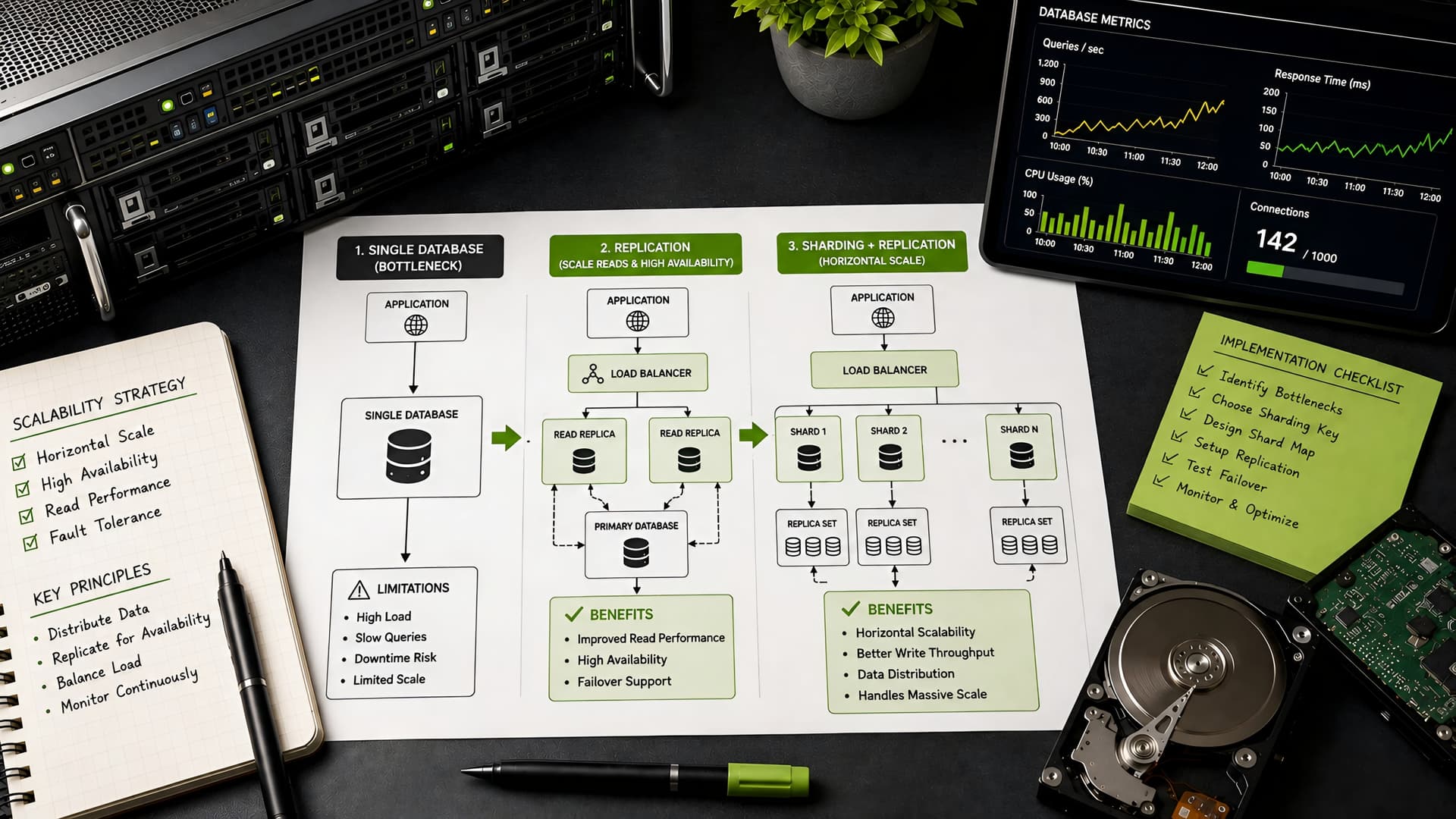
Every fast-growing application eventually hits a wall. Often, that wall isn't the frontend or the application server; it's the database. A single database instance, no matter how powerful, has finite limits on storage, I/O operations, and concurrent connections.
When query times spike, user experience degrades, and outages become more frequent, it's a clear signal. This bottleneck not only frustrates users but also severely limits business growth and innovation.
Understanding the Core Problem: Database Bottlenecks
A database bottleneck manifests in various ways. You might see slow query execution, increased latency for read/write operations, or even complete service unavailability under peak load.
The root cause is usually a combination of factors: an ever-growing dataset, a high volume of concurrent user requests, or complex queries that strain the single database server's resources.
The Limits of Vertical Scaling
Initially, you can throw more resources at the problem. Upgrading to a more powerful server with more RAM, faster CPUs, or SSDs is known as vertical scaling. It's often the simplest first step.
However, vertical scaling has practical and economic limits. There's only so much you can upgrade a single machine before the cost-to-performance ratio becomes unsustainable, or you simply run out of hardware options.
Horizontal Scaling: Sharding and Replication as Solutions
When vertical scaling is no longer viable, horizontal scaling becomes essential. This involves distributing the database load across multiple machines. The two primary strategies for achieving this are sharding and replication.
Both techniques aim to improve performance, availability, and fault tolerance, but they achieve these goals in different ways and address distinct aspects of the scaling challenge.
Database Replication: Enhancing Read Scalability and Redundancy
Replication involves creating multiple copies of your database. These copies, or replicas, synchronize with a primary (master) database.
This setup allows read operations to be distributed across multiple servers, significantly improving read throughput. It also provides redundancy, acting as a failover in case the primary database goes down.
How Replication Works (Master-Slave Model)
In a common master-slave replication setup, all write operations (inserts, updates, deletes) are directed to the master database. The master then asynchronously or synchronously propagates these changes to one or more slave (read-replica) databases.
Applications can then route read queries to any of the slave replicas. This offloads the master, allowing it to focus primarily on writes and ensuring high availability for reads.
Key Benefits of Replication
- Improved Read Performance: Distributes read load across multiple servers.
- High Availability: If the master fails, a slave can be promoted to master, minimizing downtime.
- Disaster Recovery: Replicas can be geographically distributed for data resilience.
- Analytics Offloading: Complex analytical queries can run on replicas without impacting production performance.
Challenges and Trade-offs with Replication
While powerful, replication isn't without its challenges. The primary one is often eventual consistency.
Changes written to the master might take a short time to propagate to the replicas, meaning a read from a replica might return slightly stale data. This is a crucial consideration for applications requiring strong consistency.
At Muhyo Tech, we often design our systems to gracefully handle eventual consistency where appropriate. For example, user profiles might tolerate a few seconds of delay, but financial transactions demand immediate consistency, which can impact architectural choices around replication.
Database Sharding: Distributing Write Load and Storage
Sharding, also known as horizontal partitioning, goes a step further than replication. It involves breaking a large database into smaller, more manageable pieces called shards.
Each shard is a completely independent database instance, running on its own server. A shard holds a subset of the total data, and the application or a sharding layer determines which shard to query based on a sharding key.
How Sharding Works
The core concept is to distribute data and processing load across multiple servers. Instead of one large table, you have several smaller tables, each residing on a different server.
For example, a user table might be sharded by user ID, with users 1-10,000 on Shard A, users 10,001-20,000 on Shard B, and so on. This dramatically reduces the amount of data a single server needs to manage.
Sharding Strategies (Sharding Keys)
Choosing the right sharding key is critical and depends heavily on your application's data access patterns.
- Range-Based Sharding: Data is distributed based on a range of values (e.g., user IDs 1-1000, 1001-2000). Simple to implement but can lead to hot spots if data isn't evenly distributed.
- Hash-Based Sharding: A hash function determines the shard for each record. This tends to distribute data more evenly, but makes range queries less efficient.
- List-Based Sharding: Data is distributed based on specific values (e.g., users from 'USA' on Shard A, 'Europe' on Shard B).
- Directory-Based Sharding: A lookup table maps a sharding key to its corresponding shard. Offers flexibility but adds an extra lookup step.
Key Benefits of Sharding
- Improved Write Performance: Distributes write operations across multiple servers, preventing a single point of contention.
- Increased Storage Capacity: Each shard can have its own storage, allowing for virtually unlimited data growth.
- Reduced Index Size: Smaller datasets on each shard mean smaller, faster indexes.
- Enhanced Fault Isolation: A failure in one shard only affects a subset of the data, not the entire database.
Challenges and Trade-offs with Sharding
Sharding introduces significant complexity. Data might need to be joined across shards, leading to complex distributed queries. Resharding (redistributing data when shards fill up) is also a non-trivial operation.
Furthermore, maintaining data integrity and transactional consistency across multiple shards requires careful design and often more sophisticated transaction protocols.
Replication vs. Sharding: A Comparative View
It's crucial to understand that sharding and replication address different aspects of scalability and are often used together. Here's a quick comparison:
| Feature | Replication | Sharding |
|---|---|---|
| Primary Goal | Read scalability, High Availability, Disaster Recovery | Write scalability, Storage capacity, Data distribution |
| Data Distribution | Full copy of data on each replica | Unique subset of data on each shard |
| Complexity | Moderate (eventual consistency) | High (distributed queries, resharding, cross-shard transactions) |
| Effect on Writes | All writes to master (bottleneck persists) | Writes distributed across shards (removes bottleneck) |
| Effect on Reads | Reads distributed across replicas (improved) | Reads distributed across shards (improved, but specific to data subset) |
| Fault Tolerance | High (failover to replica) | Partial (failure of one shard affects only its data) |
When to Choose Which Strategy (or Both)
The decision to implement sharding, replication, or both depends on your application's specific needs and growth trajectory. It's rarely an either/or situation.
We approach this with a clear understanding of the application's read/write ratios, data growth patterns, and consistency requirements.
Decision Framework:
- Start with Replication if:
- Your application is read-heavy (e.g., content sites, analytics dashboards).
- You need high availability and disaster recovery for your data.
- You want to offload reporting or backup processes without impacting primary performance.
- Your primary bottleneck is read throughput.
- Consider Sharding when:
- Your write operations are becoming a bottleneck.
- Your dataset is growing beyond the capacity of a single server.
- You need to reduce the size of indexes and improve query performance on very large tables.
- You can logically partition your data based on a clear sharding key.
- Combine Both if:
- You need both high read and write scalability.
- You require maximum availability and resilience.
- Your application has very high traffic and data volume.
- Each shard itself needs redundancy for fault tolerance. (Each shard can be a master with its own replicas).
Practical Implementation Considerations and Best Practices
Implementing these strategies requires careful planning and execution. Rushing into sharding or replication without a clear understanding of your application's architecture and future needs can lead to more problems than solutions.
Our team always emphasizes a phased approach, rigorous testing, and continuous monitoring.
Pre-Implementation Checklist:
- Analyze Workload: Understand your read/write ratios, common query patterns, and data growth.
- Choose Sharding Key Wisely: This is the most critical decision for sharding. A poor choice leads to uneven distribution or hot spots.
- Plan for Resharding: Assume you'll need to redistribute data in the future. Design for it from the start.
- Application Layer Awareness: Your application needs to know how to interact with multiple database instances.
- Monitoring and Alerting: Implement robust monitoring for all database instances, including replication lag and shard health.
- Backup and Recovery: Ensure your backup strategy accounts for distributed databases.
- Test Thoroughly: Performance test under simulated load to validate your scaling strategy.
Common Pitfalls to Avoid:
- Premature Optimization: Don't shard or replicate until you've exhausted simpler optimization techniques (indexing, query tuning, caching).
- Ignoring Data Locality: Cross-shard joins are expensive. Design your data model to keep related data together.
- Inadequate Sharding Key: A non-uniform sharding key can lead to imbalanced shards and new bottlenecks.
- Lack of Monitoring: Without proper monitoring, you won't know if your scaling strategy is working or if new issues are emerging.
- Underestimating Complexity: Both strategies add operational overhead. Ensure your team has the expertise to manage them.
Business Value: Beyond Just Performance
While the immediate benefits of sharding and replication are technical—faster queries, higher throughput—the ultimate value is business-centric. These strategies ensure your application can handle growth, maintain user satisfaction, and support new features without collapsing under load.
Preventing costly downtime and ensuring a smooth user experience directly impacts revenue, brand reputation, and competitive advantage. By architecting for scale, you're investing in the longevity and resilience of your digital platform, which is a core part of our philosophy at Muhyo Tech.
Frequently Asked Questions (FAQs)
Q: What's the biggest challenge when implementing database sharding?
A: The biggest challenge is often choosing the right sharding key and managing cross-shard operations. A poorly chosen key can lead to uneven data distribution (hot spots), while operations spanning multiple shards introduce significant complexity in query logic and transactional integrity.
Q: Can I use both sharding and replication together?
A: Absolutely, and it's a very common and powerful strategy for highly scalable systems. You can set up replication within each shard (e.g., each shard is a master with its own read replicas) to gain both write scalability (from sharding) and read scalability/fault tolerance (from replication).
Q: When should I consider these advanced scaling techniques?
A: You should consider sharding and replication when vertical scaling is no longer sufficient, or when your application consistently experiences performance degradation, high latency, or frequent outages due to database load. Often, this happens when your user base or data volume grows significantly, and simpler optimizations have been exhausted.
Q: Are there any alternatives to sharding and replication for database scalability?
A: Yes, other strategies include caching (at various layers), optimizing queries and indexes, using a faster database engine, or even migrating to a NoSQL database that is inherently designed for horizontal scaling. These are often considered before or in conjunction with sharding and replication.