


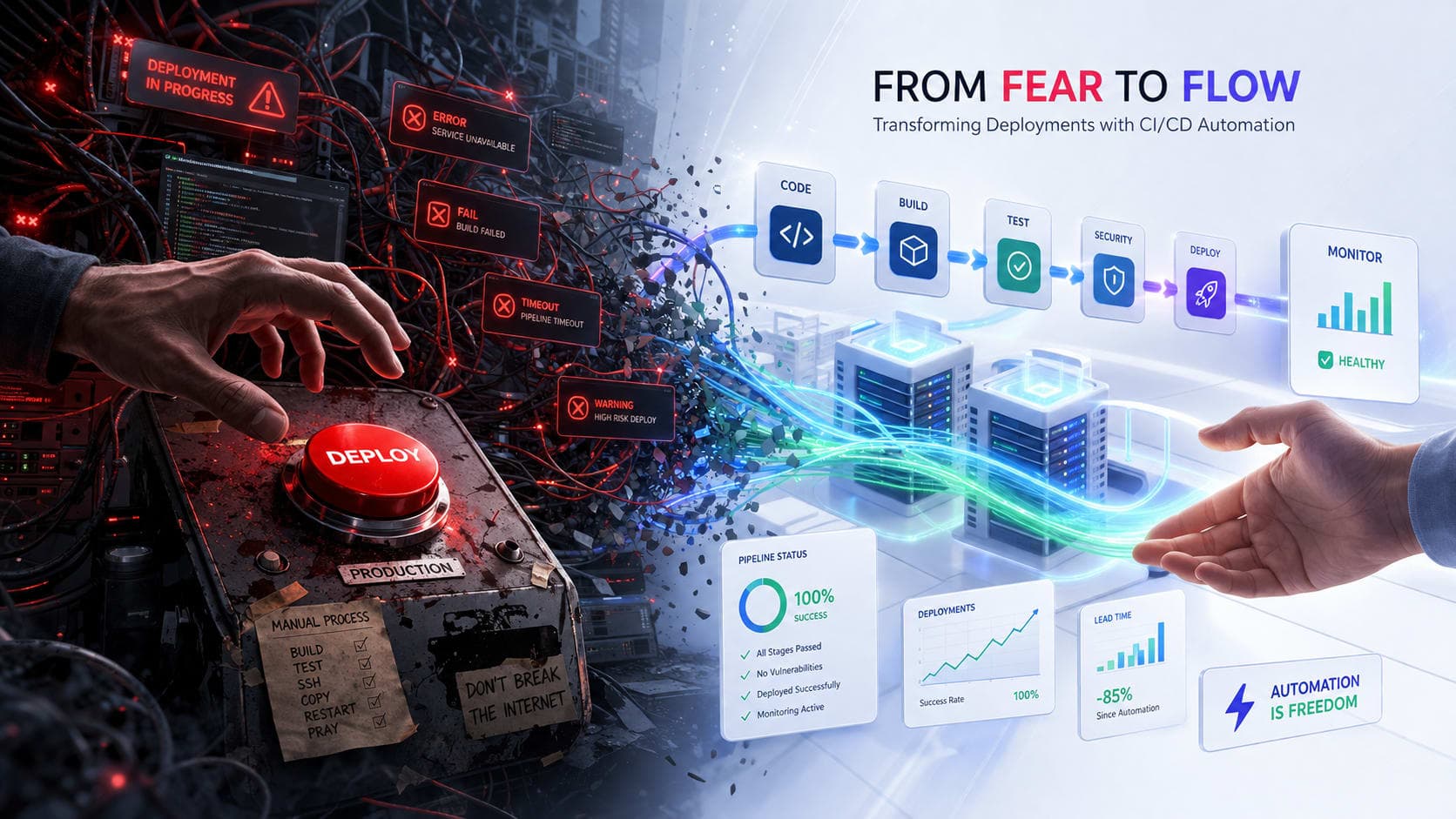
I still remember the knot in my stomach. It was 2 AM, and we were pushing a critical update, manually SSHing into servers, painstakingly copying files, and hoping nothing broke.
That familiar dread of a major deployment, the frantic double-checks, and the inevitable "did we forget anything?" question — that was our reality for far too long at Muhyo Tech.
The Weight of the "Big Red Button"
Every significant release felt like defusing a bomb. Our small team spent hours, sometimes days, coordinating changes, running manual tests, and performing rituals we thought would prevent disaster.
This wasn't just inefficient; it was soul-crushing. The fear of introducing a bug or causing downtime paralyzed us, slowing down our innovation and burning out our engineers.
We were building great products, but our release process was holding us hostage. It was clear something fundamental had to change if we wanted to scale without breaking.
The manual steps invited human error, and even the most meticulous engineer could miss a crucial detail. Rollbacks were often just as complex and terrifying as the initial deployment.
Our Journey to Sanity: Identifying the Bottlenecks
The first step was admitting we had a problem beyond just 'being careful.' Our environments were inconsistent, our configuration management was ad-hoc, and knowledge often resided in one person's head.
We recognized that our deployment process was not predictable or repeatable. Every release was a bespoke operation, which is fine for a one-off, but catastrophic for continuous delivery.
Our team conducted a deep dive into every step of our release cycle, from code commit to production. We meticulously documented every manual intervention and every point of potential failure.
This audit revealed a critical insight: the anxiety wasn't just about making mistakes, but about the sheer cognitive load and the lack of a reliable safety net.
The Pillars of Our Automation Strategy
Once we understood the beast, we started building our defenses. Our strategy wasn't about finding a silver bullet, but about establishing a robust, multi-layered approach to automation.
We focused on three core pillars:
1. Comprehensive CI/CD Pipelines: This was non-negotiable. Every code change, no matter how small, now triggers an automated build, test, and potentially a deployment.
The goal was instant feedback, catching issues within minutes, not hours or days. While setting up these pipelines required significant upfront effort and learning specific tooling, the payoff in stability and speed was immense.
2. Infrastructure as Code (IaC): We moved away from manual server provisioning and configuration. Our entire infrastructure, from servers to networking, is now defined in version-controlled code.
This ensures environmental consistency across development, staging, and production. The initial investment in learning tools and principles was substantial, but now spinning up new environments or recovering from disaster is a matter of running a script.
3. Automated Testing at Every Layer: Automation without robust testing is just faster chaos. We heavily invested in unit, integration, and end-to-end tests that run automatically as part of our CI/CD pipeline.
This gives us the confidence that changes haven't broken existing functionality. Writing and maintaining these tests is a continuous commitment, but it's the bedrock of our trust in the automated deployment process.
We also embraced immutable infrastructure principles where possible. Instead of updating existing servers, we deploy entirely new, tested instances, making rollbacks simpler and state management cleaner.
More Than Just Code: The Culture Shift
Implementing technical solutions was only half the battle. The other, arguably harder, half was shifting our team's mindset and culture.
Engineers needed to trust the automation. This meant open communication about pipeline failures, continuous improvement of our testing suite, and blameless post-mortems when things inevitably went wrong.
We encouraged a sense of shared ownership. Developers became more responsible for their deployment pipelines, understanding that their code quality directly impacted the entire release process.
This wasn't about offloading work; it was about empowering the team. We moved from fearing deployments to seeing them as a routine, predictable part of our development flow.
The stress levels dropped noticeably. Instead of dreading release days, our team could focus their energy on solving complex engineering problems and building innovative features.
Real-World Gains and Lingering Challenges
The impact of this shift at Muhyo Tech has been profound. Our deployment frequency has increased dramatically, from weekly or bi-weekly releases to multiple times a day for some services.
Production incidents related to deployment errors have plummeted. This translates directly to happier customers and a more reliable product.
Perhaps most importantly, our team's morale and productivity have soared. Engineers are no longer burdened by the fear of manual errors; they are empowered by the speed and reliability of our automated systems.
However, it’s crucial to acknowledge that this journey is never truly 'done.' Maintaining these pipelines requires ongoing effort, and the complexity of our systems continues to evolve.
We face new challenges like managing tool sprawl, ensuring security in automated workflows, and continuously optimizing our infrastructure. Automation is a continuous investment, not a one-time fix.
The Tradeoffs: While the benefits are clear, we also faced significant upfront costs in time and resources. The learning curve for new tools and practices was steep, and there were initial growing pains.
We had to dedicate engineers to building and maintaining these systems, which meant temporarily diverting resources from feature development. This is a tradeoff every organization must weigh carefully.
For us, the investment was unequivocally worth it. We moved from an era of deployment anxiety to one of confidence and continuous delivery.
If you're still hitting that 'big red button' with a knot in your stomach, take heart. Automation isn't just about speed; it's about peace of mind, and that's a metric every engineering team should prioritize.