


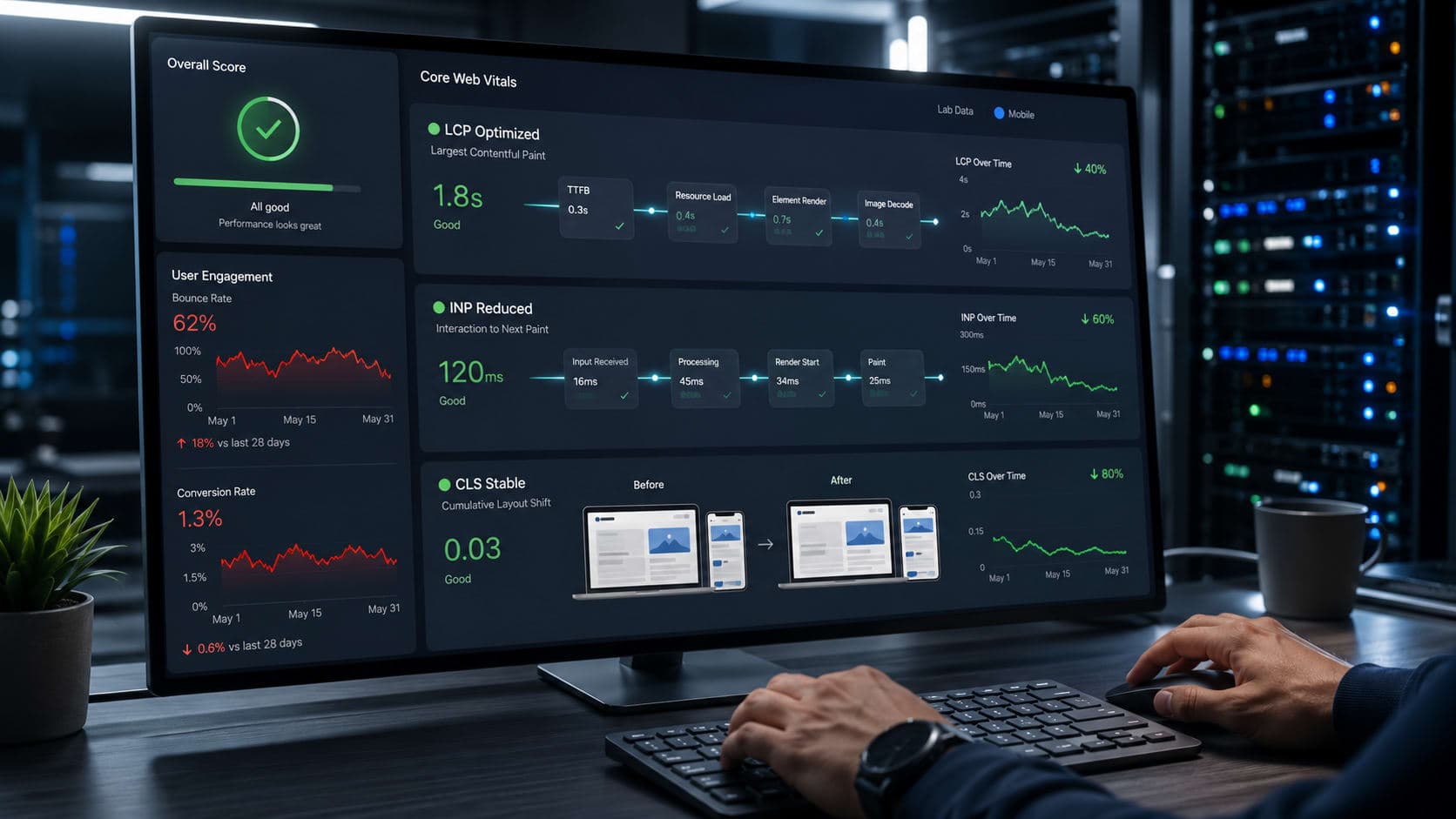
We've all been there: staring at a performance report, a beautiful sea of green checks, yet the website still feels... off. Users complain about janky scrolls or delayed interactions. Business metrics like conversions or bounce rates haven't budged.
This disconnect is a common frustration, highlighting a critical truth: a perfect Lighthouse score isn't the ultimate goal. It's a diagnostic tool, a guide, not the destination itself.
The Illusion of the Perfect Score
Many teams fall into the trap of optimizing for a number. We tweak, defer, and pre-load, pushing the needle on lab scores without deeply understanding the real-world user experience.
This often happens because synthetic tests, while valuable, can't fully replicate the chaotic reality of diverse network conditions, device capabilities, and human interaction patterns.
From Metrics to Meaning: Understanding Real User Pain
At Muhyo Tech, we approach Core Web Vitals (CWV) not as a checklist, but as a framework for understanding and resolving genuine user friction. Each metric – Largest Contentful Paint (LCP), Interaction to Next Paint (INP), and Cumulative Layout Shift (CLS) – tells a story about how users perceive and interact with a site.
Our focus shifts from merely achieving a 'good' score to diagnosing the root causes of slow loading, unresponsive interfaces, or frustrating layout shifts that directly impact user trust and business objectives.
Largest Contentful Paint (LCP): Beyond Just Speed
LCP measures when the largest visible element on a page finishes loading. A low LCP often feels like a slow, empty page to a user, leading to immediate frustration and higher bounce rates.
Our engineering response goes deeper than basic image optimization. We prioritize critical rendering paths, ensuring that the most important content – a hero image, a main heading, or a product description – appears almost instantly.
This involves strategies like server-side rendering (SSR) for initial HTML, aggressive image compression and responsive serving, and critical CSS inlining. We also carefully evaluate third-party scripts that might block rendering, often deferring or asynchronously loading them.
Interaction to Next Paint (INP): The Feeling of Responsiveness
INP, which recently replaced First Input Delay (FID), measures the latency of all user interactions with a page. A poor INP means frustrating delays after clicking a button, typing in a form, or navigating a menu.
This isn't just about reducing JavaScript bundle sizes; it's about minimizing main thread blocking time during critical user interactions. We analyze long tasks, optimize event handlers, and ensure non-essential scripts don't monopolize the browser's main thread.
Effective solutions often involve breaking up large JavaScript tasks, implementing efficient debouncing or throttling for frequent events, and carefully structuring component lifecycles to prevent unnecessary re-renders. A responsive UI builds user confidence, making the entire experience feel smooth and professional.
Cumulative Layout Shift (CLS): Stability Builds Trust
CLS measures unexpected layout shifts that occur during the page's lifecycle, often caused by dynamically loaded content pushing existing elements around. Imagine trying to click a button, only for it to jump away at the last second – it's incredibly frustrating.
Our engineering approach to CLS focuses on predictability. We ensure images and videos always have explicit `width` and `height` attributes to reserve space. We pre-render content skeletons or use appropriate placeholders for dynamically loaded elements.
Font loading is another common culprit. We employ `font-display: swap` and ensure web fonts are preloaded to prevent jarring text reflows, maintaining visual stability from the very first paint.
Integrating Performance into the Development Lifecycle
True performance gains aren't achieved through one-off fixes; they're built into the very fabric of our development process. At Muhyo Tech, we embed performance considerations from the architecture phase through deployment.
We establish performance budgets, continuously monitor real user data (RUM) in production, and integrate performance testing into our CI/CD pipelines. This proactive stance helps us catch regressions early and ensures that performance remains a non-negotiable aspect of quality.
This approach allows us to make informed engineering decisions, balancing feature development with the critical need for a fast and reliable user experience.
The Business Outcome: Beyond the Green Score
When we engineer Core Web Vitals with real user experience in mind, the business impact is tangible. It translates directly into better SEO rankings, as Google prioritizes fast and stable pages.
It means higher conversion rates because users are more likely to complete forms or make purchases on a site that feels responsive and trustworthy. It also leads to lower bounce rates and increased user engagement, as visitors stay longer and explore more content.
Ultimately, a performant website reduces operational risk, improves customer satisfaction, and strengthens your brand's digital presence. It’s about building digital assets that truly serve your business goals, not just satisfy a metric.
Our Standard: Engineering for Real People
At Muhyo Tech, we don't just chase green scores; we engineer for the human behind the screen. We believe that robust performance is a cornerstone of every successful digital product, from simple portfolio sites to complex web applications.
This commitment to real-world performance ensures that our clients launch faster, operate with stronger reliability, and provide a user experience that genuinely converts visitors into loyal customers.