


A web form is often the handshake between a user and a business. It's where potential leads are captured, support requests are made, or vital information is submitted.
When these forms falter, the impact is immediate: lost opportunities, frustrated users, and a dent in credibility. We've seen too many projects where a seemingly simple form becomes a silent failure point.
The Hidden Pitfalls of Form Submission
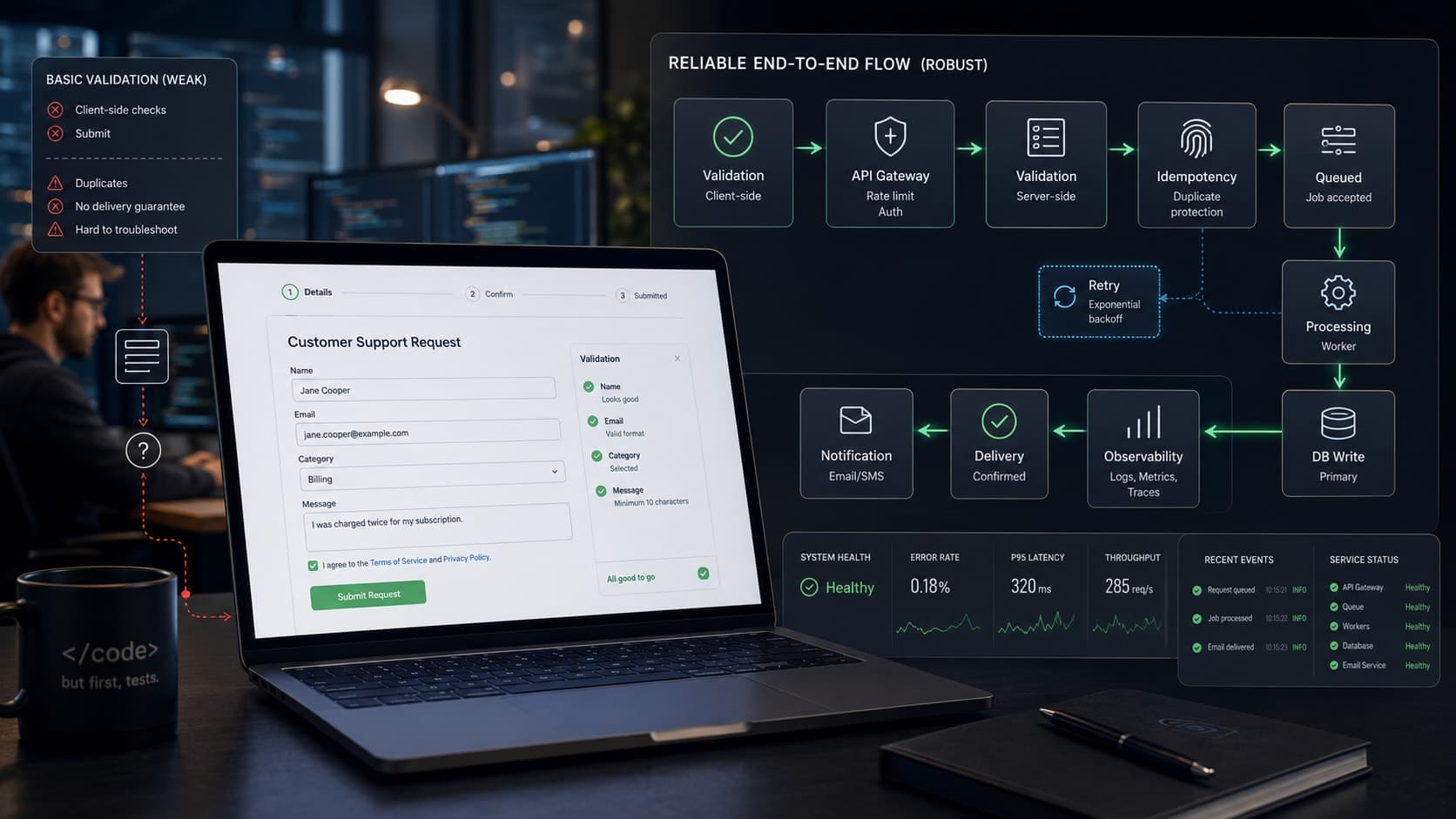
Basic client-side validation is a good start, but it's far from sufficient for true reliability. It catches obvious errors like missing fields or incorrect email formats in the browser.
However, this validation can be bypassed, disabled, or simply not exist if JavaScript fails to load. Relying solely on this frontend check leaves a significant gap in data integrity.
Server-side validation is non-negotiable. It's the essential second layer that ensures data is clean and correctly formatted before it ever hits your database or triggers an action.
We've encountered scenarios where incomplete server validation allowed malformed data to slip through. This can lead to corrupted records, broken downstream processes, and a tangled mess for administrators.
Beyond Validation: Securing the Submission Pipeline
Data integrity is only one piece of the puzzle. Ensuring a form submission is processed correctly, securely, and without interruption is paramount.
Consider the journey of a submission: from the user's click to the final confirmation. Each step is a potential point of failure that requires deliberate engineering.
We look for common issues like network interruptions during submission, server overload, or even unexpected API responses from third-party services. A robust system anticipates these problems.
This involves designing for idempotency, where a submission can be retried safely without creating duplicates. It also means handling errors gracefully, providing clear feedback to the user, and logging issues for administrators.
Engineering for User Experience and Trust
A reliable form isn't just about data; it's about the user's experience. Frustration with a form can lead users to abandon a site entirely.
Clear feedback is crucial. Users need to know instantly if their submission was successful, if there were errors, and what to do next.
We design confirmation messages that are unambiguous and reassuring. Error messages should be specific and actionable, guiding the user to correct their input.
Progress indicators or loading states are also vital for longer submission processes. This prevents users from clicking submit multiple times or assuming the system is frozen.
Our team prioritizes clear, concise communication throughout the form interaction. This builds confidence and encourages users to complete the process.
Strategic Approaches to Form Reliability
At Muhyo Tech, we employ several engineering strategies to build truly reliable forms.
We start with thorough server-side validation that covers all expected data types, lengths, and business logic constraints. This is the bedrock of data integrity.
We implement robust error handling and logging mechanisms. This allows us to quickly diagnose and resolve any submission issues that arise in production.
Asynchronous submission patterns are often employed. This keeps the user interface responsive while the backend processes the request, improving perceived performance.
We also build in retry logic, often with exponential backoff, for external API calls triggered by form submissions. This ensures that transient network issues don't cause permanent data loss.
Testing is non-negotiable. We write automated tests that simulate various valid and invalid submission scenarios, including edge cases and potential failure modes.
Tradeoffs and Long-Term Value
Implementing these advanced strategies involves a trade-off. Building forms beyond basic validation requires more development time and careful architectural planning.
However, the long-term benefits far outweigh the initial investment. Reduced support tickets, fewer data errors, and improved conversion rates translate directly to business value.
A reliable form submission process contributes to a more stable and trustworthy digital system. It frees up valuable engineering resources that would otherwise be spent fixing data issues.
This focus on foundational reliability is a core part of how we approach building web applications. It ensures that critical user interactions are handled with the robustness they deserve.
The Muhyo Tech Standard for Form Engineering
Our commitment to engineering excellence means we don't cut corners on critical components like forms. We understand their importance in the user journey and business operations.
This methodical approach, from robust server-side validation to resilient error handling and user feedback, ensures that your digital systems are dependable.
It’s this dedication to building solid, reliable foundations that helps our clients launch with confidence and operate with less stress.