


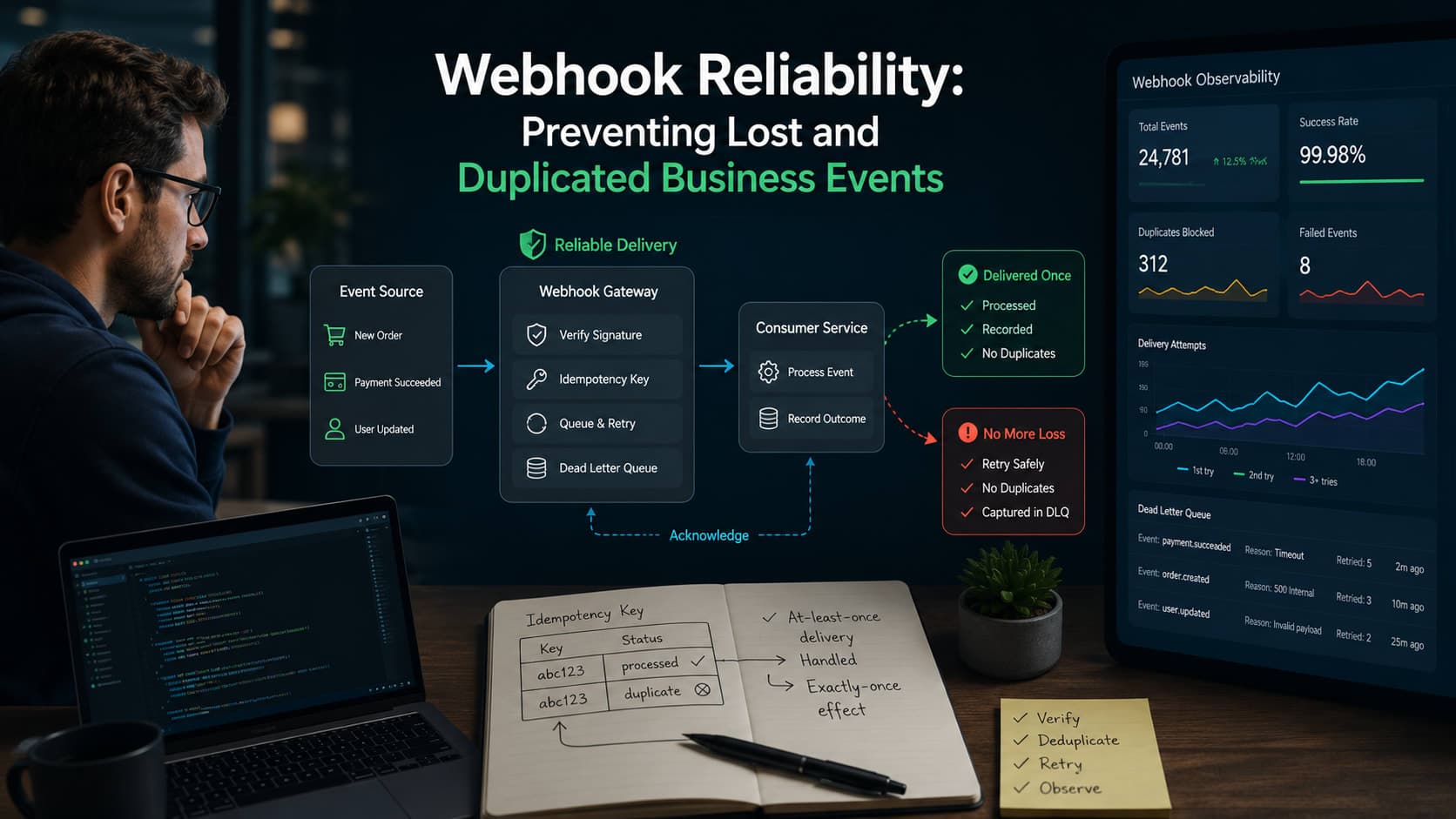
Imagine a critical business event — a new customer sign-up, a payment confirmation, or an inventory update — that needs to flow between different systems. Often, webhooks are the chosen mechanism for this real-time communication.
However, without careful design, webhooks can be a source of frustration, leading to lost data, duplicated actions, and a cascade of operational headaches. At Muhyo Tech, we frequently see these challenges when integrating third-party services or building complex internal systems.
The Pain of Unreliable Webhooks: Lost Events and Duplicates
The core problem with basic webhook implementations is their inherent 'fire-and-forget' nature. A sender sends a notification, but has no guaranteed knowledge if the receiver processed it successfully.
Network glitches, server timeouts, or temporary outages on either side can easily cause an event to be missed. Even worse, an event might be sent multiple times if the sender retries without knowing the initial delivery succeeded, leading to unwanted duplicates.
This means a customer might get charged twice, an order might be fulfilled unexpectedly, or an important user action might simply disappear from your records. These scenarios erode trust and create significant manual clean-up work.
Diagnosis: Why Webhooks Go Wrong
Unreliable webhooks usually stem from a few common architectural oversights. The primary culprits are a lack of robust error handling, insufficient idempotency, and insecure event validation.
When a system expects every webhook delivery to be perfect and unique, it's setting itself up for failure. We learned early on that assuming perfect network conditions or flawless uptime is a dangerous game.
Engineering Fix 1: Ensuring Authenticity with Webhook Signatures
Before even processing an event, you need to be sure it's legitimate. Malicious actors could try to send fake webhooks to manipulate your system or trigger unwanted actions.
Webhook signatures provide a cryptographic way to verify the sender's identity and ensure the payload hasn't been tampered with. The sender computes a hash of the payload using a shared secret and includes it in a header.
Upon receipt, your system recomputes the hash using the same secret and compares it to the incoming signature. If they don't match, the webhook is rejected immediately. This is a foundational step in building secure and reliable webhook integrations.
Engineering Fix 2: Idempotency for Retry-Safe Processing
Even with signatures, network issues mean webhooks might arrive multiple times. Idempotency is the concept that performing an operation multiple times has the same effect as performing it once.
For webhooks, this means your processing logic must be designed to handle duplicate events gracefully. The most common approach involves using a unique 'idempotency key' provided by the sender, often a UUID or event ID.
When your system receives a webhook, it first checks if this idempotency key has already been processed. If it has, you simply acknowledge receipt without re-executing the business logic. This prevents double charges, duplicate entries, or unwanted state changes.
At Muhyo Tech, we often design our API endpoints and event processors with idempotency in mind from the start. It’s a core pattern for building resilient backend systems, ensuring that retries are a safety net, not a source of new problems.
Engineering Fix 3: Robust Retry Mechanisms and Dead-Letter Queues
What happens if your system is temporarily down or an internal error occurs during processing? A well-designed webhook sender will implement a retry mechanism with exponential backoff.
This means if your server returns a non-2xx status code (e.g., 500 Internal Server Error), the sender will wait for a bit, then try again, increasing the wait time with each subsequent attempt. Your system, in turn, should return appropriate HTTP status codes to guide the sender's behavior.
For events that consistently fail after multiple retries, a 'dead-letter queue' (DLQ) is invaluable. These are separate queues where failed events are stored for manual inspection or later reprocessing. This prevents critical events from simply disappearing into the ether.
Tradeoffs and Business Value
Implementing these reliability patterns adds complexity. You need to manage shared secrets, store idempotency keys, and build out retry logic or integrate with services that provide it.
However, the business value far outweighs this initial engineering investment. Reliable webhook processing means fewer manual interventions, reduced customer support tickets, and more accurate data across your systems. This directly translates to cleaner operations, better customer trust, and easier system growth.
It also reduces the risk associated with integrating new services or scaling your existing infrastructure. When your integrations are solid, you can launch new features faster with confidence.
Our Approach at Muhyo Tech
When we build or integrate systems that rely on webhooks, these principles are fundamental. We look beyond basic connectivity to design for the inevitable failures that occur in distributed systems.
Whether it's for a custom web app, an e-commerce platform, or a complex AI-assisted workflow, ensuring event integrity is paramount. It’s about building digital services that are not just functional, but truly robust and dependable.
Conclusion
Webhooks are powerful tools for real-time system integration, but their reliability is not automatic. By consciously implementing webhook signatures for security, idempotency for retry-safe processing, and robust retry mechanisms with dead-letter queues, you can transform a potential liability into a strong, resilient communication channel.
These engineering practices prevent the costly headaches of lost or duplicated data, allowing your business to operate smoothly and scale with confidence. It's an investment in the long-term health and integrity of your digital ecosystem.