


Imagine your web application feels sluggish. Pages load slowly, especially those displaying lists of items with related details. You've checked the network, optimized front-end assets, and still, there's a frustrating lag.
Often, the culprit isn't obvious. It's a silent performance killer hiding in plain sight: the N+1 query problem.
What is the N+1 Query Problem?
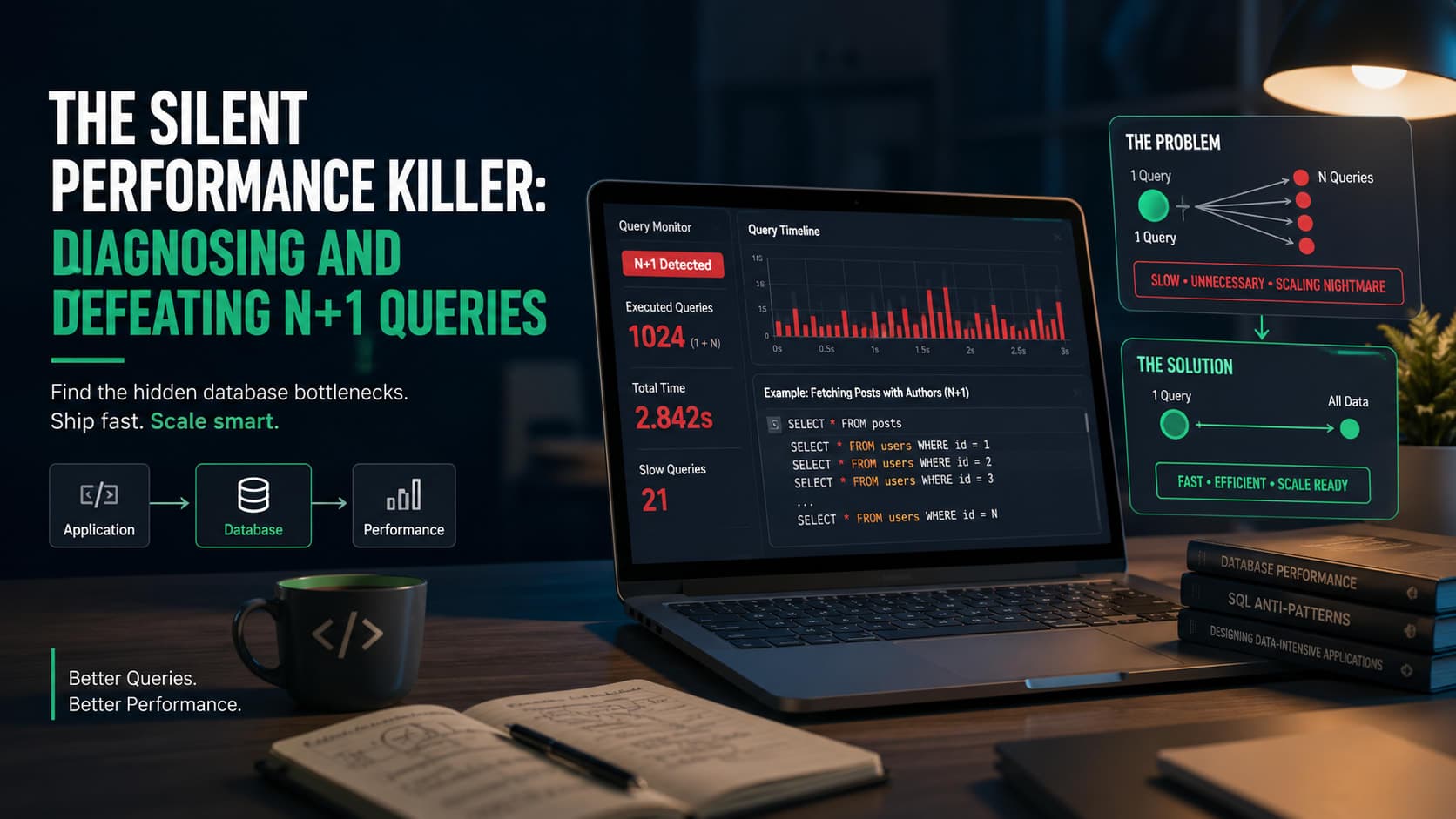
The N+1 query problem occurs when an application makes one initial query to retrieve a list of parent records. Then, for each of those 'N' parent records, it executes an additional, separate query to fetch associated child data.
This means if you have 10 parent items, you're making 1 (for parents) + 10 (for children) = 11 database queries. If you have 100 items, that's 101 queries. Each query adds network latency, processing time, and database load, quickly escalating into a significant performance bottleneck.
The Hidden Cost of N+1 Queries
This issue is particularly insidious because it might not show up during early development or with small datasets. As your application grows and the number of records increases, performance degrades exponentially.
Users experience slower page loads, which impacts engagement and conversion rates. For businesses, this translates to lost opportunities and a poor brand image. Our team at Muhyo Tech frequently identifies this as a root cause when optimizing existing web applications.
Diagnosing the N+1 Problem
Identifying N+1 queries requires a keen eye and the right tools. Most modern web frameworks and ORMs (Object-Relational Mappers) offer ways to log database queries.
By examining your application's log files, you can spot patterns of repeated queries for individual records within a loop. Tools like Laravel Debugbar, Django Debug Toolbar, or ActiveRecord-related gems in Ruby on Rails provide excellent visual indicators and detailed query analysis right in your development browser.
We approach performance diagnosis by starting with user experience. If a page feels slow, we dive into the server-side logs and database activity to pinpoint inefficient data access patterns. This often leads us directly to N+1 scenarios.
Engineering Solutions: Defeating N+1 Queries
Once diagnosed, several robust engineering strategies can effectively eliminate N+1 queries. The goal is always to retrieve all necessary data with the fewest possible database round trips.
1. Eager Loading (Joins)
This is the most common and often simplest solution. Instead of fetching child data individually, you instruct your ORM or database query to 'eager load' related data alongside the parent records in a single query.
For example, using a SQL JOIN or an ORM's with() or includes() method can fetch all parent and child data efficiently. This reduces 1+N queries to just 1 query, dramatically improving performance.
2. Subqueries
In some complex scenarios, subqueries can be used to gather related data without resorting to multiple round trips. While eager loading is usually preferred for simplicity and clarity, subqueries offer another powerful tool in the optimization toolkit.
They allow you to embed one query's result into another, often for aggregation or conditional filtering. This keeps data retrieval within a single database call.
3. Select Specific Columns
While not strictly an N+1 fix, selecting only the columns you need can complement eager loading by reducing the amount of data transferred. An N+1 query often fetches entire rows repeatedly.
By being explicit about which fields you retrieve, you further optimize network usage and database processing. This is a good practice for overall efficiency.
4. Caching Strategies
For data that doesn't change frequently, caching can provide significant relief. Once optimized with eager loading, the results of that single, efficient query can be stored in a cache layer (like Redis or Memcached).
Subsequent requests can then serve the data from the cache, bypassing the database entirely. This is particularly effective for highly-trafficked pages with static or semi-static content.
Tradeoffs and Considerations
Implementing these solutions isn't without tradeoffs. Eager loading, while powerful, can sometimes fetch more data than strictly necessary if not carefully managed. This might slightly increase memory usage on the server.
Additionally, complex joins can sometimes make queries harder to read or debug. It's a balance between query efficiency and code maintainability, which we always consider in our web app development practices.
Business Value: Faster, More Reliable Web Apps
Solving the N+1 query problem isn't just a technical exercise; it delivers tangible business value. Faster applications lead to better user experiences, which means higher engagement, lower bounce rates, and improved conversions.
For businesses relying on web applications for operations or customer interaction, improved performance translates directly to smoother workflows and reduced operational stress. It's about building scalable systems that stand the test of time and traffic.
At Muhyo Tech, optimizing for database efficiency, including the elimination of N+1 queries, is a fundamental part of our full-stack web app development process. We aim to deliver not just functional, but high-performing and reliable digital solutions that support your long-term goals.
Beyond N+1: A Culture of Performance
Defeating the N+1 query problem is a crucial step, but it's part of a larger commitment to performance. Our team continuously evaluates database interactions, API endpoints, and front-end rendering to ensure optimal speed.
This proactive approach prevents many performance issues before they impact users. It builds a foundation for scalable, resilient web applications that can grow with your business.