


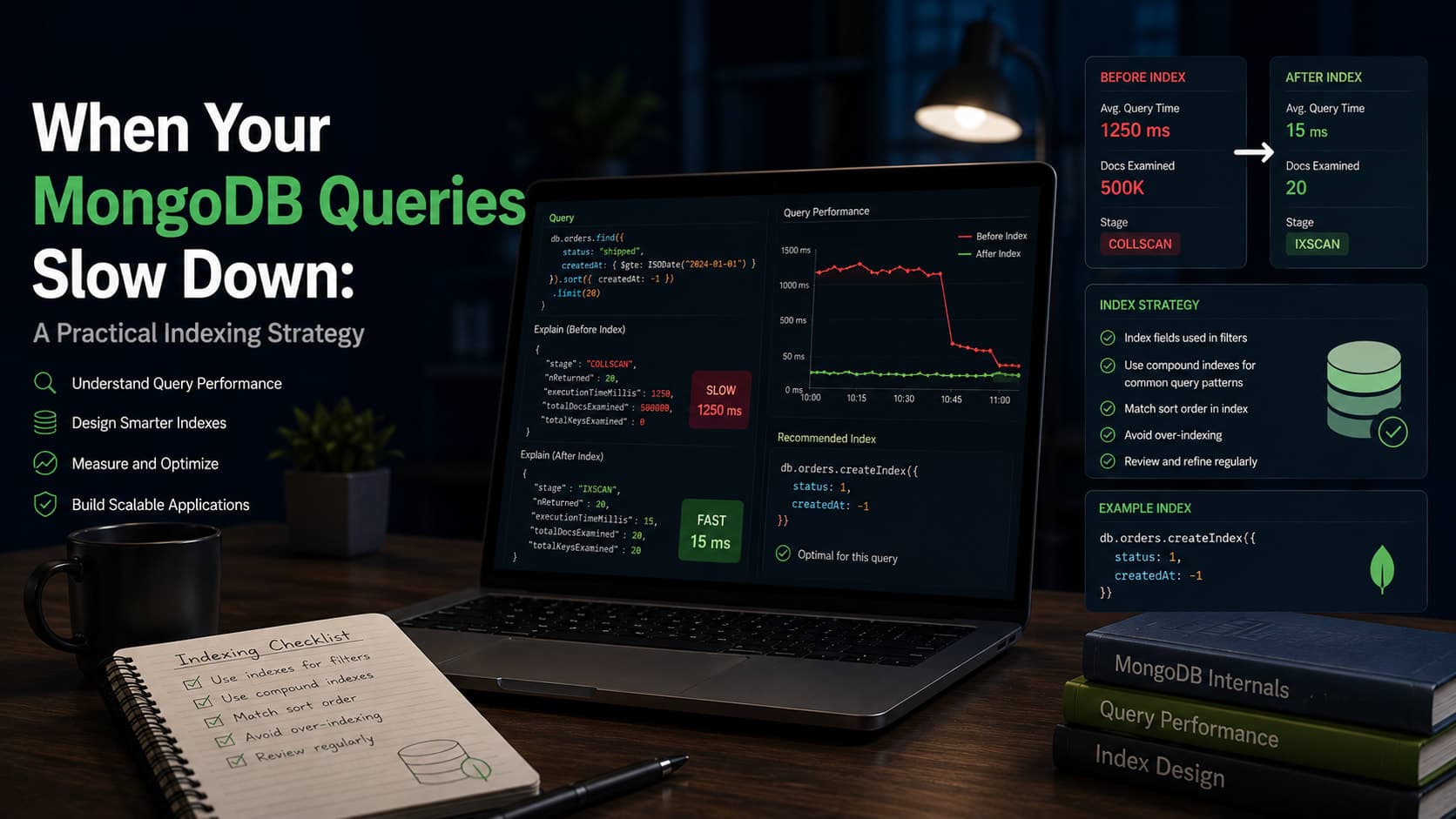
It’s a familiar story: your application launches smoothly, queries fly, and everything feels responsive. Then, as your user base grows and your data volume expands, those same queries start to crawl.
This slowdown is often a direct consequence of how your database handles increasingly large datasets. Without proper optimization, even a well-designed system can hit performance bottlenecks.
The Hidden Cost of Unindexed Data
In MongoDB, indexes are crucial for fast query execution. They work much like an index in a book, allowing the database to quickly locate relevant documents without scanning the entire collection.
When data is unindexed, or indexes are poorly designed, MongoDB has to perform full collection scans. This means reading every single document to find the ones that match your query criteria. As your collection grows, this operation becomes exponentially more expensive in terms of time and resources.
Identifying the Bottleneck: Access Patterns Are Key
The first step in fixing slow queries is understanding *how* your application actually accesses the data. We look for common query patterns, focusing on fields used in filter clauses (WHERE), sort operations (ORDER BY), and projections (SELECT fields).
Are you frequently querying by user ID and status? Do you often sort search results by creation date in descending order? Identifying these recurring access patterns is the bedrock of an effective indexing strategy. Without this analysis, you're essentially guessing.
Crafting Compound Indexes for Efficiency
Single-field indexes are a good starting point, but most real-world applications benefit significantly from compound indexes. These are indexes that cover multiple fields in a specific order.
The order of fields in a compound index is critical. It should generally reflect the order of fields used in your queries, prioritizing fields used for equality matches first, followed by sort fields or range queries. We learned early on that getting this order wrong can negate the benefits of the index.
For example, if you frequently query for documents where userId is a specific value and then sort by createdAt, an index on { userId: 1, createdAt: -1 } would be highly effective. This single index can support both the filtering and the sorting aspects of your query.
When to Use Covered Queries
A particularly powerful optimization is a covered query. This occurs when an index contains all the fields required to satisfy a query, including those in the projection. If your query only needs fields present in the index, MongoDB can return the results directly from the index itself.
This bypasses the need to access the actual documents altogether, offering a significant performance boost. We aim for covered queries whenever feasible, as it drastically reduces I/O operations and speeds up retrieval times.
However, it's a tradeoff: a larger index is needed, which consumes more memory and disk space. We must balance the performance gains against the resource implications.
The Tradeoffs and Pitfalls of Indexing
While indexes are essential, they are not without their costs. Every index adds overhead to write operations (inserts, updates, deletes) because the index itself must also be updated.
Too many indexes, or indexes on fields that are rarely queried, can actually degrade performance and increase storage requirements. Our team always emphasizes a disciplined approach: index what you use, and periodically review your indexes to remove unused ones.
We also consider the cardinality of fields. Indexing fields with very low cardinality (few unique values, like a boolean `isActive` field) might not be as effective as indexing fields with high cardinality. Understanding your data distribution is key.
Monitoring and Iteration: An Ongoing Process
Database performance tuning isn't a one-time fix; it's an ongoing process. We implement robust monitoring to track query performance and identify new bottlenecks as data and access patterns evolve.
Tools like MongoDB’s `explain()` command are invaluable for analyzing query plans and understanding index usage. This iterative approach ensures that your application remains performant as it scales.
At Muhyo Tech, we bake this performance-first mindset into our development process from the outset. This proactive approach helps prevent many common scaling issues before they impact users.
Connecting Indexing to Business Value
Implementing a smart MongoDB indexing strategy has direct business benefits. Faster queries mean a snappier user experience, which can lead to higher engagement and conversion rates.
Reduced database load translates to lower infrastructure costs. Furthermore, a well-indexed, performant database reduces the risk of critical downtime due to performance failures, offering greater reliability.
For founders and product teams, this means less stress about unexpected performance regressions and more confidence in your application's ability to handle growth. It contributes to cleaner operations and a more scalable digital system overall.