


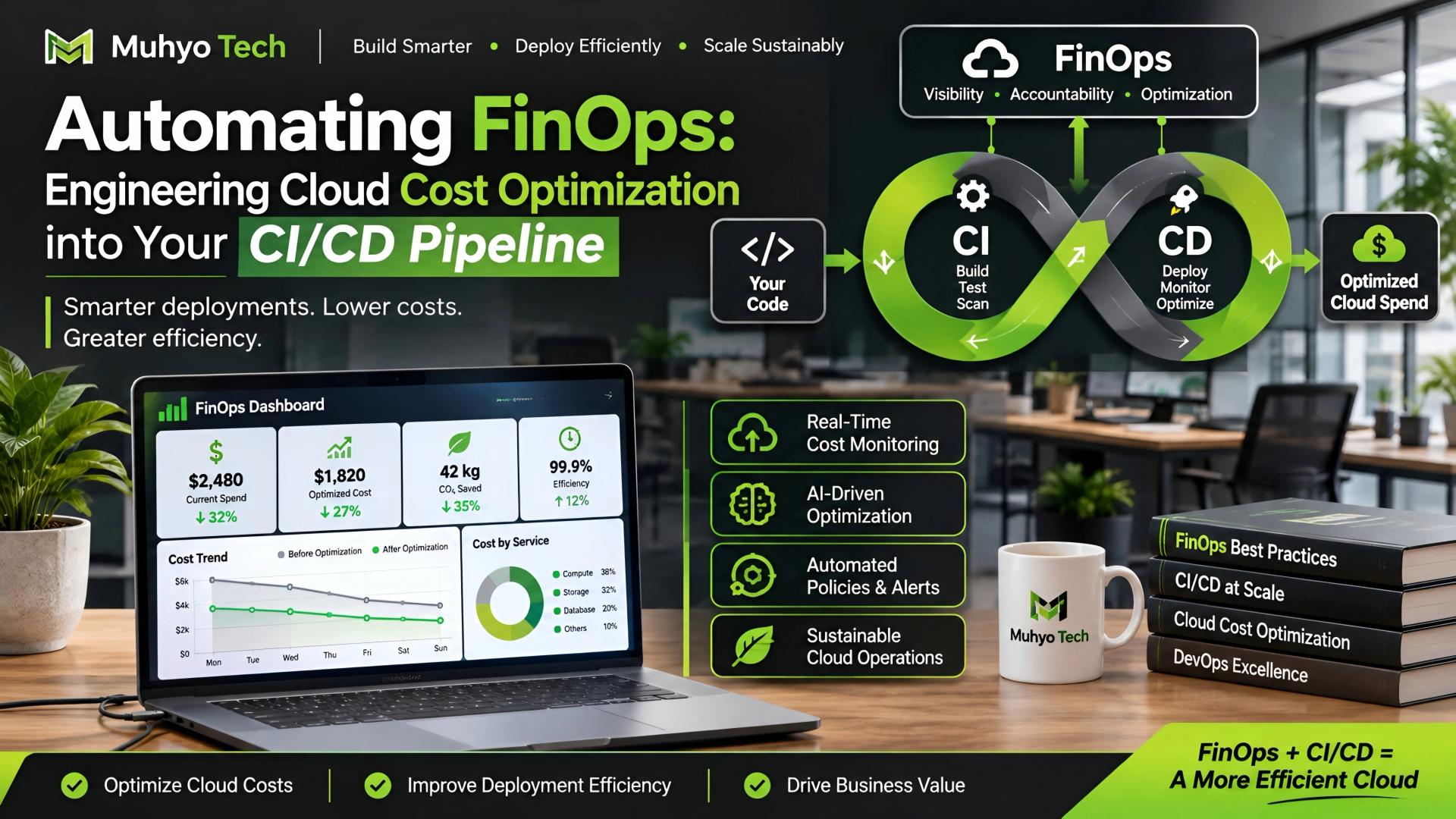
Cloud costs can feel like a hidden current, steadily eroding budgets if not actively managed. Many organizations still treat cost optimization as a reactive, manual exercise, often after a billing cycle has already closed. This reactive approach creates a significant drag on profitability and team morale.
The real challenge isn't just seeing the bill, but understanding the root causes of expenditure in real-time. It's about empowering engineering teams to make cost-aware decisions at every stage, not just at the end of the month. This is where integrating FinOps automation directly into your CI/CD pipeline becomes essential.
The Cloud Cost Problem: Beyond the Bill
Uncontrolled cloud spend often stems from a lack of immediate feedback. Developers provision resources, deploy applications, and scale services without an instant understanding of the cost implications.
This disconnect leads to orphaned resources, over-provisioned instances, and inefficient architecture choices that accumulate silently. By the time finance flags an issue, the engineering effort required to untangle the problem is significantly higher.
What is FinOps Automation in CI/CD?
FinOps automation in CI/CD means embedding cost awareness and optimization actions directly into your continuous integration and continuous deployment workflows. It transforms cost management from a monthly reconciliation task into an ongoing, automated process.
This approach shifts cost responsibility left, enabling engineers to identify and address cost inefficiencies before they ever reach production. It's about making cost a first-class metric alongside performance and reliability.
Core Pillars of FinOps Automation in CI/CD
To effectively automate FinOps, we need to consider several interlocking components. These pillars ensure that cost is continuously monitored, analyzed, and optimized throughout the application lifecycle.
At Muhyo Tech, we design systems that integrate these aspects seamlessly, ensuring that our deployments are not just robust but also fiscally responsible from day one.
1. Cost Visibility and Reporting in Real-time
You can't optimize what you can't see. Real-time visibility into cloud spend, broken down by project, service, and even individual deployment, is foundational. This means integrating cloud billing APIs and cost management tools directly into your monitoring dashboards.
During a deployment, a developer should be able to see the projected cost impact of their changes. Post-deployment, granular reports help quickly identify anomalies or unexpected spikes.
2. Anomaly Detection and Alerting
Unexpected cost spikes are often indicators of misconfigurations, resource leaks, or even security incidents. Automating anomaly detection involves setting baselines for typical spend patterns and alerting teams when deviations occur.
These alerts should be integrated into existing communication channels, like Slack or email, and ideally trigger automated rollback or resource scaling actions if the anomaly is severe enough. Timely alerts prevent small issues from becoming budget-busting problems.
3. Automated Resource Optimization
This is where the rubber meets the road. Automated optimization involves mechanisms that right-size instances, adjust auto-scaling policies, and identify idle resources for termination. These actions can be triggered by predefined rules or machine learning algorithms.
Examples include automatically scaling down development environments outside business hours, recommending smaller instance types based on utilization metrics, or terminating resources that haven't been accessed in a specified period. The goal is to eliminate waste without impacting performance.
4. Policy-as-Code for Cost Governance
Defining cost governance policies as code allows you to enforce budget constraints and best practices automatically. This means writing rules that prevent the provisioning of overly expensive instance types, ensure proper tagging for cost allocation, or enforce resource lifecycle management.
These policies can be integrated into your CI/CD pipeline as a gate, failing deployments that violate cost rules. This proactive approach prevents costly mistakes before they are deployed to production.
Integrating FinOps into Your CI/CD Pipeline: A Blueprint
Implementing FinOps automation isn't a single tool but a strategic integration of practices and technologies. Here's a conceptual blueprint:
Phase 1: Pre-Deployment Cost Analysis
- Infrastructure as Code (IaC) Scanning: Tools like Terraform cost estimation or CloudFormation Linter can provide projected costs for planned deployments. Integrate these into your build step.
- Policy Enforcement: Use tools like Open Policy Agent (OPA) or cloud-native policy engines (e.g., AWS Config Rules, Azure Policy) to validate IaC against cost policies before provisioning.
- Developer Feedback: Present estimated costs directly in pull requests or CI/CD logs, encouraging developers to optimize their infrastructure designs upfront.
Phase 2: Post-Deployment Monitoring & Optimization
- Cost Monitoring & Tagging: Ensure all deployed resources are correctly tagged for cost allocation. Use cloud billing APIs (e.g., AWS Cost Explorer, Azure Cost Management) to ingest real-time cost data.
- Performance & Utilization Metrics: Integrate metrics from monitoring tools (e.g., Prometheus, Datadog) to understand actual resource usage.
- Rightsizing & Scaling Automation: Implement serverless functions or cron jobs that analyze utilization data and automatically suggest or apply rightsizing recommendations. Configure auto-scaling groups based on cost-performance tradeoffs.
- Anomaly Detection: Use machine learning-driven services (e.g., AWS Anomaly Detection, Azure Cost Anomaly Detection) or custom rules to alert on unusual spend patterns.
Phase 3: Continuous Governance & Reporting
- Automated Reporting: Generate daily/weekly cost reports broken down by team, project, and environment.
- Waste Identification: Run regular scans for idle, unattached, or underutilized resources (e.g., EBS volumes, unused IPs).
- Chargeback/Showback: Implement mechanisms to accurately attribute costs back to specific teams or departments, fostering accountability.
Tools and Technologies for FinOps Automation
The landscape of FinOps tools is diverse, ranging from cloud-native services to open-source projects and commercial platforms. Here's a brief comparison:
| Category | Tool/Service | Pros | Cons | Use Case |
|---|---|---|---|---|
| Cloud-Native Cost Management | AWS Cost Explorer, Azure Cost Management, GCP Billing Reports | Deep integration, granular data, free (built-in) | Vendor-specific, limited cross-cloud views | Initial cost visibility, budget alerts |
| IaC Cost Estimation | Terraform Cloud (Cost Estimation), Infracost | Proactive cost analysis, integrates with Git workflows | Requires IaC, estimates can vary from actuals | Pre-deployment cost visibility in CI/CD |
| Policy-as-Code | Open Policy Agent (OPA), Cloud-native policies (AWS Config, Azure Policy) | Enforces governance, prevents costly misconfigurations | Requires policy definition, learning curve | Automated governance, compliance |
| Resource Optimization | Cloud Custodian, Custom Lambda/Azure Functions | Automated cleanup, rightsizing, custom rules | Requires setup & maintenance, potential for service disruption if misconfigured | Idle resource cleanup, scheduled scaling |
| Third-Party FinOps Platforms | Cloudability, Apptio Cloudability, Finout | Cross-cloud visibility, advanced analytics, recommendations | Costly, potential vendor lock-in, data latency | Large enterprises, complex multi-cloud environments |
Trade-offs and Considerations
While FinOps automation offers significant benefits, it's not without its challenges. Implementing these systems requires an upfront investment in engineering time and expertise.
There's a constant balance between aggressive cost optimization and maintaining performance and reliability. Over-optimizing can lead to under-provisioned resources, causing performance degradation or outages. We approach this by carefully tuning automation thresholds and integrating robust monitoring to catch any negative impacts quickly.
Common Mistakes to Avoid
- Over-automating without monitoring: Don't automate cost actions without robust monitoring to ensure performance isn't negatively impacted.
- Ignoring developer feedback: Developers are key; involve them in policy creation and provide clear, actionable insights, not just alerts.
- Lack of tagging strategy: Without consistent, comprehensive tagging, cost allocation and optimization efforts will be severely hampered.
- Focusing only on reactive cleanup: While cleanup is important, proactive measures in CI/CD prevent waste from occurring in the first place.
The Business Value: Beyond Just Saving Money
The immediate benefit of FinOps automation is, of course, reduced cloud spend. However, the value extends far beyond the balance sheet.
It fosters a culture of cost awareness among engineering teams, making them more thoughtful about resource consumption. This translates to faster innovation, as teams can experiment without fear of runaway costs, and improved predictability in operational expenses. Ultimately, it frees up engineering time from manual reconciliation, allowing them to focus on building value.
Our Approach at Muhyo Tech
At Muhyo Tech, we integrate FinOps principles into our foundational architectural decisions. Before we even write a line of code, we consider the cost implications of chosen services and deployment patterns.
Our CI/CD pipelines are engineered with cost gates, ensuring that new deployments meet predefined cost efficiency standards. This proactive stance means our clients benefit from optimized infrastructure from launch, translating directly into better long-term operational sustainability.
Frequently Asked Questions
How can I integrate FinOps into my existing CI/CD pipeline?
Start by adding IaC cost estimation tools (e.g., Infracost) to your pull request workflow. Next, implement policy-as-code checks (e.g., OPA) to validate resource configurations against cost policies before deployment. Finally, integrate cloud billing APIs for post-deployment cost monitoring and anomaly detection.
What are the essential tools and practices for FinOps automation in CI/CD?
Essential tools include cloud-native cost management services, IaC cost estimators, policy-as-code frameworks (like OPA or cloud-specific policies), and custom scripting (e.g., serverless functions) for automated resource optimization. Key practices involve comprehensive tagging, continuous monitoring, and fostering a cost-aware culture across engineering teams.
What are the benefits of automating FinOps in a CI/CD context?
Benefits include reduced cloud spend, improved cost predictability, faster identification and resolution of cost anomalies, and a shift-left approach to cost optimization. It also frees up engineering time from manual tasks, allowing teams to focus on core development, and fosters a culture of cost accountability.
How does FinOps automation help optimize cloud costs during development?
During development, FinOps automation provides immediate feedback on the cost implications of infrastructure changes through IaC scanning. It enforces cost governance policies proactively, preventing expensive configurations from ever reaching production. This empowers developers to design and build cost-efficient solutions from the outset, rather than fixing problems later.