


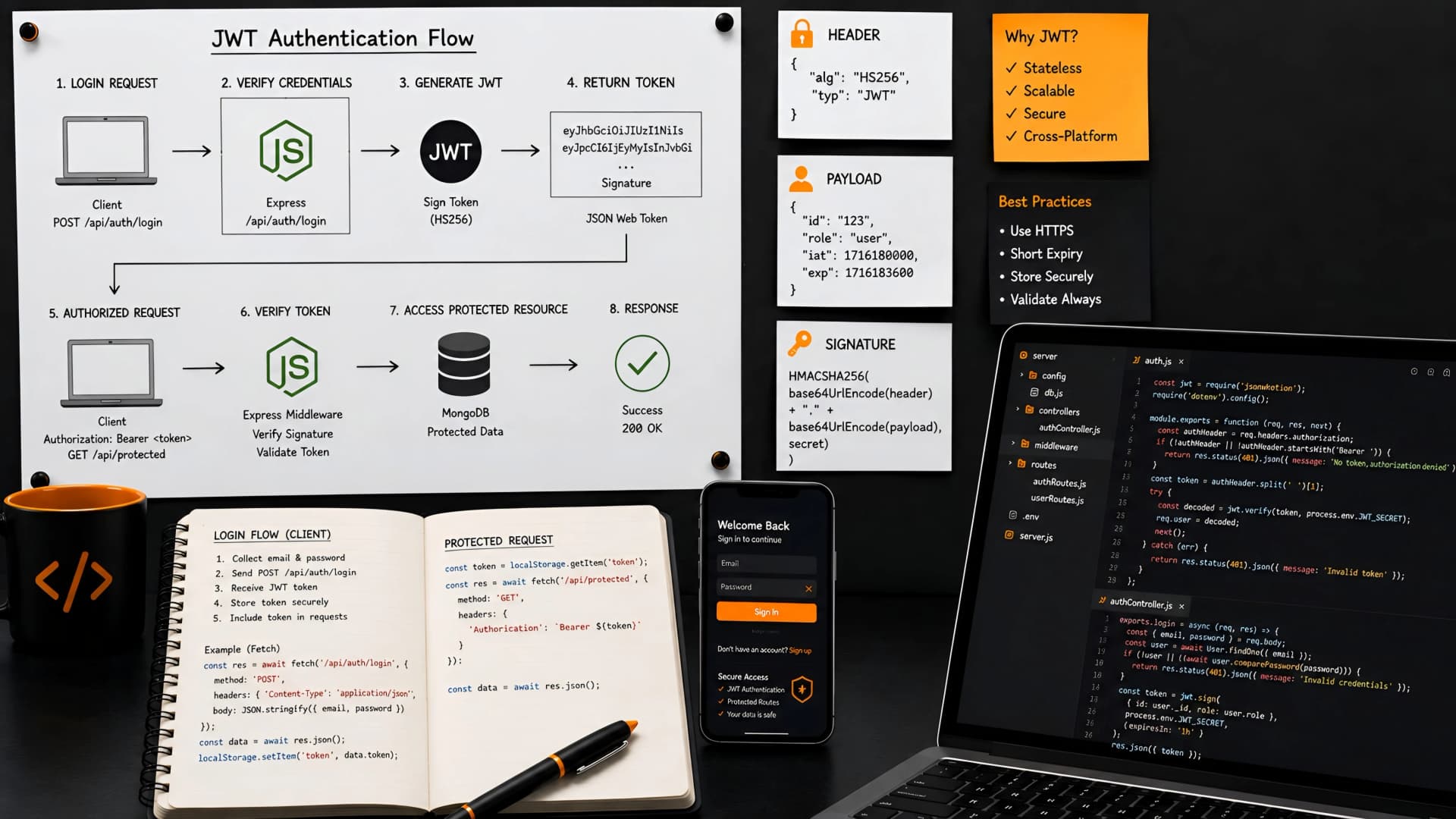
Securing MERN stack applications requires a robust authentication strategy. While session-based approaches have their place, JSON Web Tokens (JWTs) offer a stateless, scalable alternative that aligns well with modern API-driven architectures.
At Muhyo Tech, we often choose JWTs for their efficiency and distributed nature, especially when building scalable web applications. This guide will walk you through the engineering steps to implement JWT-based authentication in your MERN projects, focusing on best practices and common pitfalls.
Understanding JWTs and Their Role in Authentication
A JWT is a compact, URL-safe means of representing claims to be transferred between two parties. It consists of three parts: a header, a payload, and a signature.
The header typically contains the token type and the signing algorithm, while the payload carries user data and other claims. The signature ensures the token's integrity and authenticity, preventing tampering.
Unlike traditional sessions, JWTs are self-contained. Once issued, the server doesn't need to store session data, making them ideal for stateless APIs and distributed systems. For a broader view of authentication strategies, you might want to review our MERN Stack Authentication & Authorization: An Engineering Deep Dive.
Setting Up the Backend for JWT Generation
Our MERN backend, typically built with Node.js and Express.js, will handle token generation. We'll use the jsonwebtoken library for this purpose.
First, ensure you have a secret key for signing your tokens; this key must be kept absolutely confidential, preferably in environment variables. A common pattern involves creating a utility function to generate tokens upon successful user login or registration.
// utils/jwt.js
import jwt from 'jsonwebtoken';
const generateToken = (id) => {
return jwt.sign({ id }, process.env.JWT_SECRET, {
expiresIn: '1h', // Token expires in 1 hour
});
};
export default generateToken;
When a user logs in successfully, you'd call this function and send the generated token back to the client. This token will then serve as proof of identity for subsequent requests.
Implementing JWT Verification Middleware
To protect your API routes, you need a middleware to verify incoming JWTs. This middleware will extract the token from the request header, typically in the Authorization field as a 'Bearer' token.
It then uses jsonwebtoken.verify() with your secret key to ensure the token is valid and not expired. If verification succeeds, the decoded user ID can be attached to the request object for use in subsequent route handlers.
// middleware/authMiddleware.js
import jwt from 'jsonwebtoken';
import User from '../models/User.js'; // Assuming you have a User model
const protect = async (req, res, next) => {
let token;
if (req.headers.authorization && req.headers.authorization.startsWith('Bearer')) {
try {
token = req.headers.authorization.split(' ')[1];
const decoded = jwt.verify(token, process.env.JWT_SECRET);
req.user = await User.findById(decoded.id).select('-password');
next();
} catch (error) {
console.error(error);
res.status(401).json({ message: 'Not authorized, token failed' });
}
}
if (!token) {
res.status(401).json({ message: 'Not authorized, no token' });
}
};
export { protect };
You then apply this protect middleware to any routes requiring authentication. This keeps your application logic clean and separates concerns effectively.
Client-Side Token Handling and Storage
Once the client receives the JWT, secure storage is paramount. The most common and generally recommended approach is to store JWTs in HTTP-only cookies.
This mitigates Cross-Site Scripting (XSS) attacks because JavaScript cannot access the cookie. Additionally, set the Secure flag for HTTPS-only transmission and the SameSite=Lax or Strict flag to prevent Cross-Site Request Forgery (CSRF).
Local Storage or Session Storage are alternatives, but they are vulnerable to XSS. If you choose these, implement robust Content Security Policies (CSPs) and regularly audit your frontend for XSS vulnerabilities.
Implementing Refresh Tokens for Enhanced Security
JWTs are typically short-lived to minimize the window of opportunity for attackers. This creates a UX problem: users would need to log in frequently.
The solution is refresh tokens. When a user logs in, the server issues both an access token (short-lived) and a refresh token (long-lived).
The access token is used for regular API calls. When it expires, the client sends the refresh token to a dedicated endpoint to obtain a new access token. This process should be carefully secured.
Refresh tokens should be stored securely on the server (e.g., in a database) and invalidated upon logout. They should also be sent via HTTP-only, secure cookies to prevent client-side access.
Trade-offs and Security Considerations
While JWTs offer significant advantages, they come with trade-offs. The stateless nature means a compromised token remains valid until it expires, unless you implement a server-side revocation list.
This adds complexity, negating some of the stateless benefits. We often balance short expiration times for access tokens with a well-managed refresh token system.
Always use strong, randomly generated secret keys and ensure they are not hardcoded. Regularly rotate these keys as part of your security policy. Implementing secure authentication is a continuous process of refinement, a principle we embed in every MERN stack web development project we undertake.
Conclusion
Implementing JWT-based authentication in MERN stack applications provides a flexible and scalable solution for securing your APIs. By carefully managing token generation, verification, storage, and refresh token strategies, you can build robust and secure systems.
Remember, security is not a feature to be added later; it's an architectural consideration from the outset. Following these engineering best practices will help you protect your users and your application effectively.