


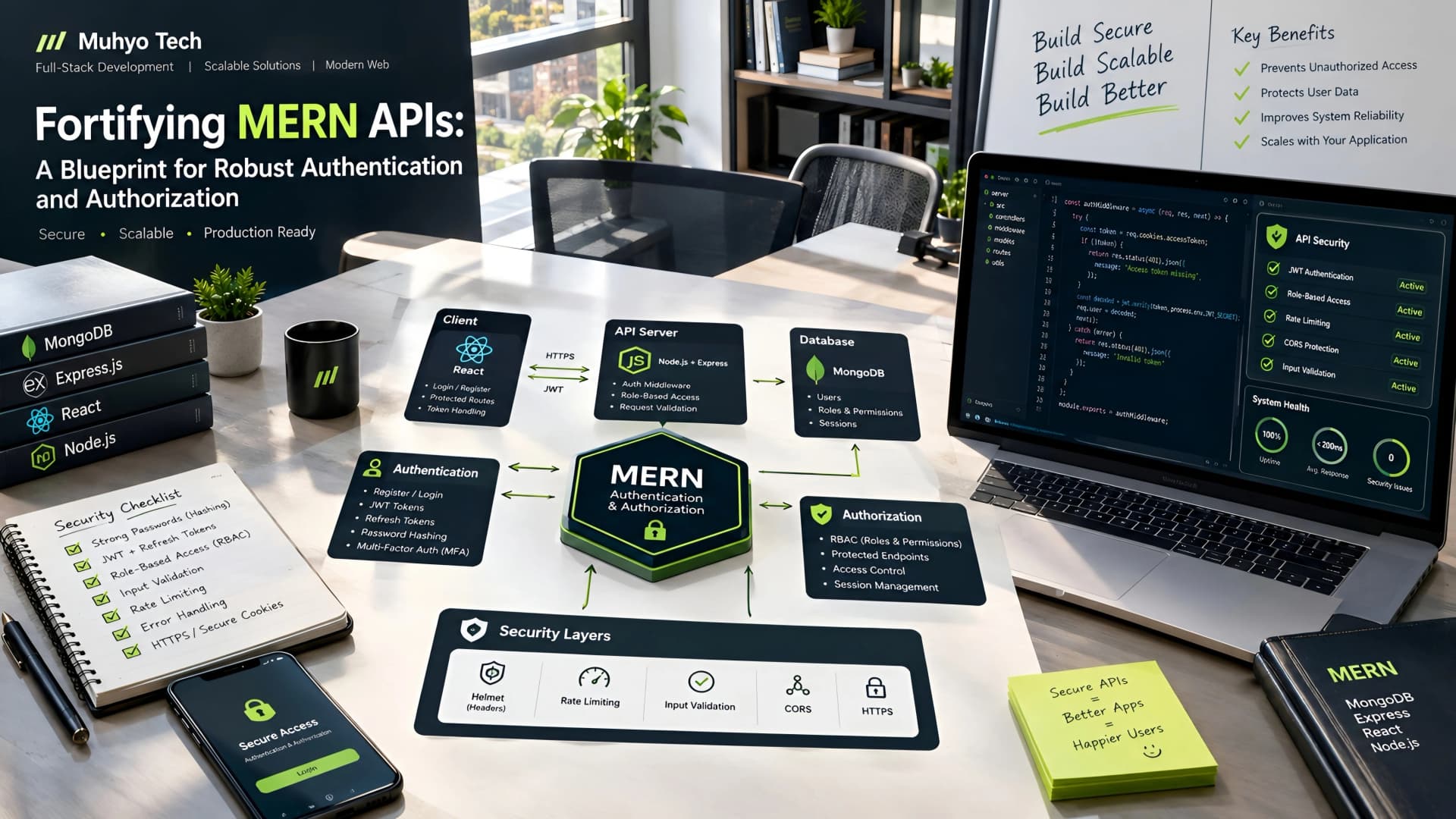
Building a MERN Stack application offers immense power and flexibility, but it also introduces significant security responsibilities. An API endpoint left unguarded, or a weak authorization scheme, can quickly become a critical vulnerability. The reality is, a single breach can erode user trust, lead to data loss, and cause severe reputational damage.
We've seen how quickly these issues can escalate. At Muhyo Tech, our approach to MERN Stack web development always prioritizes a robust security posture from the ground up, not as an afterthought. This blueprint outlines the essential strategies for fortifying your MERN APIs, ensuring both data integrity and user confidence.
Understanding the Core Problem: API Vulnerabilities in MERN
The MERN stack—MongoDB, Express.js, React, and Node.js—is incredibly popular for its full-stack JavaScript capabilities. However, its interconnected nature means a vulnerability in one layer can expose the entire system. APIs, in particular, are often the primary gateway for data interaction, making them prime targets.
Common API vulnerabilities include broken authentication, insecure direct object references, excessive data exposure, and improper authorization. These issues are not theoretical; they represent real-world attack vectors that malicious actors actively exploit. Failing to address them leads directly to increased operational risk and potential data breaches.
Pillar 1: Robust Authentication Strategies for MERN APIs
Authentication verifies the identity of a user or client attempting to access your API. For MERN applications, JSON Web Tokens (JWTs) are the de facto standard, often complemented by OAuth for third-party integrations. Choosing the right method and implementing it correctly is paramount.
JSON Web Tokens (JWT) Explained
JWTs are compact, URL-safe means of representing claims to be transferred between two parties. They are widely used for stateless authentication in RESTful APIs. When a user logs in, the server generates a JWT, which is then sent back to the client.
The client stores this token and sends it with subsequent requests in the Authorization header. The server then verifies the token's signature and expiration, granting access if valid. This approach minimizes server-side session management overhead, making it scalable.
Implementing JWT Authentication in Express.js
Our typical setup involves using libraries like jsonwebtoken for token generation and verification, and bcrypt for password hashing. We always hash passwords before storing them in MongoDB, never storing them in plain text.
The authentication flow involves a user submitting credentials to an API endpoint. Upon successful verification, a JWT is signed with a secret key and returned. This token then serves as the user's proof of identity for future requests.
Considering OAuth 2.0 for Third-Party Integrations
While JWT handles direct user authentication, OAuth 2.0 is crucial for scenarios where users grant third-party applications limited access to their resources without sharing credentials. Think 'Login with Google' or 'Connect with Facebook'.
Integrating OAuth 2.0, often via libraries like Passport.js, provides a standardized and secure way to manage these complex authentication flows. It's about delegating authorization safely and ensuring user consent is explicitly managed.
Pillar 2: Granular Authorization with Role-Based Access Control (RBAC)
Authentication confirms 'who you are'; authorization determines 'what you can do'. Without robust authorization, an authenticated user might access data or perform actions they shouldn't. Role-Based Access Control (RBAC) is our preferred method for managing these permissions.
Defining Roles and Permissions
RBAC assigns permissions to roles, and then assigns users to roles. For example, an 'Admin' role might have permissions to create, read, update, and delete (CRUD) all resources, while a 'Viewer' role might only have read access. This abstraction simplifies permission management.
In a MERN application, these roles and their associated permissions are typically stored in MongoDB. Each user document would contain a role field, which our API middleware then checks against the requested action.
Implementing RBAC Middleware in Express.js
Custom middleware functions are essential for enforcing RBAC. After a JWT is verified, our middleware extracts the user's role from the token. It then checks if that role has the necessary permissions for the specific API endpoint and HTTP method being accessed.
This allows for fine-grained control, ensuring that even if a user is authenticated, they cannot perform actions outside their defined scope. It's a critical layer of defense against unauthorized data manipulation or exposure.
Authorization Flow Example
Imagine an API endpoint
/api/products/:id. A 'Manager' role might have permission forPUT /api/products/:id(update product), while an 'Employee' role only hasGET /api/products/:id(view product). Our middleware checks the user's role against the endpoint's required permissions before allowing the request to proceed.
This systematic approach makes the application's security policies explicit and enforceable. It reduces the risk of logic flaws that could lead to privilege escalation.
Pillar 3: API Hardening and Best Practices
Beyond authentication and authorization, several other practices are vital for comprehensive API security. These techniques protect against common attack vectors and enhance the overall resilience of your MERN application.
Input Validation and Sanitization
Never trust user input. All incoming data to your API must be rigorously validated and sanitized to prevent injection attacks (SQL injection, NoSQL injection, XSS). Libraries like express-validator or Joi are invaluable for schema validation.
This prevents malicious data from reaching your database or being rendered in the frontend. It's a fundamental security principle that applies to every API endpoint.
Rate Limiting and Throttling
Protect your API from brute-force attacks and denial-of-service (DoS) attempts by implementing rate limiting. This restricts the number of requests a user or IP address can make within a given timeframe.
Libraries such as express-rate-limit can be easily integrated into your Express.js application. This helps maintain API availability and prevents resource exhaustion.
Secure Data Transmission (HTTPS)
All communication with your API must occur over HTTPS. This encrypts data in transit, protecting against eavesdropping and man-in-the-middle attacks. Without HTTPS, even the most secure authentication tokens are vulnerable.
Modern deployment environments make HTTPS configuration straightforward, often handled by load balancers or proxy servers. It is non-negotiable for any production application.
Environment Variable Management
Sensitive information like JWT secrets, database connection strings, and API keys must never be hardcoded in your application. Instead, use environment variables, accessed via process.env in Node.js.
Proper management of environment variables prevents accidental exposure of critical credentials in version control systems or deployment logs. Tools like dotenv simplify local development with environment variables.
Logging and Monitoring
Implement comprehensive logging for all security-relevant events, such as failed login attempts, unauthorized access attempts, and critical data modifications. Centralized logging systems help detect and respond to incidents quickly.
Regular monitoring of these logs is crucial. It provides visibility into potential attacks and allows for proactive defense. Security is not a one-time setup; it's an ongoing process of vigilance.
Comparing Authentication & Authorization Approaches
Choosing the right security mechanisms involves understanding their trade-offs. Here's a brief comparison of common options we evaluate.
| Feature | JWT | Session-Based Auth | OAuth 2.0 |
|---|---|---|---|
| Statefulness | Stateless | Stateful (server-side) | Token-based (delegated auth) |
| Scalability | High (no server state) | Moderate (session storage) | High (delegated auth) |
| Complexity | Moderate | Low-Moderate | High (multiple flows) |
| Use Case | API authentication | Traditional web apps | Third-party access |
| Refresh Tokens | Recommended | Not applicable | Integral |
At Muhyo Tech, we often combine JWT for direct user authentication with OAuth 2.0 for third-party service integration. Session-based authentication, while simpler, introduces scalability challenges for distributed APIs.
Common Pitfalls and How to Avoid Them
Even with a solid plan, security implementations can go wrong. Recognizing common mistakes is vital for building resilient MERN APIs.
- Weak JWT Secrets: Using easily guessable or short secret keys for JWT signing makes tokens vulnerable to brute-force attacks. Always use long, complex, and randomly generated secrets.
- No Refresh Tokens: Relying solely on short-lived access tokens without refresh tokens leads to frequent re-logins or extended token validity, increasing risk. Implement secure refresh token mechanisms.
- Exposing Sensitive Data: Returning too much information in API responses, such as user passwords (even hashed) or internal system details, provides attackers with valuable reconnaissance. Filter response data carefully.
- Ignoring OWASP Top 10: Many API vulnerabilities fall directly into the OWASP Top 10 categories. Regularly reviewing and actively mitigating these known risks is non-negotiable for production systems.
- Lack of Input Validation: As mentioned, trusting client-side validation alone is a critical error. Server-side validation is mandatory for all inputs.
Our engineering process includes rigorous code reviews and security audits to catch these issues early. Prevention is always less costly than remediation after a breach.
Building Trust: Business Value of a Secure MERN API
Investing in robust API security isn't just a technical requirement; it's a strategic business decision. A secure application translates directly into tangible benefits.
- Reduced Risk of Data Breaches: Protecting sensitive user and business data safeguards your reputation and avoids costly legal and compliance repercussions.
- Enhanced Application Trustworthiness: Users and partners are more likely to engage with applications they perceive as secure. Trust is a crucial currency in the digital economy.
- Ensured Compliance: Many industries have strict regulations (e.g., GDPR, HIPAA) regarding data protection. Robust security helps meet these compliance requirements, avoiding penalties.
- Improved Reliability and Uptime: Secure APIs are more resilient to attacks, leading to fewer disruptions and higher availability. This directly impacts user experience and operational continuity.
- Lower Maintenance Risk: A well-architected security system is easier to maintain and update than one patched reactively. It reduces long-term technical debt and operational stress.
For founders and business owners, this means faster launches without major security concerns, fewer post-launch firefighting incidents, and a stronger foundation for scaling. This is the core value we strive to deliver in every full-stack web application we build.
Frequently Asked Questions (FAQs)
How does MERN Stack API security impact performance?
Properly implemented security measures, like JWT verification and middleware, introduce a small overhead. However, this impact is typically negligible compared to the benefits. Optimizing database queries and efficient server-side logic will have a far greater impact on overall performance than standard security checks.
What are common pitfalls when scaling MERN Stack security?
Scaling issues often arise from stateful authentication (e.g., session-based), which complicates load balancing. Poorly managed refresh tokens, insecure credential storage, and a lack of centralized logging for distributed services can also become bottlenecks or vulnerabilities. Stateless JWTs and a robust RBAC system designed for scalability are key.
Should I use a third-party API gateway for MERN security?
For larger, more complex microservices architectures, an API gateway can provide centralized security features like authentication, rate limiting, and WAF capabilities. For simpler MERN monoliths or smaller applications, direct implementation within Express.js is often sufficient and more straightforward to manage initially. Evaluate based on your application's scale and complexity.
Final Thoughts on MERN API Security
Securing MERN Stack APIs is a continuous journey, not a destination. It requires a thoughtful, layered approach encompassing strong authentication, precise authorization, and diligent adherence to security best practices. There are no shortcuts when it comes to protecting user data and maintaining the integrity of your application.
By adopting a blueprint like this, you lay a solid foundation that not only protects your application today but also provides the resilience and trustworthiness needed for future growth. At Muhyo Tech, we believe in building systems that are secure by design, empowering our partners to focus on their core business without constant worry over vulnerabilities.