


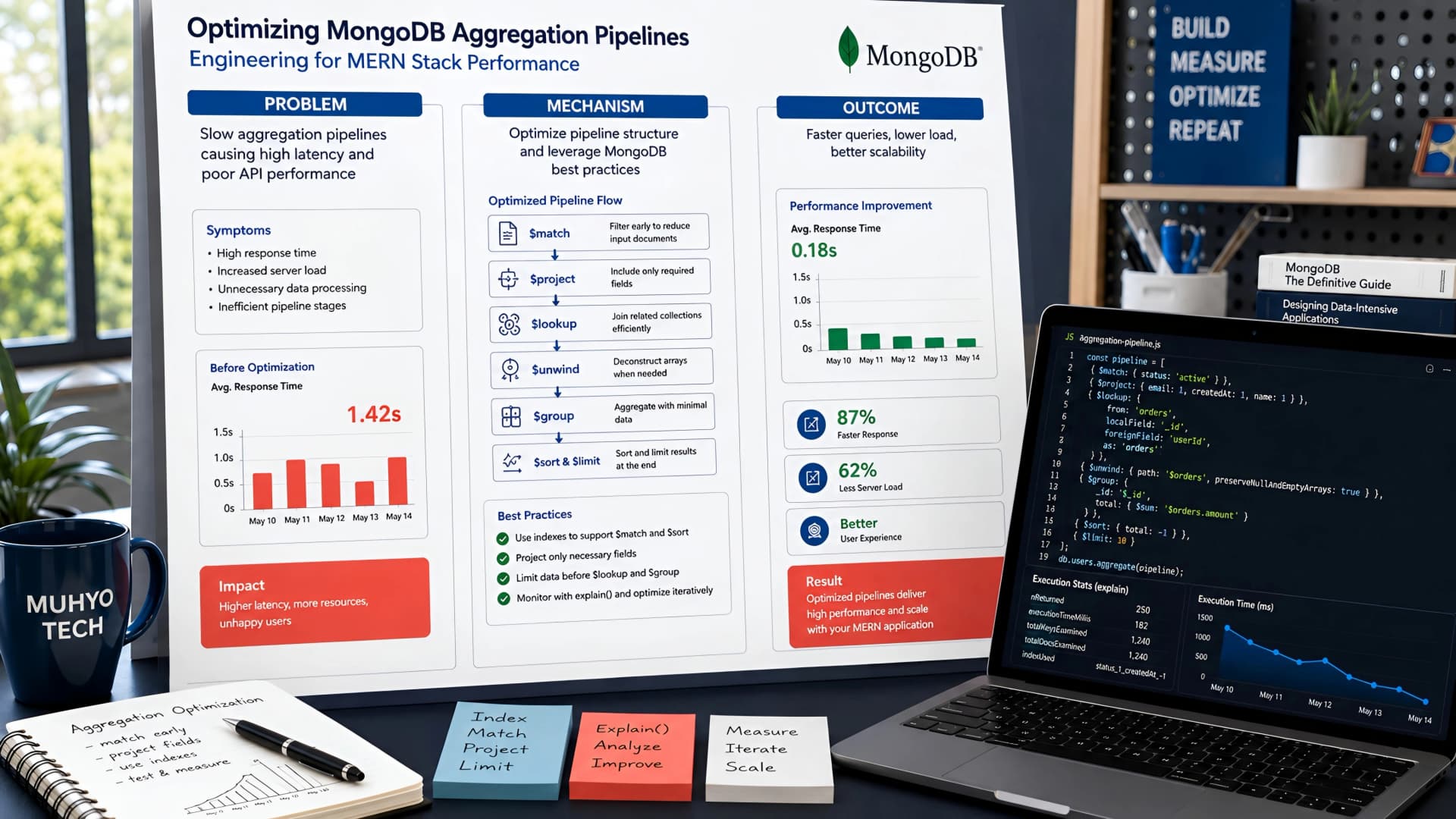
Complex data processing often relies on MongoDB's powerful aggregation pipelines. However, without careful planning, these pipelines can become significant bottlenecks, especially in MERN stack applications demanding real-time analytics or robust reporting.
The pain of a slow aggregation is immediate: dashboards lag, reports time out, and user experience suffers. Our focus at Muhyo Tech often turns to optimizing these critical data paths to ensure applications remain responsive and scalable.
The Root of Aggregation Performance Issues
Many performance problems stem from how MongoDB processes data through an aggregation pipeline. Each stage can involve scanning large datasets, creating temporary collections, or performing expensive computations.
Unoptimized pipelines often read far more data than necessary, perform operations that prevent index usage, or exceed memory limits, leading to spill-to-disk operations that drastically slow things down.
Strategic Stage Ordering: The Early Filter Principle
One of the most impactful optimizations is the strategic ordering of aggregation stages. The fundamental principle is to reduce the dataset as early as possible.
Moving $match and $project stages to the beginning of the pipeline significantly limits the amount of data that subsequent, more resource-intensive stages need to process. For example, filtering documents with $match before grouping them with $group is almost always more efficient.
Leveraging Indexes within Aggregations
Indexes are not just for simple find() queries; they are crucial for accelerating many aggregation stages. Specifically, $match, $sort, and sometimes $group stages can benefit immensely from well-placed indexes.
When designing an aggregation, we analyze which fields are frequently filtered or sorted. Creating compound indexes that cover these fields, in the order they appear in the query, allows MongoDB to use the index to quickly locate relevant documents or pre-sort data.
Understanding and Managing Memory Limits
MongoDB aggregation pipelines have a default memory limit of 100MB per stage. If a stage exceeds this limit, MongoDB attempts to write temporary data to disk, which is a significant performance hit.
For operations like $group, $sort, and $setWindowFields that process large amounts of data, setting allowDiskUse: true in the aggregation options is necessary. While it prevents errors, it's a signal that the pipeline might be inefficient and needs further optimization, ideally by reducing the dataset size earlier.
Projection and Field Exclusion for Efficiency
The $project stage is powerful but can be misused. Early projections that exclude unnecessary fields reduce the amount of data transferred between stages and held in memory.
However, be cautious: projecting fields too early might prevent later stages from accessing data they need. It's a balance of trimming fat while retaining essential information for subsequent computations.
The $lookup Stage: Performance Implications
While $lookup enables powerful joins, it's also a common source of performance issues. It effectively performs an unindexed scan on the 'foreign' collection if not supported by an index on the foreign field.
Always ensure the localField in the originating collection and the foreignField in the joined collection are indexed. For very large lookups, consider if a different data model or pre-aggregation might be more suitable, as discussed in our foundational guide, Advanced MongoDB Performance Tuning: An Engineering Guide for High-Scale MERN Applications.
Monitoring and Profiling for Continuous Improvement
Optimization is an ongoing process. MongoDB's .explain() method is invaluable for understanding how a pipeline executes, showing index usage, scan types, and memory consumption.
Monitoring tools can track slow queries, helping identify aggregation pipelines that need attention. Regular profiling allows us to catch performance regressions early and adapt our engineering approach to evolving data patterns and application needs.
Trade-offs and Real-world Considerations
Every optimization comes with trade-offs. Adding more indexes can speed up reads but slow down writes and consume more disk space. Extremely complex pipelines, even optimized, might indicate a need to reconsider the data model or offload some processing to a dedicated analytics service.
At Muhyo Tech, we balance immediate performance gains with long-term maintainability and scalability. Our goal is not just to make it fast, but to make it fast and sustainable for the application's lifecycle, ensuring robust performance for MERN stack applications, from basic CRUD to complex reporting systems.
Conclusion
Optimizing MongoDB aggregation pipelines is a critical skill for any MERN stack developer. By focusing on early filtering, effective indexing, memory management, and careful stage design, we can transform sluggish data operations into responsive, reliable features.
These engineering practices are essential for delivering the faster launches, stronger reliability, and better user experiences that modern web applications demand.