


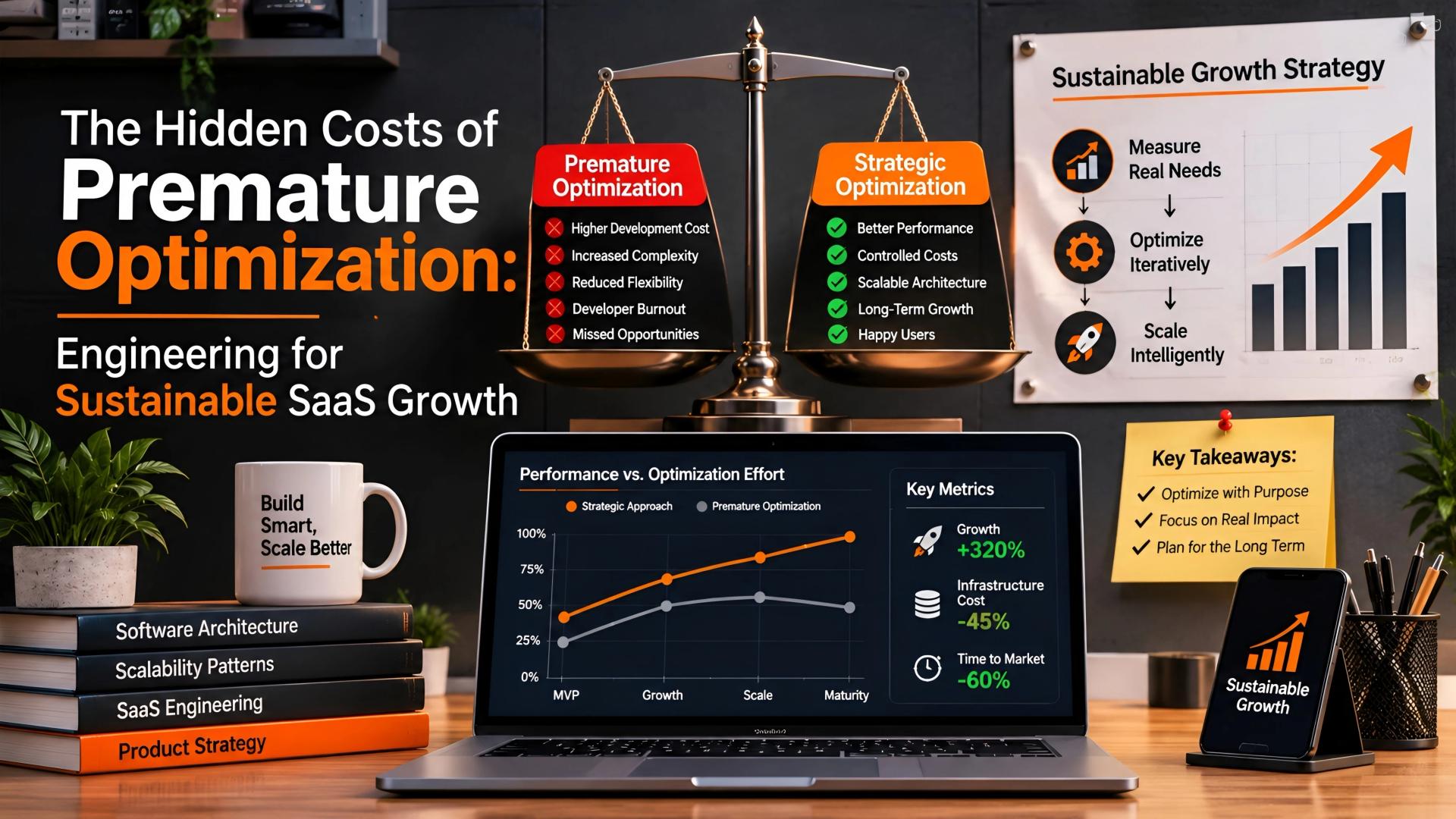
It's a common story in the SaaS world: a founder, driven by ambition and a vision of massive scale, pushes for optimizations far ahead of their product's actual needs. We've all seen or been part of projects where engineering teams spend weeks refactoring a database query that handles 10 users, anticipating millions.
This isn't just a misallocation of resources; it's a hidden cost, a form of technical debt that can strangle growth, slow down feature development, and ultimately undermine the very sustainability it aims to achieve. Understanding when and how to optimize is critical for any SaaS product.
The Temptation of "What If?"
The allure of premature optimization is strong, especially for engineers who naturally strive for efficiency and elegance. We imagine worst-case scenarios and design for them, sometimes before the best-case scenario has even materialized.
This mindset, while well-intentioned, often overlooks the immediate, pressing needs of a nascent or growing SaaS product: user validation, feature delivery, and market fit. Focusing on hypotheticals diverts attention and effort from what truly drives early success.
Why Premature Optimization Feels Right (But Isn't)
Founders and product managers often push for early optimization out of fear: fear of failure under load, fear of being caught unprepared, or fear of negative user experiences. They want a robust product from day one.
However, this often leads to building complex, over-engineered solutions for problems that might never arise, or at least not in the way initially envisioned. The complexity itself introduces new risks and maintenance burdens.
Defining Premature Optimization in SaaS
Premature optimization, as famously coined by Donald Knuth, is "the root of all evil (or at least most of it) in programming." In the SaaS context, it refers to spending significant engineering effort to improve aspects of a system that are not yet bottlenecks, or for which the performance requirements are still undefined.
It’s about optimizing for hypothetical scale or perceived future needs, rather than responding to validated performance issues or clear business demands. This often means adding layers of abstraction, choosing complex infrastructure, or writing highly optimized code for non-critical paths.
Symptoms of Premature Optimization
Over-engineered Architecture: Building microservices for a monolithic application that serves hundreds of users.
Unused Performance Features: Implementing complex caching layers or advanced database sharding when the primary database is barely stressed.
Delayed Feature Launches: Spending weeks on optimizing a part of the system before the core functionality is even shipped.
Increased Complexity: A codebase that's harder to understand, test, and maintain due to unnecessary optimizations.
The Real Costs: More Than Just Time
The impact of premature optimization extends far beyond the immediate engineering hours spent. It creates a ripple effect throughout the entire product lifecycle, impacting development velocity, operational costs, and even team morale.
At Muhyo Tech, we’ve learned that these hidden costs can significantly hinder a SaaS product’s ability to adapt and grow. Our approach emphasizes building a solid foundation first, then optimizing based on real data and user feedback.
Increased Technical Debt
Complex, unnecessary optimizations often introduce a higher degree of technical debt. Future developers inheriting the codebase might struggle to understand the rationale behind certain decisions, leading to slower bug fixes and feature development.
This debt accrues, making the system less flexible and more resistant to change. Every modification becomes a puzzle to solve, rather than a straightforward addition.
Slower Time-to-Market
Every hour spent on an unnecessary optimization is an hour not spent on building essential features or validating the core product. This directly impacts time-to-market, delaying the point at which your SaaS can start generating revenue and gathering real user feedback.
In a competitive market, speed to market can be the ultimate differentiator. Delaying a launch for an unvalidated optimization is a gamble few startups can afford.
Higher Operational Overhead and Maintenance Risk
More complex systems require more complex infrastructure, monitoring, and maintenance. Even if an optimization is technically sound, if it's not needed, it adds to your cloud bill, increases monitoring alerts, and requires more specialized knowledge to manage.
This elevates the risk of outages and makes debugging harder when actual problems arise. Simplicity, especially early on, is often the most robust path.
A Strategic Framework for Optimization in SaaS
Instead of optimizing preemptively, we advocate for a strategic, data-driven approach. This framework helps teams distinguish between foundational performance needs and premature scaling, ensuring resources are always aligned with business value.
It's about building intelligently from the start, identifying bottlenecks through measurement, and then applying targeted optimizations. This ensures every engineering effort delivers maximum impact.
1. Build for Correctness and Clarity First
Prioritize functional correctness and code clarity above all else in the initial stages. A system that works reliably and is easy to understand is far more valuable than one that is fast but buggy or opaque.
Focus on clean architecture, well-defined APIs, and comprehensive testing. These are foundational elements that prevent future headaches, regardless of scale.
2. Establish Baseline Performance Metrics
Before any optimization, you need to know what you're optimizing for. Establish clear, measurable performance benchmarks relevant to your user experience and business goals. This could include page load times, API response times, or database query durations.
Tools for monitoring and logging are crucial here. Without data, any optimization is just a guess. We integrate robust monitoring into our web app development from day one.
3. Identify and Validate Bottlenecks with Data
Only optimize once a specific bottleneck has been identified through real user data or load testing. Use profiling tools, application performance monitoring (APM) systems, and user analytics to pinpoint where the system is actually struggling.
Don't assume; measure. A perceived slowdown might be an edge case, or a problem in a completely different part of the stack than you initially thought.
4. Iterate and Measure the Impact
When you do optimize, do it iteratively. Implement a change, deploy it, and then measure its impact against your baseline metrics. Did it actually improve performance? Did it introduce new issues?
This feedback loop is crucial for ensuring that optimizations are effective and don't introduce unintended side effects. Sometimes, a simple index can be more impactful than a complex caching layer.
5. Consider Tradeoffs: Complexity vs. Performance vs. Cost
Every optimization comes with tradeoffs. Increasing performance often means increasing complexity, development time, or infrastructure costs. Always evaluate these against the tangible business value gained.
Is a 50ms improvement in an API call worth an extra week of engineering time and a more expensive database setup? The answer depends entirely on your product's specific needs and user expectations.
When *Is* the Right Time to Optimize?
Optimization is not inherently bad; it's about timing and strategic intent. The right time to optimize is when:
User Experience is Directly Impacted: Slow performance is causing user churn or preventing adoption.
Operational Costs Become Excessive: Your infrastructure bill is disproportionately high for your user base, indicating inefficiency.
Scalability Becomes a Proven Constraint: You are actively hitting limits with current user loads, and this is preventing growth.
A Critical Business Process is Hindered: A core function of your SaaS is unacceptably slow, impacting revenue or key workflows.
It’s about responding to actual problems, not anticipating them with over-engineering. Your users will tell you where the real pain points are.
Comparison: Premature vs. Strategic Optimization
| Feature | Premature Optimization | Strategic Optimization |
|---|---|---|
| Trigger | Anticipated future needs, fear, intuition | Validated bottlenecks, real user data, business metrics |
| Timing | Early in development, before validation | After product-market fit, during growth phases |
| Focus | Theoretical maximum efficiency, edge cases | User experience, cost efficiency, business impact |
| Outcome | Technical debt, delayed features, wasted resources | Improved UX, cost savings, sustainable scalability |
| Risk | High complexity, maintenance burden | Lower risk, targeted improvements |
Actionable Advice for SaaS Founders and Product Teams
As founders and product leaders, your role is to guide your engineering team towards decisions that support sustainable growth, not just hypothetical peak performance. Here’s how to foster a culture of strategic optimization:
Prioritize User Feedback: Let user complaints about speed or responsiveness be your guide for where to investigate.
Define Clear Metrics: Work with engineering to define key performance indicators (KPIs) that directly tie to user experience and business outcomes.
Embrace Iteration: Encourage a mindset of continuous improvement, where optimizations are small, measurable changes, not massive overhauls.
Challenge Assumptions: Ask "why now?" when an optimization is proposed. Is this a proven bottleneck, or a theoretical one?
Invest in Monitoring: Implement robust application performance monitoring (APM) and logging from the outset. You can't optimize what you don't measure.
Our work in full-stack web app development always includes setting up these monitoring foundations. It allows us to build with agility and optimize with precision when the time is right.
Building for Long-Term Adaptability, Not Just Speed
The goal of a successful SaaS product isn't merely speed; it's adaptability, maintainability, and sustainable growth. A codebase that is clean, modular, and easy to change will allow you to pivot, add features, and respond to market demands far more effectively than an over-optimized, rigid system.
Premature optimization stifles this adaptability. By focusing on validated needs and iterative improvements, you build a product that can truly scale with your business, not just a system that looks good on paper.
Frequently Asked Questions (FAQs)
How does premature optimization impact time-to-market for SaaS products?
Premature optimization significantly delays time-to-market because engineering resources are spent on non-critical performance improvements rather than core features. This means the product takes longer to launch, delaying revenue generation and user feedback.
What are the common pitfalls of premature optimization in a SaaS engineering context?
Common pitfalls include increased technical debt due to over-engineered solutions, higher operational costs for unnecessary complex infrastructure, slower development cycles, and a more rigid codebase that is difficult to maintain or adapt to changing requirements.
When is the right time to optimize performance in a SaaS application?
The right time to optimize is when performance issues are validated by real user data, directly impacting user experience or business metrics. This typically happens after initial product-market fit, when specific bottlenecks are identified through monitoring and user feedback.
How can SaaS teams balance agility with performance considerations?
SaaS teams can balance agility and performance by prioritizing correctness and clarity first, establishing baseline performance metrics, and only optimizing when bottlenecks are proven by data. This allows for rapid iteration on features while addressing performance issues strategically as they arise.