


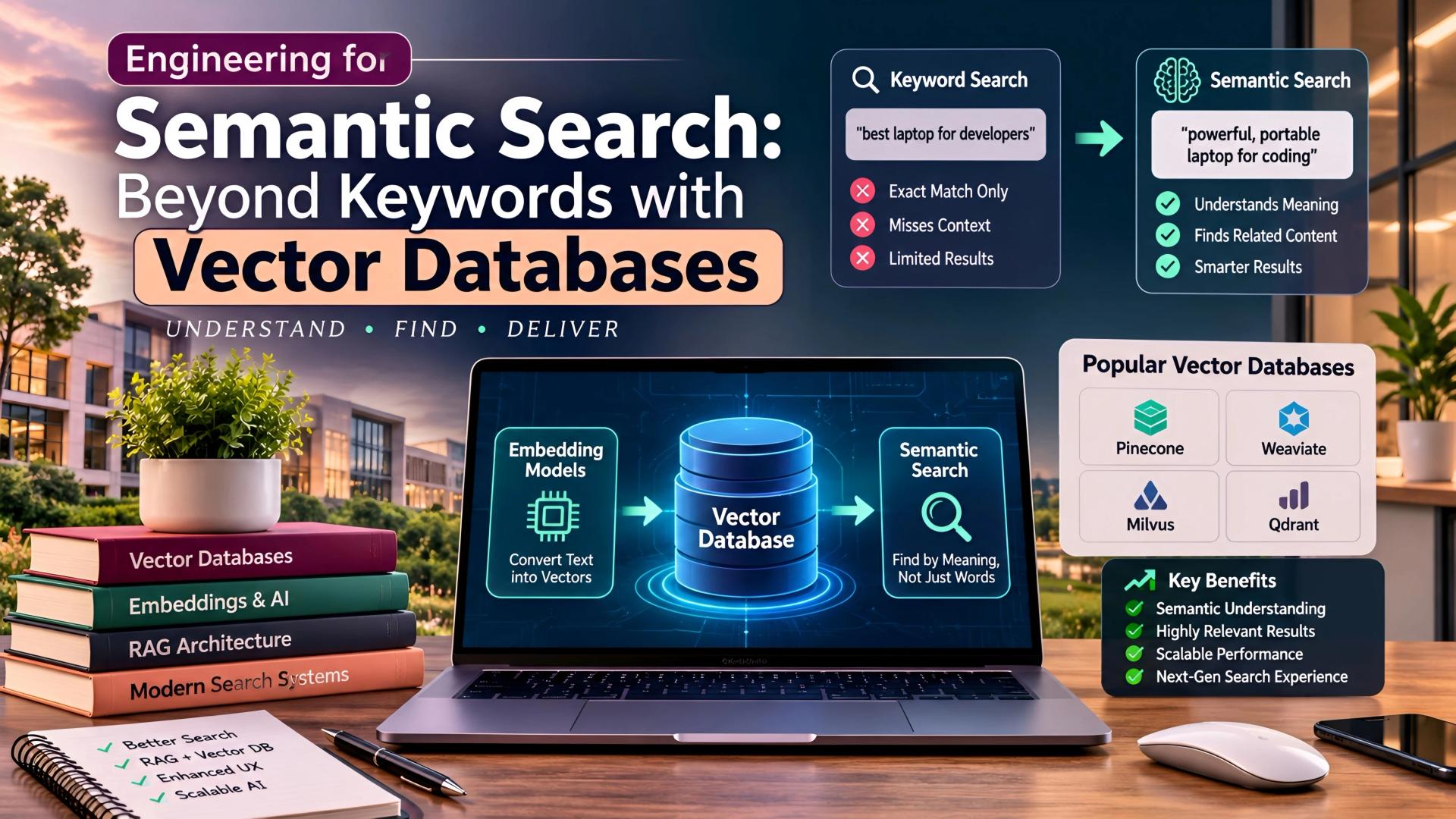
The Frustration of Keyword Search: Why Context Matters
We've all been there: typing a perfectly reasonable query into a website's search bar, only to be met with a stream of irrelevant results. Traditional keyword-based search often fails because it's literal. It matches words, not meaning.
This disconnect between user intent and search outcome leads to frustration, lost engagement, and ultimately, missed opportunities for businesses. Users give up quickly if they can't find what they need.
What is Semantic Search and Why Web Apps Need It
Semantic search moves beyond simple keyword matching. It understands the contextual meaning behind a user's query, even if the exact words aren't present in the content.
For web applications, this means delivering highly relevant results that anticipate user needs. Imagine an e-commerce site where searching 'warm winter coat' returns actual coats, not just pages mentioning 'warm' or 'winter' separately, or a documentation site that understands 'how to connect to the database' means a specific configuration guide.
The Core: Embeddings and Vector Databases
Understanding Embeddings: The Language of AI
The magic behind semantic search lies in embeddings. These are numerical representations (vectors) of text, images, or other data, capturing their semantic meaning and relationships.
When we generate an embedding for a piece of text, similar concepts or words will have vectors that are numerically 'close' to each other in a multi-dimensional space. This allows us to compare meaning rather than just exact word matches.
Vector Databases: The Engine for Semantic Retrieval
Once we have these embeddings, we need a way to store and efficiently query them. This is where vector databases come in.
Unlike traditional databases optimized for structured data or full-text search, vector databases are purpose-built for storing high-dimensional vectors and performing fast similarity searches, often using Approximate Nearest Neighbor (ANN) algorithms.
Architecting Semantic Search in Your Web Application
Building semantic search requires a multi-component architecture, integrating several key services. This isn't just about plugging in a database; it's about a complete data pipeline.
At Muhyo Tech, our approach focuses on robust, scalable pipelines that handle data ingestion, embedding generation, storage, and retrieval efficiently, ensuring high performance and accuracy.
The Semantic Search Architecture Flow:
- Data Ingestion: Your application's content (articles, product descriptions, user reviews) is fed into the pipeline.
- Embedding Generation: A pre-trained language model (e.g., from OpenAI, Hugging Face, or a self-hosted model) converts this content into dense vector embeddings.
- Vector Database Storage: These embeddings, along with a reference to the original content, are stored in a vector database.
- User Query: A user enters a query into your web application's search bar.
- Query Embedding: The user's query is also converted into a vector embedding using the *same* language model.
- Similarity Search: The query embedding is sent to the vector database, which finds the 'nearest' content embeddings.
- Result Retrieval & Display: The application retrieves the original content corresponding to the most similar embeddings and presents them to the user.
Choosing Your Vector Database: A Comparison
The vector database landscape is evolving rapidly. Each option has its strengths, ideal use cases, and operational considerations.
When making a choice, we consider factors like scalability, ease of integration, managed service offerings, open-source flexibility, and cost implications for the project's long-term health.
| Feature | Pinecone | Weaviate | Milvus | Qdrant |
|---|---|---|---|---|
| Type | Managed Service | Managed/Self-hosted | Self-hosted/Managed | Self-hosted/Managed |
| Scalability | Excellent (Cloud-native) | Good | Excellent (Cloud-native) | Good |
| Indexing Algo | Custom (ANN) | HNSW | HNSW, IVF_FLAT | HNSW |
| Query Language | API (REST/gRPC) | GraphQL/REST | Python/Go/Java SDK | REST/gRPC |
| Hybrid Search | Yes (sparse-dense) | Yes (BM25, RAG) | Yes | Yes |
| Open Source | No | Yes | Yes | Yes |
| Use Case | Large-scale, production | Semantic search, RAG | Massive scale, ML | Real-time, filtering |
Implementing Semantic Search: A Practical Checklist
Successfully integrating semantic search requires careful planning and execution. This checklist guides our development process for robust systems.
- Content Preprocessing Strategy: Define how raw content will be cleaned, chunked, and prepared for embedding.
- Embedding Model Selection: Choose a suitable pre-trained model (e.g., Sentence-BERT, OpenAI's `text-embedding-ada-002`) that aligns with your content domain and performance needs.
- Vector Database Setup: Provision and configure your chosen vector database, including index creation and schema definition.
- Data Ingestion Pipeline: Build a robust system to extract, embed, and upsert content into the vector database. Consider batching and error handling.
- Query Embedding Service: Create an API endpoint or function to convert user queries into embeddings using the *same* model as content.
- Search & Ranking Logic: Implement similarity search and refine ranking by potentially combining semantic results with traditional keyword scores or other metadata filters.
- Fallback Mechanism: Design a fallback to traditional keyword search or a simplified result set if semantic search fails or yields poor results.
- Observability & Monitoring: Set up logging, metrics, and alerting for embedding generation, database performance, and search result quality.
- Security & Access Control: Ensure proper authentication and authorization for accessing both the embedding model and the vector database.
- Cost Management: Monitor API calls for embedding models and vector database usage to manage operational expenses.
- User Experience (UX) Integration: Design the UI to clearly present semantic results, potentially with contextual snippets or refinement options.
- Regular Model Updates: Plan for updating embedding models or retraining when new data or better models become available.
Common Pitfalls and Tradeoffs
While powerful, semantic search isn't a silver bullet. We've learned to navigate several common challenges:
- Embedding Model Drift: The meaning represented by an embedding model can change over time or with different data. Regular evaluation and potential retraining are crucial.
- Computational Cost: Generating embeddings and running similarity searches can be resource-intensive, especially at scale. Optimizing chunking and batching is key.
- Data Freshness: Ensuring new content is quickly embedded and indexed requires a well-designed, often event-driven, ingestion pipeline.
- Cold Start Problem: For new content, the semantic model might not fully understand it until it has enough context. Hybrid approaches can mitigate this.
- Vendor Lock-in: Relying heavily on a specific managed vector database or embedding API can create dependencies. Consider abstraction layers.
The tradeoff often lies between search relevance, operational complexity, and infrastructure cost. A perfectly semantic search might be too slow or expensive for every query, necessitating intelligent caching or hybrid strategies.
Business Value: What Semantic Search Delivers
Implementing semantic search directly impacts key business metrics by enhancing the user experience and operational efficiency.
Improved search relevance means users find information faster, leading to higher conversion rates, longer session durations, and reduced support queries. It makes content truly discoverable.
For content-heavy platforms, this translates to increased engagement and better utilization of your existing assets. It unlocks the potential for personalized recommendations and advanced AI features down the line, setting a strong foundation for future growth.
Frequently Asked Questions (FAQs)
How does semantic search improve SEO?
While semantic search primarily impacts on-site user experience, a better user experience (lower bounce rate, higher engagement) can indirectly signal quality to search engines. Moreover, understanding user intent better allows you to create more relevant content, which aids external SEO efforts.
Is semantic search only for large companies?
Not anymore. With managed vector database services and accessible embedding APIs, small to medium-sized businesses can now integrate powerful semantic search capabilities without massive infrastructure investments. It's about smart engineering, not just scale.
What's the difference between semantic search and RAG (Retrieval Augmented Generation)?
Semantic search focuses on finding relevant documents or snippets based on meaning. RAG builds upon this by taking those retrieved documents and feeding them to a large language model (LLM) to generate a coherent, contextual answer. Semantic search is a foundational component of most RAG systems.
Can I combine keyword search with semantic search?
Absolutely. This is often the recommended approach. A hybrid search strategy can combine the precision of keyword matching with the recall of semantic understanding, allowing you to fine-tune results and provide a more robust user experience. Many vector databases offer built-in hybrid search capabilities.
Conclusion: Building Smarter Search for the Modern Web
The era of simple keyword matching is fading. Users expect intelligent, context-aware experiences from web applications. Semantic search, powered by vector databases, delivers exactly that.
By investing in a well-engineered semantic search solution, you're not just upgrading a feature; you're fundamentally improving user satisfaction, content discoverability, and the overall value proposition of your web application. It’s a core component of future-proofing your digital presence.