


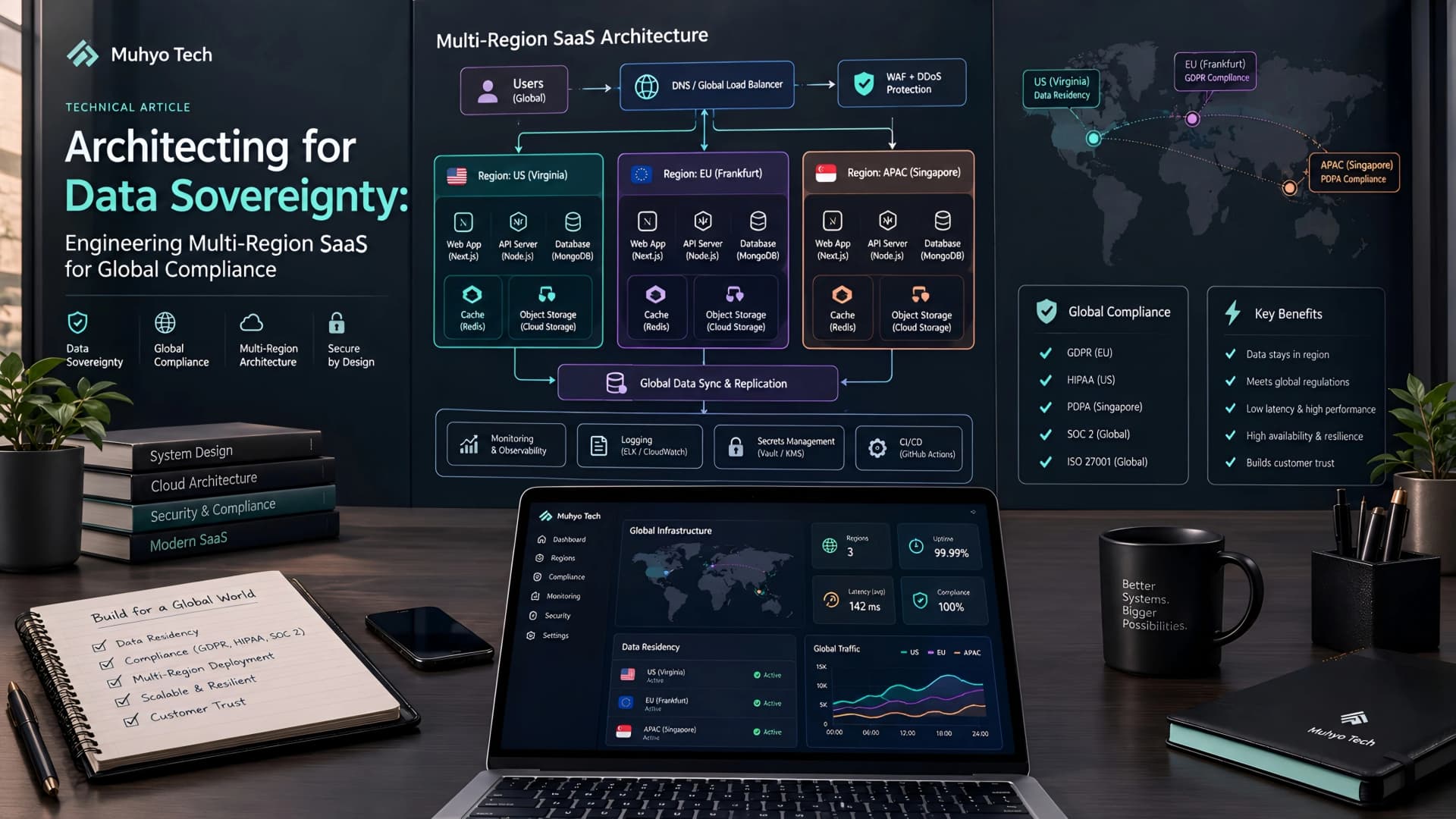
Expanding a SaaS product globally isn't just about translating UI strings or setting up CDNs. It quickly becomes an exercise in navigating a labyrinth of international data regulations. The moment user data crosses borders, a new layer of complexity emerges: data sovereignty.
Ignoring these regulations — think GDPR in Europe, Schrems II implications, or local data residency laws in Canada, Australia, or India — isn't an option. The risks include hefty fines, operational disruption, and a catastrophic loss of customer trust. For founders and CTOs, this isn't just a legal challenge; it's a fundamental engineering problem requiring a strategic architectural response.
The Core Problem: Data Residency vs. Data Sovereignty
Before diving into solutions, it's crucial to distinguish between two often-confused terms. Data residency dictates the physical location where data must be stored, usually within specific geographic boundaries like a country or economic bloc.
Data sovereignty, on the other hand, refers to the legal frameworks and jurisdiction governing that data. This means that even if data is physically stored in Country A, if the originating user or business is in Country B, the laws of Country B (or even Country C, if data is processed there) might still apply.
This dual challenge requires a nuanced approach, blending physical infrastructure choices with robust legal and technical controls. We look for solutions that address both the 'where' and the 'whose laws apply' aspects comprehensively.
Designing for Data Segmentation: The Foundation of Compliance
The first step in any multi-region SaaS architecture for data sovereignty is meticulous data segmentation. You cannot treat all data equally. Customer data, operational data, and analytics data often have different sensitivity levels and residency requirements.
Our approach at Muhyo Tech involves categorizing data early in the design phase. This typically means identifying which data elements are personally identifiable (PII), which are sensitive business data, and which can be more freely replicated.
This segmentation informs everything from database schema design to network topology and access controls. It's the bedrock upon which all subsequent compliance efforts are built.
Architectural Patterns for Multi-Region Data Residency
Achieving data residency for global SaaS applications involves choosing the right architectural pattern. Each comes with its own set of tradeoffs in terms of complexity, cost, and operational overhead.
1. Single-Tenant Isolation (Per-Region Deployment)
This pattern involves deploying entirely separate instances of your SaaS application and its database for each region or customer segment requiring strict data residency. Each instance operates independently, ensuring data never leaves its designated geographic boundary.
Pros: Maximum data sovereignty and residency. Simplest compliance audit trail for individual regions. Minimal cross-border data transfer concerns.Cons: Highest infrastructure cost and operational complexity. Requires significant automation for deployment and maintenance. Potentially inconsistent feature rollouts across regions if not managed carefully.
2. Region-Specific Sharding (Multi-Tenant, Zonal/Regional)
In a multi-tenant environment, sharding by region allows you to keep customer data within specific geographic boundaries while sharing a common application codebase. Each shard (database or database cluster) is physically located in the required region.
Pros: Good balance of compliance and shared infrastructure efficiency. Lower operational cost than full single-tenant isolation.Cons: Requires careful data routing logic. Data model must support sharding. Potential for performance bottlenecks if not architected correctly. Managing cross-region analytics can be complex.
3. Hybrid Approach with Data Locality for Sensitive Information
This pattern involves storing sensitive customer data (e.g., PII) in localized regional databases, while less sensitive or aggregated data can be replicated or stored centrally. This often involves a 'data locality service' that routes requests based on the user's origin or data residency requirements.
Pros: Optimized cost by centralizing non-sensitive data. Better performance for global analytics on aggregated data.Cons: Most complex to implement and maintain. Requires robust data classification and routing mechanisms. Risk of accidental data leakage if routing logic is flawed.
We often find that the optimal solution involves a pragmatic hybrid, carefully balancing strict residency needs with the efficiencies of shared services. This means thoughtful design around full-stack web app development that considers data flow from the outset.
Database Design and Data Storage Considerations
The choice of database and its configuration are paramount. Relational databases like PostgreSQL or MySQL, when properly sharded and deployed in regional instances, offer strong ACID properties suitable for sensitive data.
NoSQL databases like MongoDB or Cassandra can also be configured for multi-region deployments with replication and sharding. However, their eventual consistency models require careful consideration for data integrity across regions, especially for highly regulated data.
Regardless of the database type, encryption at rest and in transit is non-negotiable. Using region-specific encryption keys managed by local key management services adds another layer of security and compliance.
Implementing Robust Data Routing and Access Controls
Once data is segmented and physically located, the next challenge is ensuring that application logic and user requests are routed correctly. This typically involves a combination of:
- Geographic DNS: Directing users to the nearest application instance.
- Application-level routing: Based on user metadata or client configuration, ensuring data requests hit the correct regional database.
- API Gateway: Centralizing routing and access control, potentially with region-specific policies.
Access control must also be granular and region-aware. Only authorized personnel or services should be able to access data in specific regions, and auditing capabilities need to track every data access event.
Operational Workflow and Maintainability
A multi-region architecture significantly increases operational complexity. Deployment pipelines must be capable of deploying to multiple, potentially isolated, environments. Monitoring and logging need to be aggregated but also region-specific for compliance audits.
Automation is not just a nice-to-have; it's essential for managing these complex environments. Infrastructure as Code (IaC) tools like Terraform or Pulumi become critical for ensuring consistency and repeatability across regions. This focus on automation is central to how Muhyo Tech approaches API integration and system architecture.
The Tradeoffs: Cost, Performance, and Complexity
While data sovereignty is non-negotiable for global expansion, it comes with significant tradeoffs:
- Increased Infrastructure Costs: Running multiple redundant deployments across different regions is inherently more expensive than a single centralized deployment.
- Higher Operational Complexity: Managing, monitoring, and updating multiple environments requires more sophisticated tools and a larger, more skilled operations team.
- Potential Performance Implications: While data locality generally improves performance for regional users, cross-region data transfers for analytics or centralized services can introduce latency.
- Development Overhead: Engineering teams must design applications with data residency in mind from day one, affecting everything from data models to API design.
These tradeoffs are precisely why careful planning and a phased rollout are crucial. Start with the most critical regions and expand incrementally, learning and refining the architecture with each step.
Legal and Technical Frameworks for Cross-Border Transfers
Even with localized storage, some cross-border data transfers are often unavoidable for administrative, analytical, or support purposes. Here, legal frameworks become critical.
Standard Contractual Clauses (SCCs) are a common mechanism for legitimizing data transfers outside the EU. For US companies, understanding the nuances of the EU-US Data Privacy Framework is vital. Technically, robust encryption, anonymization, or pseudonymization can mitigate risks during transfer, but these are technical controls that must align with legal requirements.
A Production-Ready Architectural Checklist
When architecting for data sovereignty, consider this checklist:
- Data Classification: Have all data elements been classified by sensitivity and residency requirements?
- Regional Deployment Strategy: Is the chosen architectural pattern (single-tenant, sharded, hybrid) appropriate for each region's compliance needs?
- Database Design: Are databases configured for regional isolation and proper encryption at rest and in transit?
- Data Routing Logic: Is there robust application-level and infrastructure-level routing to ensure data stays within its region?
- Access Controls: Are granular, region-aware access controls implemented and audited?
- Encryption Key Management: Are encryption keys managed securely and regionally where required?
- Automated Deployment & Monitoring: Are IaC and CI/CD pipelines configured for multi-region deployments? Is monitoring region-aware?
- Backup & Disaster Recovery: Are regional backup and DR strategies compliant with local laws?
- Audit Trails: Can all data access and processing activities be audited for compliance?
- Legal Counsel Alignment: Has legal counsel reviewed the architecture and data flows for compliance with specific regulations (GDPR, CCPA, etc.)?
Muhyo Tech's Approach to Global SaaS Challenges
At Muhyo Tech, we emphasize a 'compliance-by-design' philosophy. This means data sovereignty isn't an afterthought; it's integrated into the very first architectural discussions. We work closely with product teams to understand their global expansion goals, then translate those into a resilient, compliant engineering blueprint.
Our focus on scalable systems and robust database integration ensures that the chosen architecture can evolve. We prioritize automation to manage the complexity, allowing our clients to focus on their core product without constant operational headaches related to compliance.
Frequently Asked Questions
How do you design a multi-tenant SaaS architecture for data sovereignty?
Designing a multi-tenant SaaS for data sovereignty typically involves region-specific sharding. This means creating separate database instances or clusters in each required geographic region. Customer data is then routed and stored exclusively in the shard corresponding to their residency requirements, ensuring legal compliance while sharing a common application layer.
What are the key technical challenges in implementing data sovereignty for global SaaS applications?
Key technical challenges include managing increased infrastructure costs for multiple regional deployments, developing complex data routing logic, ensuring consistent feature delivery across disparate environments, and handling cross-region analytics without violating data residency. Operational overhead for deployment, monitoring, and maintenance also significantly increases.
Which architectural patterns support data residency and localization in SaaS?
The primary architectural patterns are single-tenant isolation (full regional deployment per customer/region), region-specific sharding (multi-tenant with regional databases), and hybrid models that localize only sensitive data while centralizing less critical information. Each offers different levels of compliance, cost, and complexity tradeoffs.
Conclusion
Architecting a multi-region SaaS for data sovereignty is a complex, but essential, undertaking for any company aiming for global reach. It demands a holistic view that integrates legal requirements, engineering prowess, and operational discipline.
By adopting a compliance-by-design mindset and carefully selecting architectural patterns, companies can build platforms that not only scale globally but also instill confidence through unwavering adherence to data protection laws. It's about turning a compliance challenge into a strategic competitive advantage.