


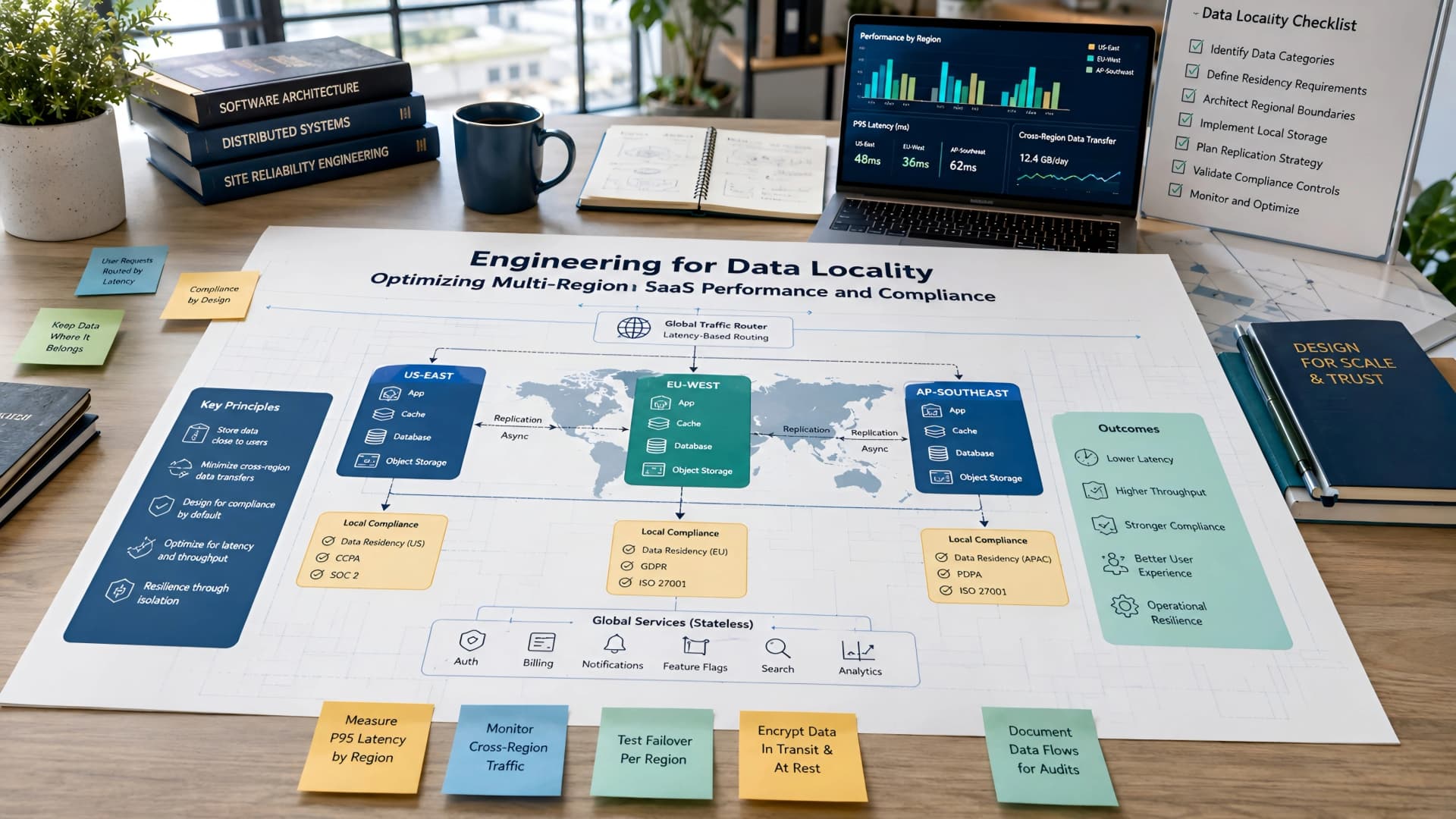
Operating a SaaS product globally means navigating a complex web of user expectations and legal mandates. Users expect fast, responsive applications, regardless of where they are. Simultaneously, regulations like GDPR, CCPA, and others demand that personal data be handled according to strict residency and privacy rules.
This tension between global reach and local compliance is a core challenge in modern SaaS development. A common point of failure is a centralized data architecture, which often compromises both performance for distant users and adherence to data residency laws.
The Core Problem: Centralization vs. Distribution
Imagine a user in Sydney trying to access data stored in a single US-based data center. The latency alone can make the application feel sluggish, leading to frustration and potential churn. Even worse, storing that user's personal data in the US might violate data protection laws specific to Australia or the EU, creating significant legal and financial risks.
The fundamental problem is that a one-size-fits-all, single-region data strategy simply doesn't scale for a global user base or a globally-aware regulatory landscape. We must engineer solutions that bring data closer to users while respecting legal boundaries.
Understanding Data Locality
Data locality, in the context of SaaS, refers to the practice of storing and processing data in specific geographic regions, often close to where the end-users are located or where specific compliance requirements dictate. This is crucial for several reasons.
Firstly, it dramatically improves application performance by reducing network latency. Data travels shorter distances, leading to quicker load times and a more responsive user experience. Secondly, and perhaps more critically, it’s a cornerstone of meeting data residency requirements mandated by various privacy laws.
Key Architectural Patterns for Data Locality
Achieving effective data locality requires careful architectural design. There isn't a single silver bullet; instead, we often combine several patterns. Our approach at Muhyo Tech focuses on selecting the right mix based on specific product needs, user distribution, and compliance obligations.
We look for patterns that balance performance gains with operational complexity and cost. The goal is a system that is both performant and maintainable over the long term.
1. Geo-Replication
Geo-replication involves maintaining copies of your data across multiple geographic regions. This can be done synchronously or asynchronously.
Synchronous Replication: Writes are confirmed only after they have been written to multiple regions. This offers strong data consistency but can introduce significant latency for writes, impacting user experience. It's often too slow for a highly interactive SaaS product.
Asynchronous Replication: Writes are confirmed once written to the primary region, and then propagated to other regions in the background. This offers much better write performance but introduces a potential for data drift or eventual consistency issues. The application must be designed to handle potentially stale data for short periods.
We often use asynchronous replication for read-heavy workloads where slight delays in data availability across regions are acceptable. It’s a good balance for many global applications.
2. Database Sharding (Horizontal Partitioning)
Sharding involves splitting a large database into smaller, more manageable pieces called shards. These shards can then be distributed geographically.
For example, you might shard customer data based on their geographic location. European customers' data resides on shards hosted in Europe, while North American customers' data is on shards in North America. This ensures that data for a specific region primarily stays within that region.
The complexity here lies in managing the sharding logic, cross-shard queries, and rebalancing if user distribution changes. It requires careful planning during initial design.
3. Edge Caching and Content Delivery Networks (CDNs)
While not directly about database locality, edge caching and CDNs are vital for global performance. They cache static and sometimes dynamic content at points of presence (PoPs) geographically closer to users.
For a SaaS application, this can mean caching API responses, user interface assets, or frequently accessed read-only data. When a user requests data, the closest edge server can serve it, drastically reducing latency.
This pattern complements data locality strategies by offloading read traffic and serving frequently accessed information quickly, even if the primary data source is further away.
4. Regionally Deployed Microservices
Instead of a single monolithic application, a microservices architecture allows different services to be deployed independently. This enables us to deploy specific services, or instances of services, closer to the regions they serve.
For instance, a user management service might be deployed in multiple regions. When a user from Germany logs in, their requests are handled by the German instance of the user management service, which can then access their locally-resident data.
This approach requires robust service discovery, inter-service communication strategies, and careful orchestration across regions. It adds significant operational overhead but offers granular control over performance and compliance.
Comparing Data Locality Strategies
Choosing the right strategy involves understanding the trade-offs. Here's a look at common approaches and their implications:
| Strategy | Primary Benefit | Key Challenge | Best For |
|---|---|---|---|
| Geo-Replication (Async) | Improved read performance, basic data residency | Eventual consistency, potential data drift | Global read-heavy applications, content sites |
| Geo-Replication (Sync) | Strong consistency across regions, high data residency | High write latency, complexity | Applications requiring strict transactional consistency globally (rare) |
| Database Sharding (Geo-Partitioned) | Strict data residency, distributed load | Complex query logic, rebalancing, operational overhead | Large user bases with clear geographic clusters |
| Edge Caching / CDN | Drastic latency reduction for cached content | Cache invalidation, not a solution for dynamic/personal data | Serving static assets, API responses, read-only data |
| Regionally Deployed Microservices | Granular control, optimal performance & residency per service | High complexity, orchestration, distributed systems challenges | Complex, large-scale SaaS with diverse user needs |
At Muhyo Tech, we often start with simpler patterns like asynchronous geo-replication and edge caching, as they provide significant benefits with manageable complexity. As the product and user base grow, we evaluate more sophisticated sharding or microservices strategies.
Implementation Considerations and Best Practices
Building a multi-region, data-local SaaS isn't just about picking an architecture; it's about diligent execution. Here are some practices we emphasize:
1. Data Governance and Compliance First
Before writing a single line of code, understand the specific regulations that apply to your target markets. GDPR, CCPA, LGPD, and others have nuanced requirements. Consult with legal experts to ensure your architecture meets these obligations.
This includes not just where data is stored, but also how it's accessed, processed, and secured. We design systems with data flow and access controls mapped directly to compliance needs.
2. Choose the Right Database Technology
Many modern databases offer built-in support for replication and geo-distribution. Cloud providers offer managed services that abstract away much of the underlying complexity. Evaluating these managed services (like AWS Aurora Global Database, Google Cloud Spanner, Azure Cosmos DB) is often a good starting point.
However, sometimes a custom solution using open-source databases with custom replication logic might be necessary for very specific requirements.
3. Design for Eventual Consistency
If you opt for asynchronous replication, your application *must* be built to handle eventual consistency. This means understanding that data might not be immediately identical across all regions.
For example, a user might update their profile in one region, but a read operation from another region might still show the old information for a brief period. Design UI elements and workflows to account for this, perhaps by indicating when data is being updated or by providing mechanisms for users to refresh their view.
4. Implement Robust Monitoring and Alerting
Managing distributed systems across multiple regions is complex. You need comprehensive monitoring to track replication lag, service availability in each region, and potential data inconsistencies.
Alerting is crucial. When replication fails or latency spikes, you need to be notified immediately to intervene before it impacts users or causes compliance issues.
5. Plan for Failover and Disaster Recovery
What happens if an entire region goes down? Your architecture must have a plan for failover to another region, ensuring business continuity. This often involves automated or semi-automated processes to reroute traffic and promote a replica region to primary.
Disaster recovery planning ensures that even in catastrophic scenarios, you can recover your data and operations, often from a completely different geographical zone.
Common Pitfalls to Avoid
Building for data locality is challenging, and missteps are common. We've learned to watch out for these:
- Over-Complication: Trying to implement the most complex solution upfront when simpler methods suffice. Start with what you need now and architect for future expansion.
- Ignoring Operational Costs: Running infrastructure in multiple regions can be expensive. Carefully consider the ongoing costs of data transfer, storage, and management.
- Neglecting Data Governance Early: Treating compliance as an afterthought leads to costly re-architecting and potential legal trouble. Integrate it from day one.
- Poorly Designed Data Models: A data model not designed for distribution or replication will fight any attempt to achieve locality, leading to performance bottlenecks and increased complexity.
- Assuming Network Reliability: Always design for network partitions and latency. Assume that connections between regions will sometimes be slow or unavailable.
A Practical Checklist for Data Locality
When approaching a multi-region SaaS architecture, we find this checklist helpful:
- Define Target Regions: Where are your users? Where are your regulatory obligations?
- Map Data Types: Identify sensitive data, PII, and data with strict residency rules.
- Choose Replication Strategy: Synchronous, asynchronous, or a hybrid?
- Select Database(s): Evaluate managed cloud services vs. self-hosted solutions.
- Design Sharding Strategy (if applicable): How will data be partitioned? What's the shard key?
- Plan for Consistency: How will your application handle eventual consistency?
- Integrate Edge Caching: Identify static assets and cacheable API responses.
- Deploy Services Regionally: Determine which services need local instances.
- Implement Monitoring & Alerting: Track replication lag, latency, and uptime.
- Develop Failover & DR Plans: What happens when a region fails?
- Test Thoroughly: Simulate failures, high load, and network partitions.
- Regularly Review & Optimize: User behavior and regulations change; your architecture should adapt.
Real-World Engineering at Muhyo Tech
When we tackle projects involving global reach, our engineering philosophy centers on building resilient, scalable, and compliant systems. We don't just implement features; we architect solutions.
This means rigorously evaluating the trade-offs of data replication versus sharding, designing APIs that gracefully handle distributed data, and ensuring that our deployment pipelines support regional infrastructure. Our goal is to deliver a product that performs exceptionally well for every user, everywhere, without compromising on security or legal requirements.
We believe that strong data locality isn't just a technical nicety; it's a fundamental aspect of building trust and delivering value in the global SaaS market.
Frequently Asked Questions
How do I choose between geo-replication and sharding for multi-region SaaS?
Geo-replication is generally simpler and better for read performance across regions. Sharding offers stricter data residency and can help manage very large datasets, but it's operationally more complex. The choice depends on your specific compliance needs, data volume, and performance requirements.
What is the biggest risk of not implementing data locality?
The biggest risks are severe performance degradation for non-local users, leading to poor user experience and churn, and significant non-compliance with data residency regulations, which can result in hefty fines and reputational damage.
Can I use a single global database and still achieve data locality?
Some modern distributed SQL databases (like Google Cloud Spanner) offer features that allow you to define data placement policies within a single logical database. However, for strict data residency, it's often more straightforward and compliant to use separate, regionally-aware data stores or shards.
How does data locality affect SEO?
While not a direct SEO factor, improved site speed and user experience resulting from data locality *can* indirectly benefit SEO. Search engines favor faster, more responsive websites. Also, ensuring data is served from local servers can improve performance for users in specific countries, which might be a consideration for localized search rankings.
Conclusion
Engineering for data locality in a multi-region SaaS product is a critical undertaking. It demands a deep understanding of performance optimization, data governance, and complex distributed systems. By carefully selecting architectural patterns, adhering to best practices, and anticipating common pitfalls, you can build a product that is both globally competitive and locally compliant.
This isn't just about keeping the lawyers happy; it's about delivering the best possible experience to every user, wherever they are. A well-architected, data-local system is a foundation for sustainable global growth.