


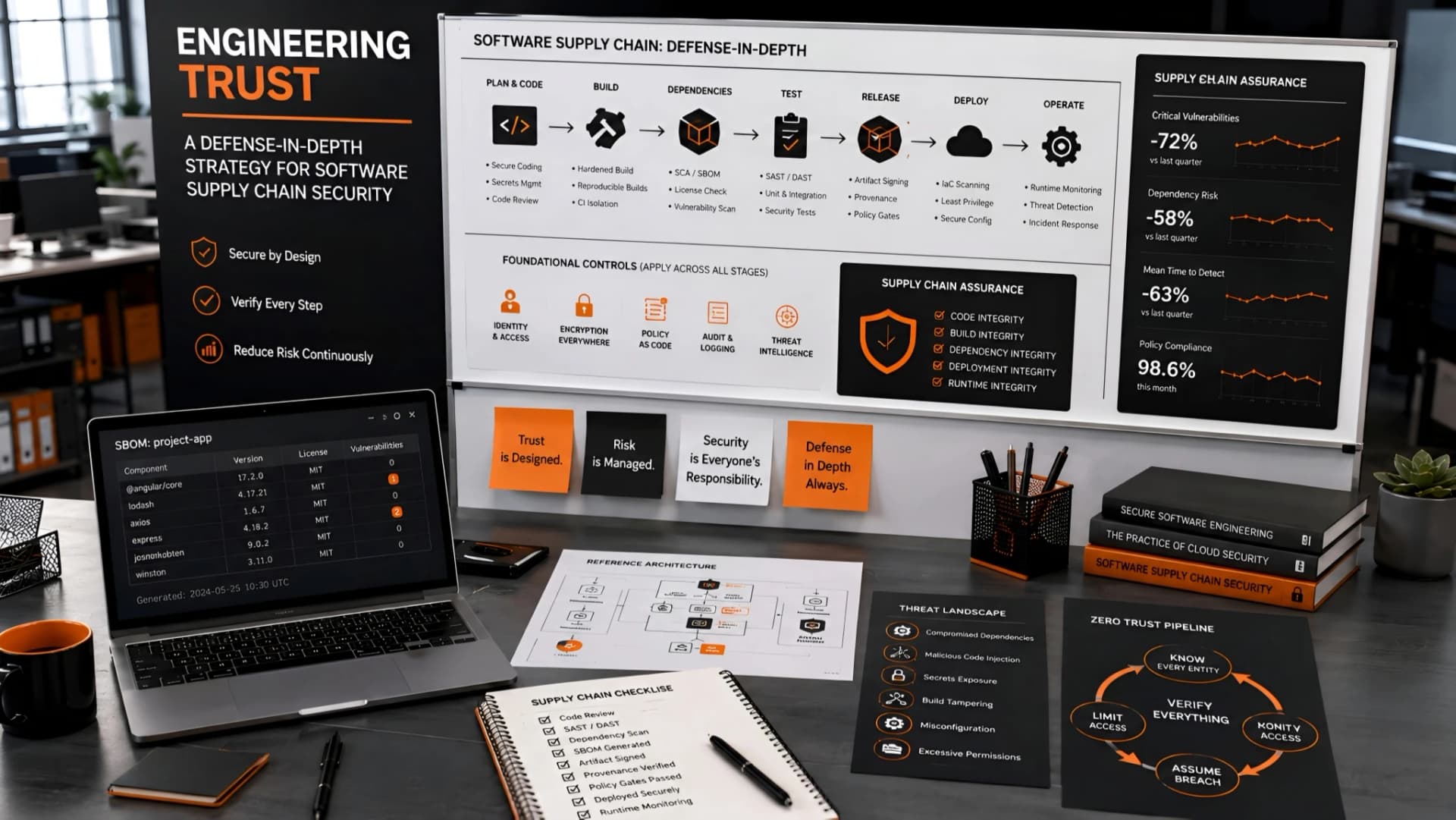
Every piece of modern software, from a simple website to a complex enterprise application, stands on the shoulders of giants. These 'giants' are the countless third-party libraries, frameworks, and open-source components that accelerate development.
While this dependency accelerates innovation, it also introduces a significant attack surface. A vulnerability or malicious code injected into just one of these components can compromise an entire system, leading to data breaches, reputational damage, and severe operational disruptions.
The Growing Threat of Supply Chain Attacks
The problem isn't just theoretical; supply chain attacks are increasingly sophisticated and common. Attackers target less-secure links in the software development ecosystem, injecting malware into legitimate packages or exploiting known vulnerabilities in widely used libraries.
This creates a downstream ripple effect, compromising every application that uses the tainted component. For CTOs and engineering leaders, securing the software supply chain is no longer optional; it's a critical architectural imperative.
Understanding Your Dependencies: The Foundation of Security
Before you can secure your supply chain, you must first understand what's in it. This means having a clear, comprehensive inventory of every component, its version, and its origin.
Ignoring this foundational step is like trying to secure a house without knowing how many doors and windows it has. At Muhyo Tech, our initial architecture reviews always begin with a deep dive into existing dependency structures.
Software Bill of Materials (SBOM) Generation
A Software Bill of Materials (SBOM) is essentially a formal, machine-readable list of ingredients that make up a software component. It details direct and transitive dependencies, their versions, licenses, and often their cryptographic hashes.
Generating SBOMs is crucial for transparency and accountability. It provides a baseline for tracking potential vulnerabilities and ensuring compliance with various regulations.
Dependency Scanning (SCA) and Vulnerability Management
Software Composition Analysis (SCA) tools automate the process of identifying open-source components and their known vulnerabilities. These tools scan your codebase, compare identified components against public vulnerability databases (like NVD), and flag issues.
Effective vulnerability management isn't just about finding problems; it's about prioritizing and remediating them promptly. This involves integrating SCA into CI/CD pipelines to catch issues early and maintaining a clear process for patching or upgrading vulnerable dependencies.
Establishing Trust: Curated Sources and Code Integrity
Once you know what you're using, the next step is to ensure that those components are trustworthy. This involves controlling where your dependencies come from and verifying their integrity.
Relying solely on public registries without additional checks is a significant risk. We advocate for a more controlled approach to dependency sourcing.
Trusted Registries and Proxies
Using a private, trusted registry or a proxy for public package managers (like npm, Maven Central, or PyPI) provides an essential layer of control. This allows you to vet packages before they enter your development environment.
You can cache approved versions, scan them for malware, and enforce policies on allowed licenses or component sources. This acts as a gatekeeper, preventing unverified or potentially malicious packages from being pulled directly into your builds.
Code Signing and Verification
Code signing provides cryptographic assurance that a piece of software hasn't been tampered with since its original release by the publisher. While not all open-source packages are signed, for critical internal components or vetted third-party libraries, requiring and verifying digital signatures adds a strong layer of trust.
This verification process should be integrated into your build pipeline. Any unsigned or invalidly signed components should trigger an alert or fail the build entirely.
Defense in Depth: Protecting the Runtime Environment
Even with robust pre-deployment checks, vulnerabilities can emerge, or zero-day exploits might be discovered. A true defense-in-depth strategy extends security measures into the runtime environment.
This proactive posture helps mitigate risks that might slip through earlier stages. It acknowledges that no single security measure is foolproof.
Runtime Application Self-Protection (RASP)
RASP technologies integrate directly into the application runtime, monitoring its behavior and detecting attacks in real-time. Unlike traditional firewalls, RASP understands application logic and can block attacks that exploit vulnerabilities within the application itself.
For critical applications, RASP offers an additional layer of protection against known and unknown threats, including those originating from compromised dependencies.
Least Privilege and Containerization
Applying the principle of least privilege to your application's runtime environment is fundamental. Applications and their dependencies should only have access to the resources absolutely necessary for their operation.
Containerization (e.g., Docker, Kubernetes) can significantly aid this by isolating applications and their dependencies within lightweight, well-defined environments. This limits the blast radius of any successful exploit.
Architectural Choices and Trade-offs
Implementing a comprehensive software supply chain security strategy involves careful architectural choices and acknowledges various trade-offs. There's no one-size-fits-all solution; the right approach depends on your specific risk profile, budget, and operational constraints.
At Muhyo Tech, we work with clients to balance security rigor with development velocity and maintainability.
Comparison Matrix: Key Supply Chain Security Tools
| Feature | SCA Tools | SBOM Generators | Private Registries | Code Signing | RASP |
|---|---|---|---|---|---|
| Primary Function | Identify known vulnerabilities in dependencies | Create a list of all software components | Control and vet dependency sources | Verify software integrity and authenticity | Real-time application attack detection/prevention |
| Integration Point | CI/CD, codebase scan | Build process, CI/CD | Dependency resolution, CI/CD | Build/release process, CI/CD | Application runtime |
| Key Benefit | Proactive vulnerability detection | Transparency, compliance, auditability | Supply source control, caching | Tamper detection, authenticity | Runtime protection, exploit mitigation |
| Potential Drawback | False positives, licensing complexity | Overhead, tooling integration | Setup complexity, maintenance | Key management, certificate costs | Performance overhead, tuning complexity |
| Complexity | Medium | Low-Medium | Medium-High | Medium | High |
Common Pitfalls to Avoid
- Ignoring Transitive Dependencies: Attackers often target vulnerabilities deep within the dependency tree. Only scanning direct dependencies leaves significant gaps.
- Set-and-Forget Mentality: Security is an ongoing process. Vulnerability databases are constantly updated, and new threats emerge. Regular scanning and updates are essential.
- Over-reliance on Single Tools: No single tool provides a complete solution. A layered approach combining multiple strategies is far more effective.
- Lack of Automation: Manual dependency management and security checks are error-prone and unsustainable at scale. Automate everything possible within your CI/CD pipeline.
- Neglecting Runtime Context: Focusing only on build-time security ignores the dynamic nature of threats once an application is deployed.
The Business Value: Beyond Just Preventing Attacks
Implementing robust software supply chain security delivers significant business value far beyond simply preventing breaches. It builds a foundation of trust and resilience.
This proactive stance can differentiate your offerings and provide a competitive edge in a security-conscious market.
Reduced Risk and Compliance
A secure supply chain directly reduces the risk of costly data breaches, system downtime, and reputational damage. It also helps meet increasingly stringent regulatory requirements (e.g., GDPR, CCPA, various industry-specific standards) that mandate transparency and security in software development.
The ability to generate an SBOM, for instance, is becoming a compliance necessity for many industries.
Enhanced Trust and Customer Confidence
Demonstrating a robust security posture builds trust with customers, partners, and stakeholders. In an era where software reliability is paramount, an explicit commitment to supply chain security can be a powerful differentiator.
It assures users that the applications they rely on are built with integrity and protected against known threats.
Operational Efficiency and Maintainability
While initial setup requires effort, automated dependency scanning and vulnerability management streamline operations in the long run. Catching issues early in the development cycle is significantly cheaper and faster than fixing them in production.
A well-managed dependency ecosystem also reduces technical debt and makes future updates and migrations smoother.
Building a Secure Supply Chain: A Practical Checklist
Implementing a strong software supply chain security strategy doesn't happen overnight. It's a journey that requires commitment and a phased approach. Here's a checklist to guide your efforts:
- Inventory All Dependencies: Use SCA tools to identify direct and transitive dependencies across all projects.
- Generate and Maintain SBOMs: Automate SBOM generation for every build and keep them up-to-date.
- Integrate SCA into CI/CD: Scan dependencies automatically at every commit and build.
- Establish a Vulnerability Management Process: Define clear roles and procedures for triaging, prioritizing, and remediating identified vulnerabilities.
- Implement a Trusted Registry/Proxy: Control and vet all external dependencies before they enter your environment.
- Enforce Code Signing (Where Applicable): Sign your own code and verify signatures of critical third-party components.
- Harden Runtime Environments: Apply least privilege, use containerization, and consider RASP for critical applications.
- Regularly Audit and Review: Periodically review your supply chain security practices and update them as threats evolve.
- Educate Your Team: Ensure developers understand the importance of dependency hygiene and secure coding practices.
- Plan for Incident Response: Have a clear plan for how to respond if a supply chain vulnerability is discovered in production.
Frequently Asked Questions (FAQs)
How does software supply chain security impact development velocity?
Initially, integrating new tools and processes might introduce some overhead. However, by automating scanning and vulnerability management within CI/CD, you catch issues earlier. This prevents costly, time-consuming fixes later in the development cycle, ultimately improving overall velocity and reducing unexpected delays.
What are common pitfalls when scaling Supply Chain Security?
A major pitfall is a lack of automation, leading to manual processes that don't scale. Another is inconsistent enforcement across different teams or projects, creating security gaps. Ignoring transitive dependencies and failing to regularly update vulnerability databases are also common traps.
How does software supply chain security impact performance and maintenance?
The impact on performance from security tools is generally minimal, especially if integrated efficiently into build pipelines. Maintenance overhead can be reduced by automating dependency updates and using tools that provide clear, actionable remediation advice. A well-managed supply chain actually simplifies long-term maintenance by reducing technical debt and security vulnerabilities.
Final Thoughts on Engineering Trust
The complexity of modern software means we can't avoid third-party dependencies. Instead, we must embrace a proactive, multi-layered approach to secure them. Engineering trust into our software supply chain is about diligence, automation, and a commitment to continuous improvement.
At Muhyo Tech, we embed these principles into our full-stack web app development and maintenance services, ensuring that the systems we build and maintain are robust, reliable, and secure from the ground up. This layered defense helps protect your intellectual property and builds lasting confidence in your digital products.