


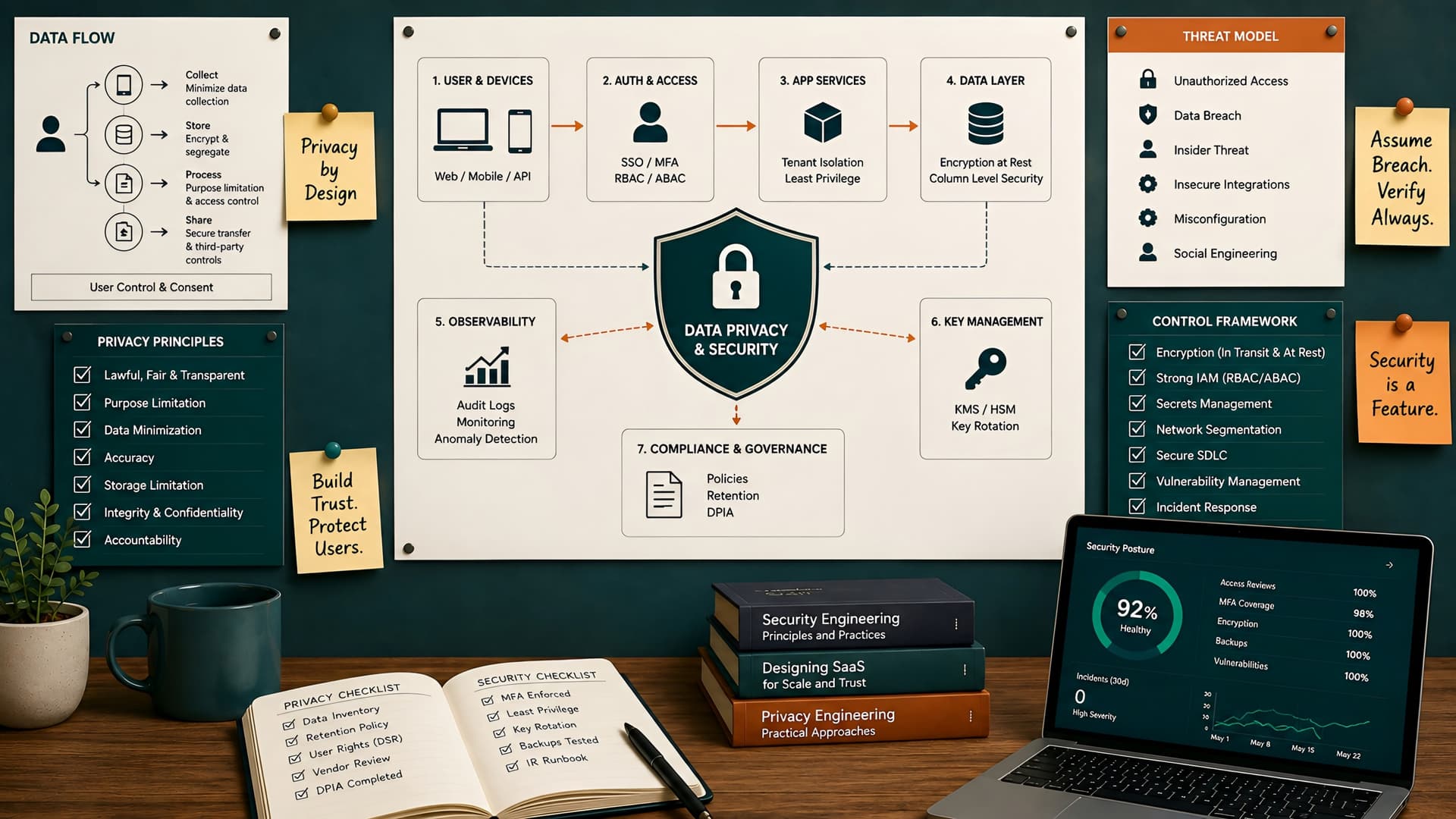
When you're building a SaaS product, the sheer excitement of feature development often overshadows critical, less glamorous aspects. Yet, nothing can derail a promising product faster than a data breach or a privacy misstep.
We've seen how quickly customer trust erodes and regulatory fines stack up when data privacy and security aren't baked into the engineering process from day one. It’s not just about avoiding disaster; it’s about building a foundation of trust.
The Non-Negotiable Core: Data Privacy & Security by Design
For any SaaS offering, handling user data comes with immense responsibility. From personal identifiers to proprietary business information, this data is a prime target for malicious actors.
Ignoring data privacy and security during the initial design phase is a critical miscalculation. Retrofitting these measures later is always more expensive, complex, and riskier than integrating them from the start.
At Muhyo Tech, our approach emphasizes 'security and privacy by design,' ensuring these principles guide every architectural decision and development sprint.
Why 'By Design' is Your Best Defense
Adopting a 'by design' philosophy means considering data privacy and security at every stage of the product lifecycle. This includes initial concept, architecture, development, deployment, and ongoing operations.
It's about proactive prevention rather than reactive damage control. This foresight protects your users, your reputation, and your bottom line.
Foundational Pillars of Secure SaaS Architecture
A truly secure SaaS product stands on several architectural pillars. These aren't optional extras; they are fundamental requirements for any modern web application handling sensitive information.
Neglecting even one of these pillars can create significant vulnerabilities that undermine the entire system.
1. Data Encryption: In Transit and At Rest
Encryption is the bedrock of data protection. Any sensitive data your SaaS product handles must be encrypted both when it's moving between systems (in transit) and when it's stored (at rest).
This means using TLS/SSL for all network communications and strong encryption algorithms (like AES-256) for databases, backups, and file storage.
Tradeoff: Encryption adds a small overhead to processing power and storage. However, the security benefits far outweigh these minimal performance impacts, especially with modern hardware.
2. Robust Access Controls and Authentication
Who can access what data, and under what circumstances? This question is central to security. Implementing strong authentication and granular authorization mechanisms is paramount.
Multi-factor authentication (MFA) should be standard for all administrative and user accounts. Role-based access control (RBAC) ensures users only have the minimum permissions necessary to perform their tasks.
3. Secure Coding Practices and Vulnerability Management
The code itself can be a source of vulnerabilities. Adopting secure coding guidelines, conducting regular code reviews, and performing static and dynamic application security testing (SAST/DAST) are essential.
Staying vigilant against common vulnerabilities like SQL injection, cross-site scripting (XSS), and insecure direct object references (IDOR) is an ongoing process.
Compliance & Regulatory Landscape Navigation
The global regulatory landscape for data privacy is complex and ever-evolving. Failing to comply can result in severe penalties and a significant loss of trust.
Understanding and integrating relevant regulations into your engineering blueprint is a critical step for any SaaS product aiming for broad adoption.
Understanding Key Regulations: GDPR, CCPA, HIPAA
Depending on your target market and the type of data you handle, you might need to comply with several regulations. GDPR (General Data Protection Regulation) is a global standard for privacy, affecting anyone handling data of EU citizens.
CCPA (California Consumer Privacy Act) and its successor CPRA, provide similar protections for California residents. HIPAA (Health Insurance Portability and Accountability Act) is crucial for any SaaS dealing with Protected Health Information (PHI) in the US.
Implementing Data Subject Rights
These regulations grant individuals significant rights over their data: the right to access, rectification, erasure ('right to be forgotten'), data portability, and restriction of processing. Your SaaS product needs mechanisms to facilitate these rights.
This often involves building user-facing dashboards for data access and deletion requests, and robust internal processes for handling more complex data subject requests efficiently and securely.
Operational Security & Incident Response
Security isn't a one-time setup; it's an ongoing operational discipline. Even with the best preventive measures, incidents can occur. How you respond defines your resilience.
A well-defined incident response plan minimizes damage, ensures quick recovery, and maintains transparency with affected parties.
Logging, Monitoring, and Alerting
Comprehensive logging of all security-relevant events is fundamental. This includes access attempts, data modifications, administrative actions, and system errors. Centralized logging and real-time monitoring tools are invaluable.
Automated alerts for suspicious activities, failed logins, or unusual data access patterns allow your team to detect and respond to threats quickly, often before significant damage occurs.
Building an Incident Response Plan (IRP)
An IRP is your playbook for a security incident. It outlines roles, responsibilities, communication protocols (internal and external), containment strategies, eradication steps, recovery procedures, and post-incident analysis.
Regularly testing this plan through tabletop exercises ensures your team is prepared to act decisively under pressure. This is a core part of our maintenance and support offerings for clients.
Practical Checklist for SaaS Data Privacy & Security Engineering
To help founders and engineering leads, we’ve distilled our experience into a practical checklist. This isn't exhaustive but covers the most critical areas for immediate focus.
- Data Inventory & Classification: Understand what data you collect, where it lives, and its sensitivity level.
- Threat Modeling: Proactively identify potential threats and vulnerabilities in your system architecture.
- Secure Development Lifecycle (SDL): Integrate security into every phase, from requirements to deployment and maintenance.
- Input Validation & Output Encoding: Protect against injection attacks and XSS by sanitizing all user inputs and encoding outputs.
- Regular Security Audits & Penetration Testing: Engage third-party experts to identify weaknesses before attackers do.
- Vendor Security Assessment: Vet all third-party services and libraries for their security practices.
- Data Minimization & Retention Policies: Collect only the data you need and delete it when no longer necessary.
- Backup and Disaster Recovery: Ensure data can be restored quickly and reliably in case of loss or corruption.
- Employee Training: Educate your team on security best practices and the importance of data privacy.
- Privacy Policy & Terms of Service: Clearly communicate your data practices to users in an understandable way.
The Business Value: Beyond Compliance and Risk Mitigation
While avoiding fines and breaches is a powerful motivator, engineering for data privacy and security delivers substantial positive business value. It's a strategic differentiator.
In a world increasingly aware of data exploitation, a strong privacy posture builds profound customer trust and loyalty.
Competitive Advantage and Market Positioning
Customers are more likely to choose a SaaS provider they trust with their data. Demonstrating a commitment to privacy can be a powerful selling point, especially in competitive markets.
It positions your product as reliable, ethical, and forward-thinking, attracting a more discerning customer base. This is particularly true for sectors like healthcare or finance, where data sensitivity is extremely high.
Reduced Technical Debt and Easier Scaling
Building security in from the start minimizes future technical debt related to security fixes and compliance updates. A well-architected secure system is inherently more maintainable and scalable.
It reduces the operational burden and allows your engineering team to focus on feature development rather than constant patching and firefighting.
Engineering Tradeoffs and Decision Criteria
Every engineering decision involves tradeoffs. When it comes to security and privacy, these tradeoffs often balance user experience, development speed, and cost against the level of protection achieved.
For example, implementing strong MFA might add an extra step for users, but it drastically reduces the risk of account compromise. The decision often comes down to your product's specific risk profile and target audience's expectations.
| Security Measure | Pros | Cons | Decision Criteria |
|---|---|---|---|
| End-to-End Encryption | Maximal data protection; prevents eavesdropping | Can complicate debugging; key management overhead | Sensitivity of data; regulatory requirements |
| Strict RBAC | Granular control; 'least privilege' principle | Complex to configure and manage; potential for misconfiguration | Team size; data access patterns; compliance needs |
| Biometric Authentication | Convenient for users; strong security | Hardware dependency; privacy concerns for biometric data | Target audience; specific use cases; regulatory comfort |
| Aggressive Data Retention Policies | Minimizes data breach impact; simplifies compliance | May limit analytics capabilities; requires careful planning | Regulatory mandates; business intelligence needs |
Our Approach at Muhyo Tech
At Muhyo Tech, we integrate these principles into every full-stack web app development project. We believe that robust security isn't an add-on; it's an intrinsic part of delivering reliable, high-quality software.
Our team works to identify potential vulnerabilities early, design resilient architectures, and implement secure coding practices that protect your users and your business.
Frequently Asked Questions (FAQs)
What is 'privacy by design' in SaaS product engineering?
'Privacy by design' means embedding data protection and privacy considerations into the entire engineering process from conception to deployment. It's about proactive rather than reactive security, ensuring privacy is a core architectural principle, not an afterthought.
How do regulations like GDPR and CCPA impact SaaS development?
These regulations mandate specific requirements for how user data is collected, stored, processed, and protected. For SaaS development, this translates to implementing mechanisms for data subject rights (e.g., access, deletion), secure data handling, transparent privacy policies, and potentially data localization or cross-border transfer rules.
Is end-to-end encryption always necessary for SaaS products?
While not every piece of data requires end-to-end encryption (E2EE), it is highly recommended for sensitive user data where confidentiality is paramount. For example, E2EE for messaging apps ensures only sender and receiver can read content. For general SaaS, strong encryption for data in transit (TLS) and at rest (database encryption) is often sufficient, depending on the data's sensitivity and regulatory requirements.
What's the most common mistake SaaS companies make regarding data security?
One of the most common mistakes is treating security as a perimeter defense problem, focusing solely on firewalls and network security. True security requires a multi-layered approach that includes secure coding practices, robust access controls, regular vulnerability scanning, and an effective incident response plan. Neglecting any of these layers leaves critical gaps.
Final Thoughts on Building Trust
Building a successful SaaS product in today's environment demands more than just great features. It requires an unwavering commitment to data privacy and security. This isn't just about technical implementation; it's about fostering a culture of responsibility within your engineering team.
By proactively integrating a robust data privacy and security blueprint, you're not just mitigating risks; you're building a product that earns and keeps the trust of its users. This trust is ultimately your most valuable asset.