
Finding the right MERN stack developer, especially in a competitive market like Pakistan, often feels like navigating a maze. Resumes highlight technical skills, but they rarely tell you if a candidate can truly own an entire application. This ownership—from database design to deployment strategy—is crucial for project success.
We’ve seen businesses struggle when developers excel at coding specific features but falter when it comes to the bigger picture. Their project then stalls, requiring additional hires or significant reworks to get back on track. This guide focuses on how to identify candidates who can deliver complete application solutions.
The Core Challenge: Finding Full-Stack Ownership
Many MERN developers are proficient in specific layers: a React wizard, a Node.js API expert, or a MongoDB schema designer. The real value, however, comes from someone who can seamlessly connect these layers into a robust, scalable product.
The challenge isn't just finding someone who knows the technologies. It's about finding someone who understands how they interact, how to optimize them for performance, and how to secure them against real-world threats. We look for this integrated understanding in every MERN project we undertake at Muhyo Tech.
Beyond Basic Coding: Evaluating Production Architecture
When you hire a MERN stack developer, you're not just hiring a coder; you're bringing on an architect for your digital product. A strong candidate should be able to discuss architectural decisions beyond simply listing technologies.
Ask them about scaling strategies for high traffic, how they would structure microservices versus a monolithic approach, or their experience with serverless functions in a MERN context. Their answers will reveal their depth of understanding and their ability to plan for the future of your application.
At Muhyo Tech, our MERN stack web development approach prioritizes thoughtful architecture from day one. We believe that a well-designed foundation prevents costly refactoring down the line.
API Design and Data Modeling: The Backbone of MERN
The efficiency and maintainability of your MERN application heavily rely on its API design and MongoDB data modeling. A developer who truly owns the stack will understand the intricate relationship between these two components.
Probe their experience with RESTful principles, GraphQL, or real-time communication using WebSockets. Ask how they approach schema design in MongoDB to ensure both performance and data integrity, especially for complex relationships or evolving data structures. Poor API design often leads to frontend development bottlenecks and difficult maintenance.
Security First: Protecting Your Application and Users
Security is not an afterthought; it must be ingrained in every stage of development. A skilled MERN developer should demonstrate a proactive understanding of common web vulnerabilities and how to mitigate them.
Discuss their experience with authentication (JWT, OAuth), authorization, input validation, and protecting against common attacks like XSS or SQL injection (even though MongoDB is NoSQL, injection-like vulnerabilities can still exist). Understanding how to implement secure coding practices across the stack is non-negotiable for us.
Testing and Operational Support: Ensuring Reliability
A great developer doesn't just write code; they ensure it works reliably and can be maintained. This means having a strong grasp of testing methodologies and an awareness of operational best practices.
Inquire about their experience with unit testing (Jest, Mocha), integration testing, and end-to-end testing (Cypress, Playwright) for both frontend and backend. Also, ask how they approach logging, monitoring, and debugging in a production environment. These practices directly translate to fewer bugs and lower downtime for your business.
Deployment and DevOps: Bridging Development to Production
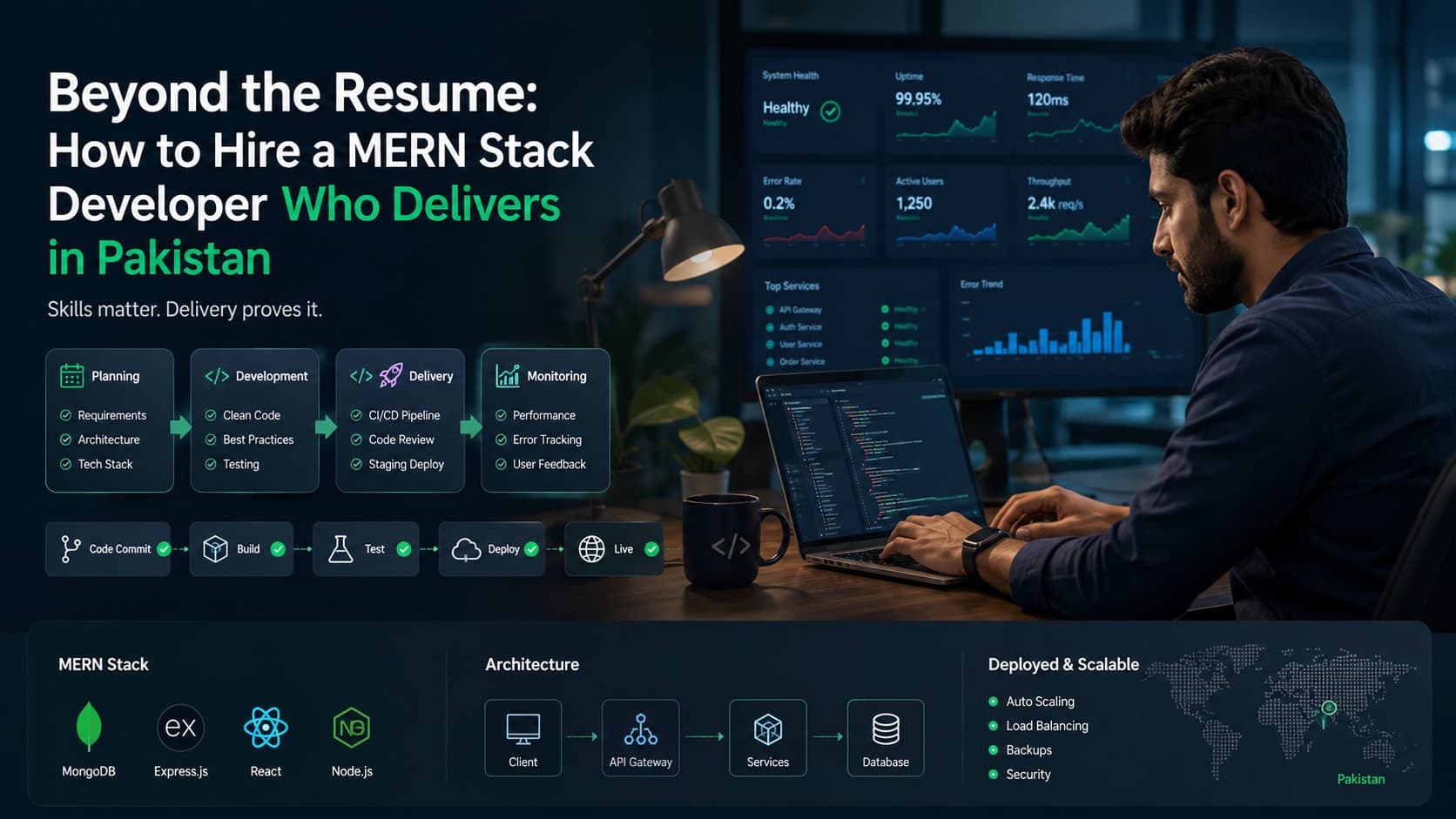
Many projects falter at deployment, turning what should be a smooth transition into a stressful scramble. A full-stack MERN developer worth their salt should be comfortable with deployment pipelines and basic DevOps concepts.
Discuss their experience with cloud platforms like AWS, Google Cloud, or Azure, and containerization with Docker. Ask about CI/CD pipelines and how they automate the process of getting code from development to production. This capability ensures faster launches and more reliable updates for your full-stack web app development projects.
Interview Strategies: Beyond the Technical Quiz
To truly assess a candidate, move beyond rote technical questions. Present them with real-world scenarios or hypothetical project requirements.
Ask them to design a simple API for a specific feature, model the database, and discuss the frontend components required. Pay attention to their problem-solving process, their ability to articulate tradeoffs, and how they consider the entire system, not just isolated parts. This holistic view is what we foster within our own engineering team.
The Muhyo Tech Approach to MERN Talent
At Muhyo Tech, we don't just look for developers; we look for engineers who can envision, build, and support entire applications. Our internal standards for MERN stack development emphasize end-to-end ownership, robust architecture, and a strong focus on security and maintainability.
When you choose to hire a MERN stack developer in Pakistan, look for these same qualities. Prioritize those who can demonstrate a comprehensive understanding of the stack and a commitment to delivering a complete, reliable product. This approach will save you time, reduce risk, and ultimately lead to a more successful digital solution.