


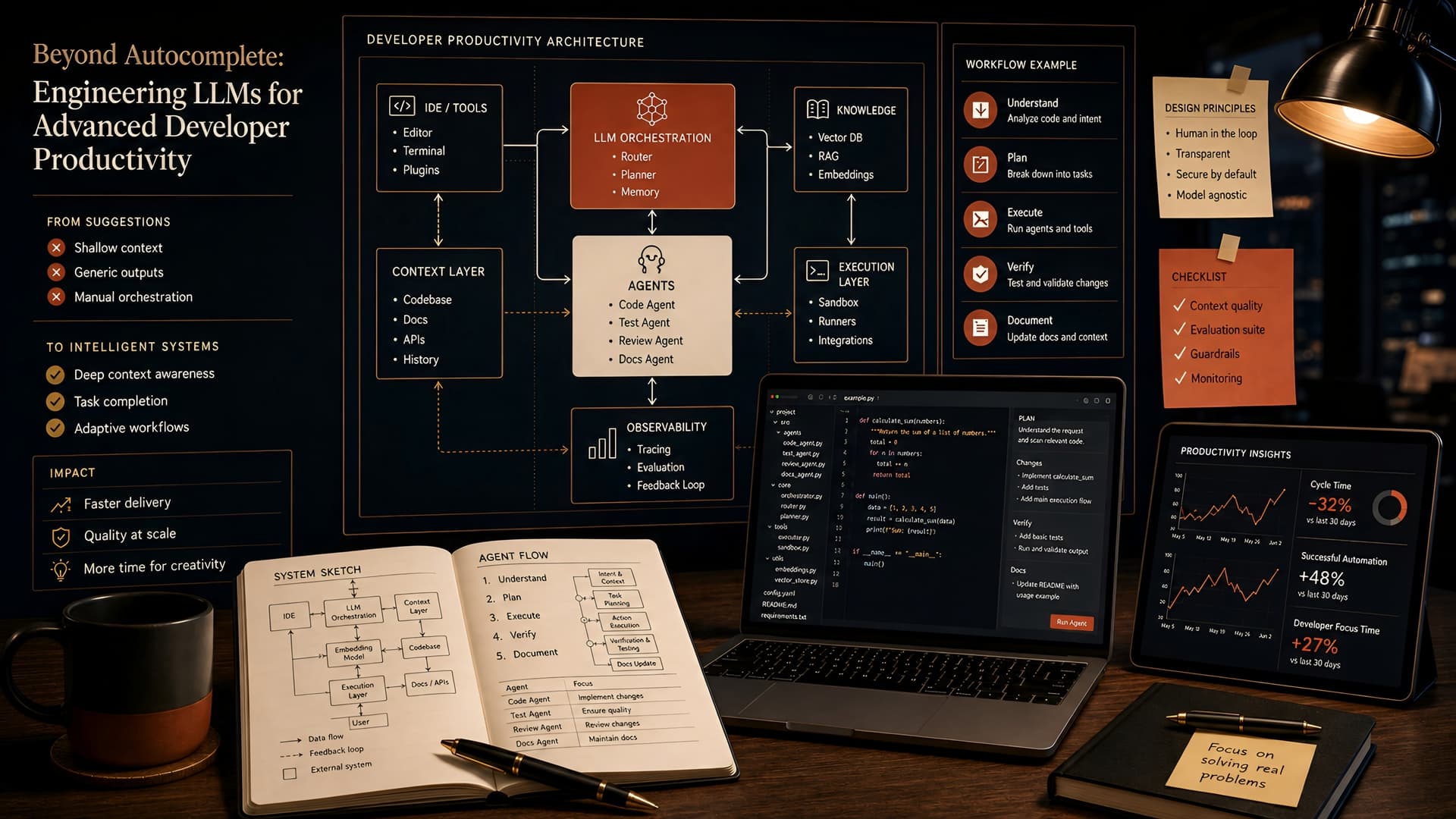
Many developers feel the promise of AI code assistants remains just out of reach. While basic autocomplete is helpful, truly leveraging Large Language Models (LLMs) for complex tasks like refactoring, debugging, or generating comprehensive tests often feels like a missing piece.
The core challenge isn't the LLM itself, but the engineering around it. We need to move beyond simple prompts and integrate these powerful tools into our daily workflows and even our CI/CD pipelines to unlock their full potential.
The AI Code Assistant Dilemma: Underutilized Potential
The initial hype around AI code assistants was immense, and for good reason. Imagine a tool that understands your codebase, suggests improvements, and even writes boilerplate for you. For many, however, the reality has been closer to an advanced autocomplete, not a true co-pilot.
This gap stems from a common mistake: treating LLMs as magic black boxes. Without proper engineering, validation, and integration into existing processes, their probabilistic nature can introduce more problems than solutions.
Establishing a Clear Separation: Probabilistic vs. Deterministic Controls
Integrating LLMs into a software development workflow requires a fundamental distinction. We must separate the probabilistic output of the AI model from the deterministic controls of our application and infrastructure.
The LLM provides suggestions, code snippets, or analyses, which are inherently uncertain. Our engineering responsibility is to build deterministic layers around this uncertainty: validation, human review, fallback mechanisms, and robust security checks. This architectural approach ensures reliability, even when the AI provides less-than-perfect output.
Engineering Custom Prompts for Deeper Impact
The quality of an LLM's output is directly proportional to the quality of its input. Generic prompts yield generic results. To move beyond autocomplete, we need to engineer prompts that provide sufficient context and specify desired outcomes.
This means defining the programming language, architectural patterns, existing code context, and even performance or security considerations. A well-crafted prompt acts as a mini-specification for the AI, guiding it towards more useful and accurate suggestions.
Prompt Engineering Best Practices
- Provide Ample Context: Include relevant code snippets, file contents, error messages, and architectural guidelines.
- Define the Persona: Ask the LLM to act as an 'expert Python developer' or 'senior Java architect'.
- Specify Output Format: Request JSON, specific code blocks, or markdown tables for easier parsing and integration.
- Set Constraints and Requirements: "Ensure thread safety," "Use dependency injection," or "Adhere to SOLID principles."
- Iterate and Refine: Treat prompt engineering as a development task, constantly testing and improving.
Integrating LLMs into CI/CD for Automated Enhancement
The true power of AI code assistants emerges when they're integrated beyond the IDE. Embedding LLM capabilities into CI/CD pipelines can automate tasks that traditionally consumed significant developer time.
Imagine a pipeline that, upon a pull request, not only runs tests but also suggests refactorings for readability, identifies potential performance bottlenecks, or generates documentation stubs. This shifts the LLM from a reactive tool to a proactive quality gate.
Use Cases in CI/CD
- Automated Code Review Suggestions: LLMs can analyze new code for common patterns, suggest stylistic improvements, or even identify potential security vulnerabilities before a human reviewer sees it.
- Test Case Generation: For new functions or bug fixes, an LLM can propose unit or integration tests based on the code's logic and existing test patterns.
- Documentation Generation: Automatically generate or update function docstrings, API endpoint descriptions, or even higher-level architectural summaries based on code changes.
- Refactoring Identification: Suggest refactorings for complex functions or classes to improve maintainability and adherence to best practices.
Designing Workflows for Advanced Code Generation and Refactoring
Beyond isolated tasks, we can design entire workflows that leverage LLMs for more sophisticated code generation and refactoring. This requires a human-in-the-loop approach, where the LLM provides the initial heavy lifting, and the developer provides the critical review and final approval.
For example, when tackling a complex feature, an LLM could generate an initial skeleton based on a high-level description. The developer then iterates, refining the generated code, while the LLM assists with tests, error handling, and documentation for each step.
Example Workflow: Feature Implementation with LLM Assistance
- High-Level Prompt: Developer describes a new feature, including its purpose, inputs, outputs, and any specific technologies or architectural patterns.
- LLM Generates Skeleton: The AI provides initial file structures, function definitions, and core logic.
- Developer Refines & Prompts for Details: The developer reviews the skeleton, makes adjustments, and then prompts the LLM for specific sub-components (e.g., "Implement the data validation logic for this function").
- Iterative Testing & Debugging: As code is generated, the LLM can assist in writing tests for new functions or even suggest debugging steps for issues.
- Documentation & Review: Once the feature is complete, the LLM can generate initial documentation, which is then reviewed and finalized by the developer.
Managing Risks: Validation, Privacy, Security, and Human Oversight
The integration of LLMs introduces new vectors of risk. Without careful management, the benefits can quickly be overshadowed by issues related to code quality, intellectual property, or security vulnerabilities. At Muhyo Tech, we emphasize a layered approach to risk mitigation.
Critical Risk Mitigation Strategies
- Output Validation: Never trust LLM output blindly. Implement static analysis, linting, unit tests, and integration tests to validate generated code. Consider schema validation for structured outputs.
- Privacy Concerns: Be acutely aware of what code or data you're sending to external LLM providers. Ensure sensitive information is redacted or processed locally if using on-premise models. Understand the provider's data retention and usage policies.
- Security Vulnerabilities: LLMs can generate code with subtle security flaws. Treat all AI-generated code as if it came from an untrusted external source. Apply robust security scanning tools and manual security reviews.
- Human-in-the-Loop Oversight: Automated tools are assistants, not replacements. Critical decisions and final code approval must always involve a human developer. This provides a necessary sanity check and maintains accountability.
- Fallback Mechanisms: What happens if the LLM fails, returns nonsense, or is unavailable? Design systems with graceful degradation or clear fallback paths. The core development process should not grind to a halt.
- Cost Management: LLM API calls incur costs. Monitor usage, optimize prompt length, and consider caching common responses to manage expenses effectively.
Observability and Feedback Loops: Improving LLM-Assisted Workflows
To continuously improve AI code assistant productivity, we need robust observability into how these tools are being used and how effective they are. This involves collecting metrics, establishing feedback loops, and iterating on both prompts and integration points.
Key Observability Metrics
- Acceptance Rate: How often is AI-generated code accepted without significant modification?
- Time Saved: Qualitative and quantitative measures of how much time specific tasks are reduced.
- Error Rate: How often does AI-generated code introduce bugs or require extensive debugging?
- Token Usage: Monitor API token consumption to manage costs and identify opportunities for prompt optimization.
- Developer Satisfaction: Collect feedback from developers on the perceived usefulness and friction points.
Establishing clear feedback channels allows developers to report issues or suggest improvements directly. This data then informs prompt refinements, toolchain adjustments, and even training for new LLM models if using a custom approach.
The Business Value: Faster Launches, Better Code, Happier Teams
The investment in engineering sophisticated LLM workflows pays dividends far beyond simple convenience. When properly implemented, AI code assistants significantly boost developer productivity, leading to tangible business advantages.
| Benefit Category | Impact on Business |
|---|---|
| Developer Productivity | Reduces time spent on boilerplate, repetitive tasks, and initial drafts. Engineers focus on higher-value problem-solving. |
| Time-to-Market | Accelerates feature development and bug fixes, enabling faster product launches and iterations. |
| Code Quality & Consistency | Automated suggestions and reviews lead to more consistent, readable, and potentially more secure code. |
| Onboarding & Training | New team members can get up to speed faster with AI assistance, reducing ramp-up time. |
| Cost Efficiency | While LLMs have costs, the efficiency gains in developer hours can lead to overall project cost reductions. |
By freeing engineers from the mundane, we empower them to tackle more complex, creative challenges. This not only improves the final product but also fosters a more engaging and less stressful development environment.
Frequently Asked Questions
Q: Can AI code assistants replace human developers?
A: No, AI code assistants are tools designed to augment human developers, not replace them. They excel at repetitive tasks, pattern recognition, and generating initial drafts, but lack the contextual understanding, critical thinking, and creative problem-solving abilities of a human engineer. Human oversight and final approval remain crucial.
Q: What are the biggest challenges in integrating LLMs into existing CI/CD pipelines?
A: Key challenges include ensuring the LLM output is reliable and deterministic, managing the cost of API calls, handling data privacy and security for code sent to the LLM, and designing robust validation and fallback mechanisms. Integrating the LLM's probabilistic nature into a deterministic pipeline requires careful engineering.
Q: How can I measure the ROI of investing in advanced LLM workflows?
A: Measuring ROI involves tracking metrics like developer velocity (features shipped per sprint), reduction in time spent on specific tasks (e.g., writing unit tests), code quality improvements (fewer bugs, higher maintainability scores), and developer satisfaction. Qualitative feedback and A/B testing different workflow approaches can also provide valuable insights.
Q: Should we use open-source or commercial LLMs for code assistance?
A: The choice depends on your specific needs regarding data privacy, customization, and cost. Commercial LLMs often offer out-of-the-box performance and ease of use. Open-source models provide greater control, allow for fine-tuning with proprietary code, and can be run on-premise for enhanced privacy, but require more engineering effort to set up and maintain.
Conclusion: Engineering the Future of Developer Productivity
Moving beyond basic autocomplete with AI code assistants is an engineering challenge, not just an AI adoption one. It demands thoughtful prompt engineering, strategic integration into CI/CD, and robust risk management.
At Muhyo Tech, we approach AI-assisted workflows by prioritizing reliability and control. We design systems where the LLM is a powerful, yet carefully constrained, partner in the development process. This allows teams to harness the transformative power of AI while maintaining high standards of code quality, security, and maintainability.
The goal isn't just to write code faster, but to write better code, reduce developer friction, and ultimately deliver more value to clients with greater efficiency and confidence. This is how we truly unlock the potential of AI in software development.