


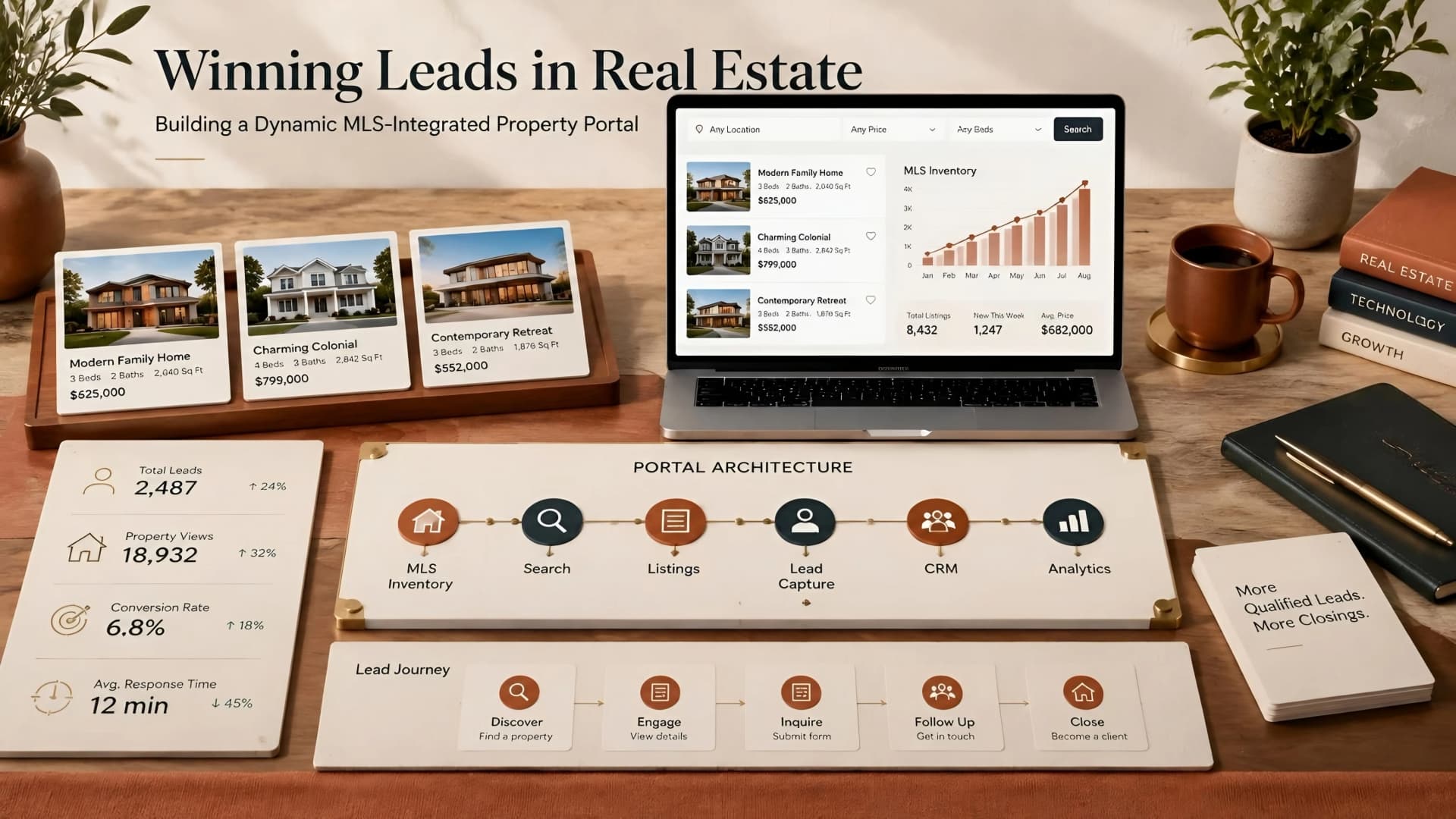
For real estate agents and brokers, a website is more than just an online brochure. It's often the first point of contact with a potential client, a digital storefront that needs to be as dynamic and informative as the market itself.
Yet, many still struggle with generic website templates and slow MLS data synchronization, finding themselves losing valuable leads to competitors offering a richer, more responsive property search experience.
The Core Problem: Stagnant Data, Lost Opportunities
The traditional real estate website often relies on pre-built themes or basic IDX solutions that offer limited control. These platforms can be slow to update, creating a frustrating experience for users searching for properties that might already be off the market.
This lag in data synchronization directly impacts lead generation. When potential buyers encounter outdated listings or a clunky search interface, they quickly move on to platforms that provide real-time information and a smoother user journey.
Why Generic Solutions Fall Short
Off-the-shelf IDX solutions, while easy to implement, often come with significant trade-offs. They limit design customization, restrict advanced search functionalities, and can burden your site with unnecessary code, hurting performance and SEO.
More critically, they prevent you from truly differentiating your brand. In a crowded market, a unique, high-performing platform isn't just a nice-to-have; it's a competitive necessity for capturing and nurturing leads.
The Engineering Response: Custom MLS-Integrated Portals
At Muhyo Tech, our approach to this challenge centers on custom web development with direct MLS/IDX integration. This isn't about slapping on a plugin; it's about building a robust, high-performance full-stack web application from the ground up.
We design systems that fetch, process, and display property data in real-time, offering users an unparalleled search experience that generic solutions simply cannot match.
How Direct MLS/IDX Integration Works
Direct MLS integration involves establishing a secure, programmatic connection with the Multiple Listing Service (MLS) or Internet Data Exchange (IDX) provider. This typically happens via an API, allowing your custom application to pull property data directly.
This direct connection ensures that your website always displays the most current listings, pricing, and property details, eliminating the lag often seen with cached or indirectly sourced data.
Architectural Deep Dive: Building a Robust Real Estate Portal
Developing a dynamic MLS-integrated portal requires careful architectural planning. Our focus is always on performance, scalability, and maintainability to ensure long-term value.
Here's a breakdown of the key components and our engineering considerations:
1. Data Ingestion & Synchronization
The foundation of any MLS portal is reliable data ingestion. We design API integration layers that securely connect to the MLS data feed.
This involves handling various data formats, managing rate limits, and implementing robust error handling to ensure data integrity during synchronization.
2. Database Design for Real Estate Data
Real estate data is complex, featuring numerous fields, relationships, and often large media assets. Our database schemas are optimized for quick queries and efficient storage.
We consider indexing strategies and caching mechanisms to ensure search results are delivered almost instantaneously, even with millions of listings.
3. User Interface & Experience (UI/UX)
A custom portal allows for a truly intuitive and personalized user experience. We focus on clean layouts, powerful filtering options, interactive maps, and high-quality image galleries.
The goal is to make property discovery enjoyable and efficient, keeping users engaged and encouraging deeper exploration.
4. Search & Filtering Engine
Beyond basic search, a powerful portal offers advanced filtering by property type, price range, number of bedrooms, amenities, and more. We implement optimized search algorithms, often leveraging technologies like Elasticsearch or dedicated database indexes.
This ensures that complex queries return accurate results quickly, a critical factor for user satisfaction and lead conversion.
Key Engineering Trade-offs and Considerations
Building a custom MLS portal involves several engineering trade-offs that need careful consideration. There's no one-size-fits-all solution, and our decisions are always guided by the specific business goals and projected scale.
Here are some common considerations we evaluate:
Performance vs. Data Freshness
Continuously fetching real-time data can be resource-intensive. We balance data freshness with performance by implementing smart caching strategies and incremental updates.
For example, frequently accessed listings might be cached aggressively, while new listings or price changes are prioritized for immediate synchronization.
Scalability vs. Cost
A highly scalable architecture can handle sudden spikes in traffic but often comes with higher infrastructure costs. We design for scalability from the outset, using cloud-native services and microservices architectures where appropriate.
However, we also optimize for cost-efficiency, ensuring resources are provisioned smartly to meet demand without unnecessary expenditure.
Customization vs. Maintenance Burden
The more customized a solution, the greater the potential for unique maintenance requirements. Our custom website development prioritizes modularity and clean code practices.
This approach minimizes the maintenance burden, making future updates and feature additions smoother and less risky.
Business Value: How a Custom Portal Drives Lead Generation
The engineering effort behind a custom MLS-integrated portal translates directly into significant business advantages for real estate professionals.
It moves beyond simply displaying listings to actively attracting, engaging, and converting prospective clients.
Increased Lead Capture & Conversion
A fast, accurate, and user-friendly portal encourages longer visits and more interactions. With features like saved searches, property alerts, and direct contact forms, you convert passive browsers into active leads.
The enhanced user experience directly correlates to higher lead capture rates and improved conversion funnels.
Enhanced Brand Authority & Trust
A professional, cutting-edge website establishes you as a leader in your market. It builds trust with potential clients who see you as tech-savvy and committed to providing the best resources.
This differentiates you from competitors relying on generic platforms, making your brand memorable and authoritative.
Improved SEO and Discoverability
Custom solutions allow for superior SEO optimization. We can implement clean URL structures, optimize metadata for each listing, and ensure fast page load times—all critical factors for higher search engine rankings.
This means more organic traffic, bringing more qualified leads directly to your portal.
Common Pitfalls and How We Avoid Them
Implementing mls integrated website development safely in production involves navigating several common pitfalls. Our experience has taught us to anticipate and mitigate these challenges early in the development cycle.
| Pitfall | Muhyo Tech's Approach |
|---|---|
| Slow Data Sync | Real-time API polling, webhooks, and incremental updates. |
| Poor Search Performance | Optimized database indexing, dedicated search engines (e.g., Elasticsearch), and caching. |
| Inconsistent Data | Robust data validation, error logging, and reconciliation processes. |
| Security Vulnerabilities | API key management, secure data transmission (HTTPS), and regular security audits. |
| Scalability Issues | Cloud-native architecture, load balancing, and efficient resource allocation. |
| Limited Customization | Ground-up custom development, flexible component-based design. |
Our Real-World Engineering Approach and Standards
At Muhyo Tech, we approach each MLS integration project with a blend of technical rigor and business understanding. We don't just build websites; we engineer solutions that solve real business problems and deliver tangible value.
Our standards include:
- Performance-First Development: Prioritizing fast load times and responsive interactions.
- Robust API Integration: Building resilient connections to MLS data feeds with comprehensive error handling.
- Scalable Architecture: Designing systems that can grow with your business and handle increasing traffic.
- User-Centric Design: Crafting intuitive interfaces that delight users and drive engagement.
- SEO Best Practices: Implementing technical SEO from day one to ensure maximum discoverability.
- Ongoing Maintenance & Support: Providing the necessary support to keep your portal running smoothly and securely.
Getting Started: Your Custom MLS Portal Checklist
Considering a custom MLS-integrated property portal? Here's a checklist of key areas to discuss with your engineering partner:
- MLS Data Access: Confirm your eligibility and access to MLS/IDX data feeds.
- Feature Set: Define core search, filtering, property detail, and lead capture functionalities.
- Design & Branding: Outline your desired aesthetic and brand integration.
- Scalability Needs: Estimate current and projected user traffic.
- Maintenance & Support: Discuss ongoing needs for updates and technical assistance.
- Security Requirements: Address data protection and user privacy considerations.
Frequently Asked Questions (FAQs)
Q: How long does it take to build a custom MLS-integrated website?
A: The timeline varies depending on the complexity of features and data integration. A robust, custom MLS portal can take anywhere from 3 to 9 months, including design, development, testing, and deployment.
Q: Is a custom MLS portal more expensive than a template solution?
A: Yes, initial development costs for a custom solution are higher than off-the-shelf templates. However, the long-term benefits in terms of lead generation, brand differentiation, performance, and scalability often deliver a significantly higher return on investment.
Q: What are the ongoing costs associated with an MLS-integrated website?
A: Ongoing costs typically include MLS data feed fees, hosting infrastructure, regular maintenance, security updates, and potential feature enhancements. These are crucial for ensuring the portal remains current and performs optimally.
Q: Can a custom MLS portal be integrated with other real estate tools?
A: Absolutely. One of the key advantages of a custom solution is its flexibility to integrate with CRM systems, marketing automation platforms, analytics tools, and other essential real estate software, creating a unified digital ecosystem.
Conclusion: Your Competitive Edge in Real Estate
In a competitive real estate market, a generic online presence is a liability. A custom-built, MLS-integrated property portal is a strategic asset, empowering agents and brokers to differentiate their brand, capture more leads, and provide an unparalleled user experience.
It's an investment in a robust digital foundation that delivers long-term value, transforming your website from a passive listing display into a dynamic lead generation engine. At Muhyo Tech, we are dedicated to engineering these powerful, reliable platforms, helping you secure your competitive edge.