


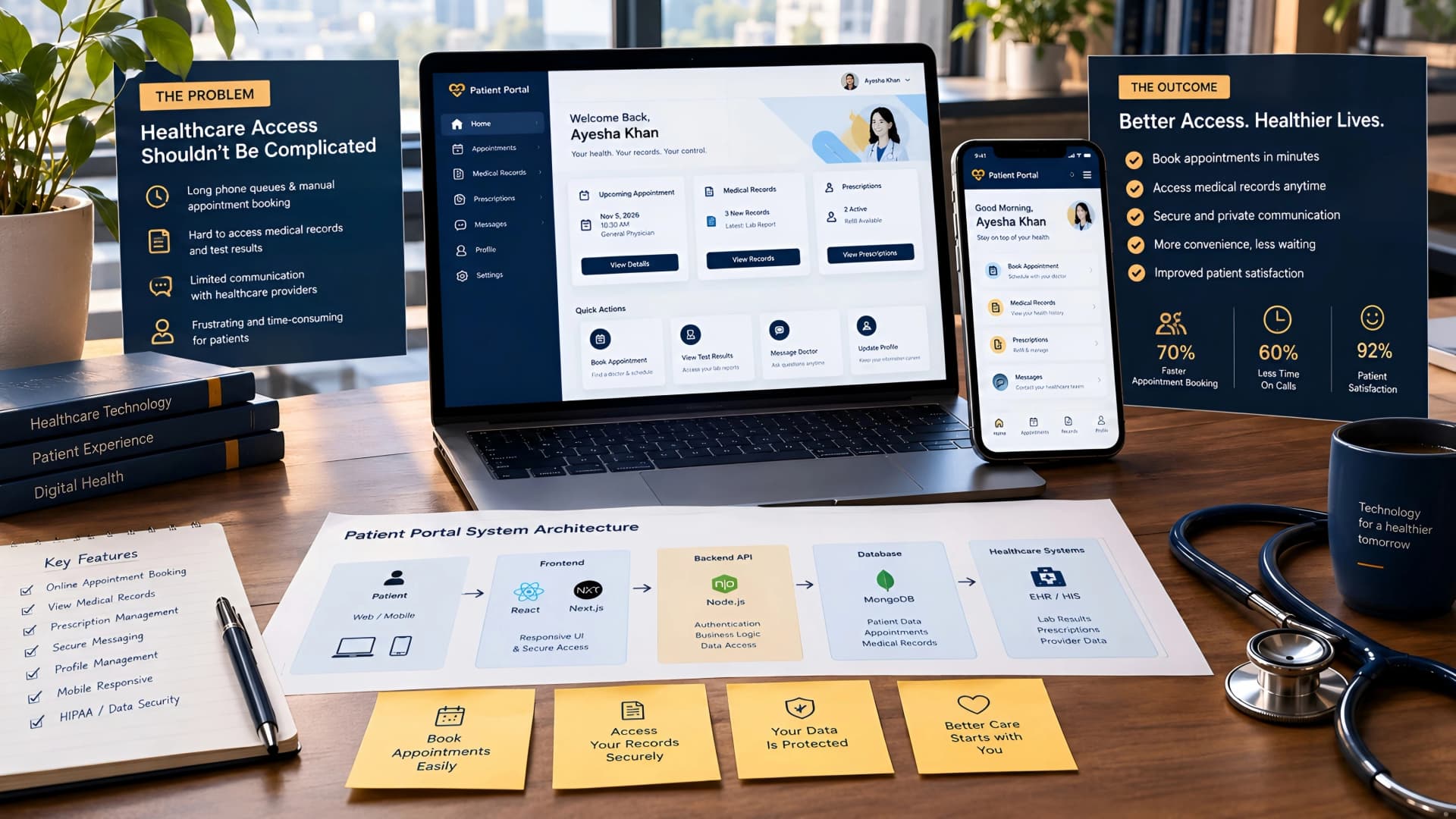
The healthcare landscape is evolving, and patient expectations are changing with it. Patients increasingly seek the same digital convenience they experience in other areas of their lives, making intuitive and secure self-service portals a necessity, not a luxury.
Fragmented communication and endless paper forms are significant pain points for both patients and clinics. This friction leads to frustration, administrative overhead, and even missed appointments.
We covered the broader strategy for streamlining clinic operations in our foundational guide, "Streamlining Clinic Operations: A Digital Blueprint for Patient Management". This article dives into the core engineering challenge: building patient portals that patients actually want to use, while upholding the strictest security and privacy standards.
The Core Challenge: Balancing Usability with Ironclad Security
Developing a patient portal means navigating a tightrope walk. On one side, you need a user experience so intuitive that even less tech-savvy patients can easily book appointments or access records.
On the other, you face the absolute imperative of data security and regulatory compliance, particularly HIPAA in the US. A single misstep here can have severe consequences, from massive fines to a complete loss of patient trust.
Our approach at Muhyo Tech focuses on building this balance from the ground up, ensuring that security features enhance usability rather than hinder it.
Engineering for HIPAA Compliance and Data Privacy
HIPAA compliance isn't just a checklist; it's a deep commitment to patient data privacy and security. For any full-stack web application development in healthcare, this dictates architectural choices from day one.
Key considerations include robust encryption for data both in transit (TLS/SSL) and at rest (database encryption). Access controls must be granular, ensuring only authorized personnel and patients can view specific information.
We implement comprehensive audit logging, tracking every access and modification to patient data. This provides an indisputable record for compliance and forensic analysis if an incident ever occurs.
Designing for Intuitive Patient Experience (UX/UI)
A secure portal is useless if patients can't figure out how to use it. Our design philosophy prioritizes clarity, simplicity, and accessibility.
This means clear navigation for appointment scheduling, easy-to-understand forms for medical history, and straightforward access to lab results or medication lists. The goal is to minimize clicks and cognitive load.
Responsive design is non-negotiable, ensuring the portal works seamlessly on desktops, tablets, and mobile phones. Many patients access their health information on the go, so a mobile-first approach is often beneficial.
Technology Stack Choices: Why Next.js Works for Patient Portals
For modern, secure, and performant patient portals, we often lean on frameworks like Next.js. Its hybrid rendering capabilities (server-side rendering and static site generation) are crucial for both initial page load speed and SEO, which helps patients find the portal.
Next.js, combined with a robust backend (like Node.js with a secure API layer) and a compliant database, provides an excellent foundation. This stack supports secure authentication flows, complex data interactions, and real-time updates.
For instance, using Next.js for the frontend allows us to create dynamic, interactive user interfaces while still benefiting from the security and performance advantages of server-side rendering for sensitive initial loads.
Key Architectural Components for a Secure Patient Portal
A well-architected patient portal requires several interconnected systems to function securely and efficiently.
First, a strong authentication and authorization system, often incorporating multi-factor authentication (MFA), is critical. This protects patient accounts from unauthorized access.
Second, a secure API gateway manages all communication between the frontend and backend, enforcing security policies and validating requests. Third, a dedicated, encrypted database stores all protected health information (PHI).
Finally, integration with existing Electronic Health Record (EHR) or Practice Management (PM) systems is essential. This is typically achieved through secure APIs, ensuring data consistency and reducing manual entry.
Deployment, Monitoring, and Ongoing Maintenance
The engineering work doesn't stop at launch. Secure deployment pipelines, continuous monitoring for anomalies, and regular security audits are vital for maintaining a compliant and reliable patient portal.
We establish automated testing frameworks to catch regressions and security vulnerabilities early. Our ongoing maintenance includes applying security patches, updating dependencies, and optimizing performance.
This proactive approach minimizes downtime and reduces the risk of security breaches. For any digital service, long-term reliability is as important as initial functionality.
The Business Value: Beyond Just Convenience
Implementing a well-engineered patient portal offers tangible business benefits for healthcare providers. Patients empowered by self-service features tend to be more satisfied, leading to improved retention and positive word-of-mouth.
Reducing the volume of inbound administrative calls by 25% or more frees up staff to focus on higher-value tasks, significantly cutting operational costs. This efficiency translates directly to better resource allocation.
Crucially, robust data privacy and security build trust with patients, a cornerstone of any successful healthcare practice. It signals a commitment to their well-being, both medical and digital.
"Building a patient portal is not just about features; it's about building trust and efficiency. The engineering choices we make directly impact patient experience and clinic operations."