


Imagine a busy clinic morning. Patients are waiting, phones are ringing, and staff are manually shuffling paperwork. This isn't just a scene of organized chaos; it's a bottleneck that frustrates patients and burns out staff.
Manual patient intake, slow appointment booking, and inefficient record management are common pains. They lead directly to lost patients, missed appointments, and a constant drain on administrative resources.
The Real Cost of Manual Clinic Operations
Every minute spent on repetitive data entry or searching for a physical file is a minute not spent on patient care. This inefficiency compounds, creating a ripple effect across the entire practice.
Beyond the immediate time sink, manual processes introduce a higher risk of human error. Misplaced forms, incorrect data entry, and communication gaps can lead to serious patient safety concerns and compliance issues.
What Defines a Modern Healthcare Patient Management System?
At its core, a robust healthcare patient management system (PMS) centralizes and automates critical administrative tasks. It moves clinics beyond fragmented tools and paper-based systems.
The goal is to create a seamless, digital workflow from the moment a patient first interacts with the clinic through their ongoing care journey. This requires careful consideration of features and architecture.
Essential Features for Clinic Efficiency
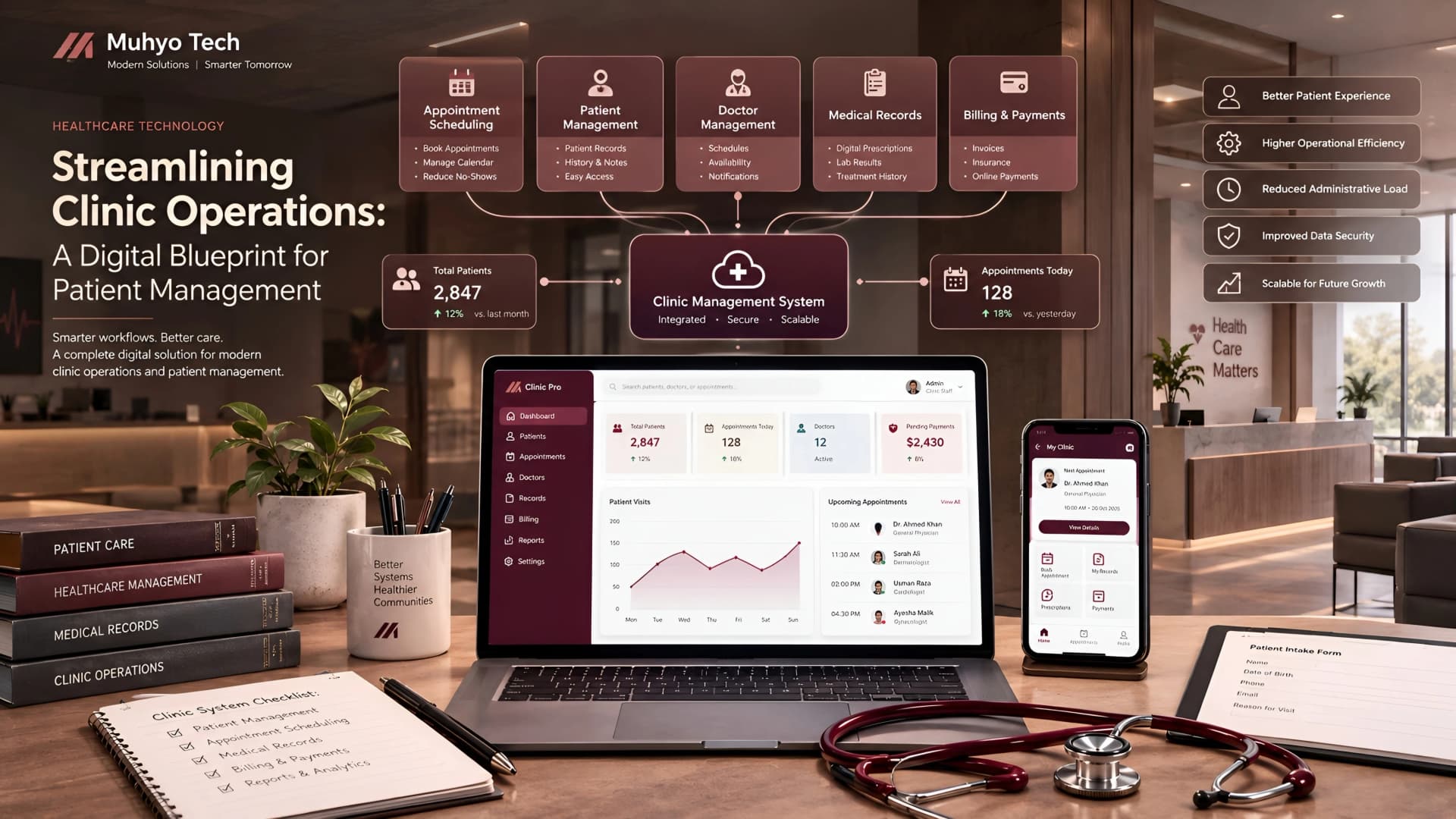
A truly effective PMS must offer a comprehensive suite of tools. These features are not just conveniences; they are foundational to improving operational flow and patient experience.
From online booking to secure communication, each component plays a vital role in reducing administrative burden and enhancing the quality of care provided.
- Online Patient Portal: Allows patients to book appointments, fill out intake forms, view lab results, and communicate securely with staff.
- Appointment Scheduling & Reminders: Automates booking, rescheduling, and sends SMS/email reminders to reduce no-shows.
- Digital Patient Intake & Forms: Replaces paper forms with digital versions, pre-populating data and collecting signatures electronically.
- Secure Patient Record Management: Centralized, encrypted storage for patient demographics, medical history, allergies, and treatment plans.
- Billing & Invoicing: Integrates with insurance verification and payment processing, simplifying financial operations.
- Staff & Resource Management: Helps manage doctor schedules, room allocations, and equipment availability.
- Reporting & Analytics: Provides insights into clinic performance, patient flow, and financial health.
- Telehealth Integration: Supports virtual consultations and secure video conferencing capabilities.
Building Your Digital Foundation: Architectural Considerations
Developing a custom patient management system isn't just about features; it's about robust architecture. We approach this with a focus on security, scalability, and maintainability.
Choosing the right technology stack and database structure from the outset is crucial. These decisions impact everything from system performance to future integration possibilities.
Key Architectural Components We Consider
When designing a full-stack web application for healthcare, several layers must work in harmony. Each layer has specific responsibilities and contributes to the overall stability and security of the system.
Our approach ensures that data integrity is maintained, user experiences are fluid, and the system can grow with the clinic's evolving needs.
- Frontend (User Interface): Typically built with modern JavaScript frameworks like React, Angular, or Vue.js for a responsive and intuitive user experience. This includes the patient portal and the admin dashboard.
- Backend (Server-side Logic): Handles business logic, data processing, authentication, and authorization. Technologies like Node.js, Python (Django/Flask), or Ruby on Rails are common choices, selected for their efficiency and ecosystem support.
- Database: Critical for secure and efficient data storage. We often recommend PostgreSQL or MongoDB for their scalability and robust security features, ensuring patient data is protected.
- APIs (Application Programming Interfaces): Facilitate communication between the frontend, backend, and external services like EHRs or payment gateways. RESTful APIs are standard for their flexibility.
- Security Layer: Implements encryption, access controls, audit trails, and compliance measures (e.g., HIPAA in the US, GDPR in Europe) at every level of the application.
- Cloud Infrastructure: Deploying on platforms like AWS, Google Cloud, or Azure provides scalability, reliability, and robust security features out-of-the-box.
Integrating with Existing Healthcare Ecosystems (EHRs)
A standalone PMS is useful, but its true power unlocks through integration. Connecting with Electronic Health Records (EHRs) is often a critical requirement for a comprehensive solution.
This integration allows for a unified view of patient information, reducing data duplication and improving the accuracy of clinical records. It's a complex task that requires careful planning and API integration expertise.
Challenges and Solutions for EHR Integration
Integrating with EHRs presents unique technical and compliance challenges. Different EHR systems use varying data standards and API capabilities, requiring flexible and secure integration strategies.
Our approach focuses on standardized protocols like HL7 or FHIR when available, ensuring data interoperability while maintaining stringent security and privacy safeguards.
At Muhyo Tech, we emphasize secure, standardized API integration. We design middleware layers to translate data between systems, ensuring compatibility and compliance without compromising patient privacy or data integrity.
Custom vs. Off-the-Shelf: Making the Right Choice
Clinic operators often face a fundamental decision: adapt an existing, off-the-shelf patient management system or invest in a custom-built solution. Both paths have distinct advantages and drawbacks.
Understanding these trade-offs is essential for making an informed decision that aligns with your clinic's specific needs, budget, and long-term vision.
Comparison Matrix: Custom vs. Off-the-Shelf PMS
| Feature | Custom Patient Management System | Off-the-Shelf Patient Management System |
|---|---|---|
| Customization | Tailored precisely to clinic workflows and unique requirements. | Limited to vendor's predefined features and configuration options. |
| Scalability | Designed to scale with specific growth patterns and future needs. | Scalability often depends on subscription tiers and vendor roadmap. |
| Integration | Seamless integration with existing systems (EHRs, labs) via custom APIs. | Integrations are limited to vendor-supported partners; often requires workarounds. |
| Cost (Initial) | Higher upfront development cost. | Lower initial subscription fees. |
| Cost (Long-term) | Lower recurring fees, greater control over maintenance. | Ongoing subscription costs, potential for rising fees with added features. |
| Control & Ownership | Full control over data, features, and future development. | Dependent on vendor for updates, features, and data access. |
| Time to Market | Longer development cycle. | Faster deployment. |
| Competitive Edge | Unique features can differentiate clinic services and patient experience. | Offers standard functionality, less differentiation. |
When a Custom Solution Makes Sense
For clinics with highly specific workflows, a desire for unique patient experiences, or complex integration needs, custom development is often the superior choice. It offers unmatched flexibility and long-term strategic advantage.
While the initial investment is higher, the ability to perfectly align software with operational goals, reduce manual workarounds, and gain full data ownership often delivers a significant return on investment over time.
The Business Value: Beyond Just Efficiency
Implementing a well-engineered patient management system goes far beyond merely saving time. It fundamentally transforms how a clinic operates, impacting both the bottom line and patient satisfaction.
The benefits extend to increased patient acquisition through better service, reduced staff burnout, and a more resilient, scalable practice.
- Increased Patient Acquisition & Retention: Easy online booking, transparent communication, and efficient service lead to happier patients and positive reviews.
- Reduced Administrative Overhead: Automation of intake, scheduling, and billing can significantly cut down on manual tasks, freeing up staff for higher-value activities.
- Improved Staff Productivity: Streamlined workflows and readily accessible information empower staff to work more efficiently and effectively, reducing stress.
- Enhanced Data Security & Compliance: Robust security measures protect sensitive patient information, ensuring adherence to regulatory requirements like HIPAA.
- Better Decision-Making: Access to comprehensive reports and analytics provides actionable insights into clinic performance, helping optimize services and resource allocation.
- Scalability for Growth: A well-designed custom system can easily adapt to an increasing patient load, new services, or additional clinic locations without major overhauls.
Muhyo Tech's Approach to Healthcare Solutions
At Muhyo Tech, we approach healthcare technology development with a deep understanding of both engineering excellence and clinical realities. We prioritize security, usability, and scalability in every project.
Our process involves detailed discovery to understand your clinic's unique challenges, followed by iterative development and rigorous testing. This ensures the final product is robust, intuitive, and truly solves your pain points.
We believe that technology should serve healthcare, not complicate it. Our aim is to build systems that empower clinics to deliver better care, more efficiently, and with greater peace of mind.
Key Takeaways for Clinic Operators & Practice Managers
Digital transformation in healthcare is no longer optional; it's a strategic imperative. A well-implemented patient management system can be the cornerstone of a modern, efficient, and patient-centric practice.
Focus on systems that offer strong security, seamless integration capabilities, and the flexibility to evolve with your clinic. Prioritize solutions that reduce administrative burden and enhance both patient and staff experiences.
Frequently Asked Questions (FAQs)
What are the essential features of a patient management system?
Essential features include an online patient portal for booking and forms, automated appointment scheduling with reminders, secure digital patient record management, integrated billing, and reporting tools for clinic performance.
How much does it cost to develop or implement a patient management system?
The cost varies significantly based on complexity, features, integrations, and whether you choose a custom solution or an off-the-shelf product. Custom development typically involves a higher upfront investment but offers greater long-term value and control.
How do patient management systems integrate with Electronic Health Records (EHR)?
Integration with EHRs is typically achieved through secure APIs, often leveraging industry standards like HL7 or FHIR. This allows for the seamless exchange of patient data between systems, reducing manual data entry and ensuring data consistency.
What are the benefits of using a patient management system in healthcare?
Benefits include increased operational efficiency, reduced administrative overhead, improved patient experience and retention, enhanced data security and compliance, better data-driven decision-making, and scalability for future growth.