


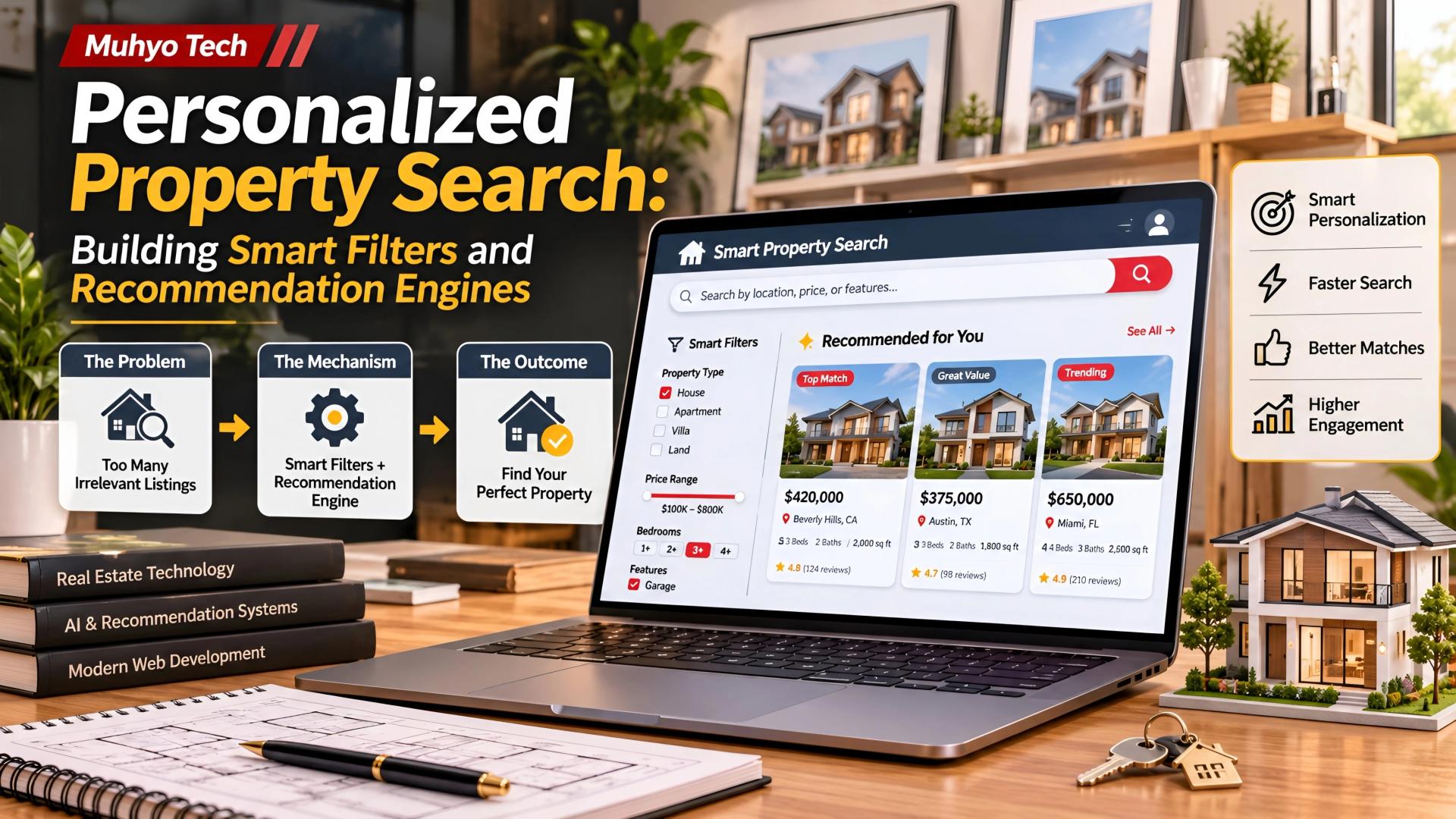
The Frustration of Generic Property Search
Imagine a potential homebuyer sifting through hundreds of irrelevant listings. They’re overwhelmed by generic search filters, seeing properties that don't match their specific needs or preferences.
This isn't just an inconvenience for the user; it’s a missed opportunity for real estate agents and brokers. High bounce rates and disengaged visitors are direct consequences of a search experience that fails to personalize.
Why Custom Filters Are Non-Negotiable
The core problem with standard MLS portals is their 'one-size-fits-all' approach. Every user sees the same broad categories, leading to a frustrating experience that buries truly relevant properties.
Custom filters empower users to define their ideal property with granular detail. Think beyond bedrooms and bathrooms to specific school districts, proximity to public transport, smart home features, or even unique architectural styles.
At Muhyo Tech, we design these filters to be highly configurable, allowing real estate professionals to define what matters most in their specific market. This directly translates to more precise searches and a better user experience.
The Power of a Real Estate Property Recommendation Engine
Once users start interacting with your portal, an AI-powered recommendation engine can elevate the experience dramatically. This isn't just about suggesting similar properties; it's about understanding implicit preferences based on behavior.
A robust real estate property recommendation engine learns from clicks, saved listings, search history, and even ignored properties. It then proactively surfaces homes that are genuinely appealing, often before the user even thinks to search for them.
This kind of predictive personalization is a game-changer for lead quality and conversion rates. It transforms a passive search into an active, guided discovery.
Architecting a Recommendation System: Data and Algorithms
Building an effective recommendation engine starts with data. Property features like location, price, size, amenities, and historical sales data are crucial. User interaction data—views, saves, shares, and inquiries—fuels the personalization.
We typically employ a hybrid approach, combining collaborative filtering with content-based recommendations. Collaborative filtering identifies users with similar tastes and recommends properties liked by those 'neighbors'. Content-based methods recommend properties similar to those a user has shown interest in based on their features.
Handling data sparsity, where new properties or users have limited interaction history, is a common challenge. Techniques like matrix factorization or incorporating demographic data can help bridge these gaps, ensuring recommendations are always available and relevant.
Integrating Smart Search and Recommendations
A truly dynamic portal combines custom filters with the recommendation engine seamlessly. Users start with their explicit criteria, and as they refine their search or view properties, the engine starts suggesting related listings.
This integration often involves a backend service, built with technologies like Python and frameworks like Flask or FastAPI, to handle the complex recommendation logic. For the frontend, we utilize modern frameworks like Next.js.
For instance, initial property listings can be rendered using Server-Side Rendering (SSR) or Static Site Generation (SSG) with Next.js for superior performance and SEO. Subsequent dynamic updates, like filtering or loading more recommendations, use client-side data fetching via API routes and libraries like SWR or React Query.
Muhyo Tech's Approach to Personalized Portals
Our philosophy at Muhyo Tech centers on building scalable, performant, and user-centric web applications. When developing custom MLS portals, we prioritize a modular architecture that supports both advanced filtering and sophisticated recommendation systems.
We design custom web application solutions that integrate directly with MLS feeds, ensuring real-time data accuracy. This foundational guide, Winning Leads in Real Estate: Building a Dynamic MLS-Integrated Property Portal, outlines our comprehensive strategy for such systems.
Our engineering standards emphasize clean API design for seamless communication between the frontend and the recommendation engine. We also focus heavily on performance optimization, including efficient image loading with Next.js Image component, to ensure a smooth user experience even with large datasets.
Business Value: What This Means for Real Estate Professionals
The impact of personalized property search and recommendation engines on a real estate business is profound. First, it significantly increases user engagement; visitors spend more time on your site because the content is genuinely relevant.
Second, it drives more qualified leads. Users who interact with personalized suggestions are often further along in their buying journey, making them more receptive to agent outreach. This translates directly to higher conversion rates.
Finally, a superior user experience builds brand loyalty. Your portal becomes a go-to resource, differentiating you from competitors who offer generic, frustrating search experiences. It positions you as an innovator, ready to serve clients with cutting-edge tools.
Frequently Asked Questions
What algorithms are commonly used in real estate recommendation engines?
Common algorithms include collaborative filtering (user-based or item-based), content-based filtering, and hybrid models. Machine learning techniques like matrix factorization, deep learning, and even simple rule-based systems can also be employed depending on data availability and complexity requirements.
How do you handle data sparsity in real estate recommendation systems?
Data sparsity is a challenge when there isn't enough user interaction data for new properties or users. Strategies include using content-based recommendations (based on property features), incorporating demographic data, employing matrix factorization techniques, or cold-start strategies like recommending popular or recently added properties.
What data features are important for property recommendations?
Crucial data features include property specifics (price, size, number of beds/baths, type), location data (neighborhood, school district, proximity to amenities), historical sales data, and user interaction data (views, saves, inquiries). Rich metadata about property styles or unique features also significantly enhances recommendation quality.
Can I build a real estate recommendation engine from scratch, or should I use a service?
Building from scratch offers maximum customization and control, ideal for unique business needs and scalable systems. It requires significant engineering expertise in data science and backend development. Using a service might be faster for basic needs but can limit flexibility and deep integration.