


One of the quiet anxieties in deploying AI models is the inevitable drift. Models, no matter how well-trained initially, degrade over time as real-world data shifts. Without a robust mechanism to capture user interactions and system performance, your AI can quickly become stale, delivering less accurate predictions and eroding user trust.
This degradation is more than just a theoretical problem; it impacts the core value proposition of an AI-powered product. Ensuring models remain sharp and responsive requires a thoughtful approach to scalable AI SaaS architecture, particularly in how we build real-time feedback loops.
The Pain of Stale AI Models
Imagine an AI assistant that once offered insightful recommendations but now suggests irrelevant items. Or a fraud detection system that misses new patterns because it's operating on outdated assumptions. This isn't just a minor inconvenience; it's a direct hit to user experience and potentially, to business bottom lines.
The root cause is often a disconnected feedback mechanism. Inference happens, but the 'lessons learned' from those inferences, especially user responses or downstream outcomes, are not effectively fed back into the training pipeline. This creates a static model in a dynamic world.
Architecting for Real-Time Feedback: An Event-Driven Approach
Our approach at Muhyo Tech centers on event-driven architectures to address this. The goal is to treat every significant user interaction or system outcome as an event that can inform future model improvements. This requires a shift from batch processing to continuous data streams.
When a user interacts with an AI-generated output – clicking a recommendation, correcting a transcription, or marking a prediction as incorrect – that interaction becomes a critical data point. Capturing these signals in real time allows us to build a dynamic feedback loop.
Key Components of a Real-Time Feedback System
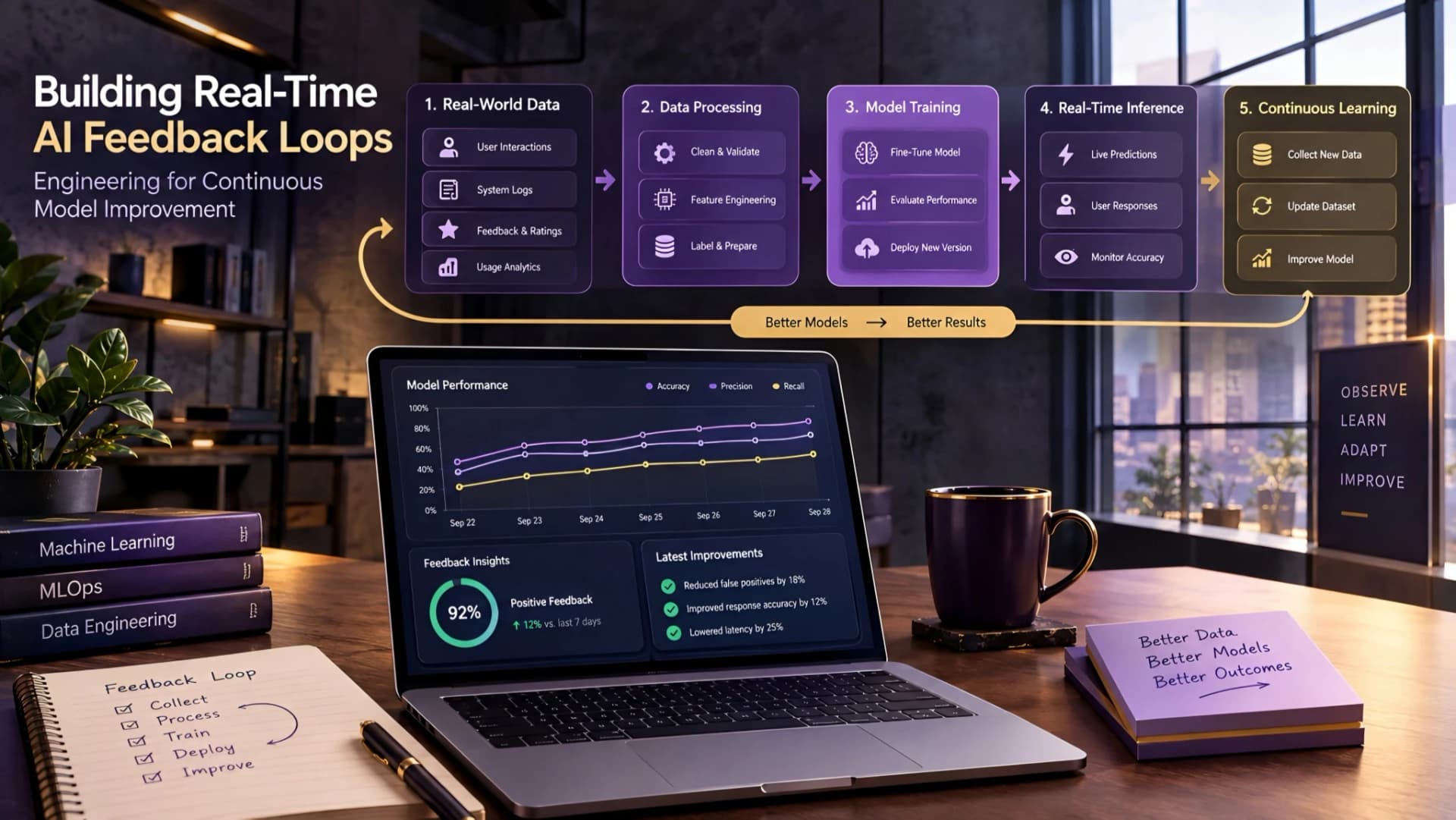
Building such a system involves several interconnected components, working in concert to ensure data flows efficiently from interaction to model update. Each component plays a vital role in the overall architecture.
First, we need robust event producers. These are typically the frontend applications or backend services that generate AI inferences and capture user responses. For instance, a web app might emit an 'item_recommended' event and then a subsequent 'item_clicked' event.
Next, an event bus or streaming platform acts as the central nervous system. Technologies like Apache Kafka, Amazon Kinesis, or Google Cloud Pub/Sub are ideal here. They provide the resilience and scalability needed to handle high volumes of real-time data, decoupling producers from consumers.
Data processing pipelines then consume these events. These pipelines clean, transform, and enrich the raw interaction data, preparing it for model training. This might involve aggregating user sessions, filtering out noise, or joining with other contextual data via robust database integrations.
Finally, a model retraining and deployment pipeline uses this processed data to update the AI model. This can be an automated process, triggering retraining when new data thresholds are met, or a semi-automated one with human oversight.
Designing for Data Quality and Feature Engineering
The success of any feedback loop hinges on the quality of the data flowing through it. Raw interaction data can be messy and incomplete. Our engineering standards emphasize rigorous data validation and schema enforcement at the point of ingestion.
Furthermore, effective feature engineering on the feedback data is crucial. This means identifying what aspects of user interaction are most predictive of model performance. Was the AI's confidence score high? How long did the user spend on the recommended item? These granular details become new features for retraining.
When we design these systems, we look for ways to make these pipelines resilient. This often involves dead-letter queues for malformed events and robust monitoring to detect anomalies in the data stream. Good API integration design also ensures consistent data formats across services.
Trade-offs and Considerations for Implementation
While the benefits of real-time feedback loops are clear, there are always engineering trade-offs. The primary challenge lies in balancing real-time responsiveness with computational cost and data consistency. Full, continuous retraining on every single event is rarely practical or necessary.
We often employ strategies like micro-batching or windowed processing to aggregate events over short periods before triggering retraining. This reduces the computational load while still maintaining near real-time relevance. Another consideration is the potential for feedback loops to introduce bias if not carefully managed.
For instance, if a model's output influences user behavior, and that behavior then exclusively trains the next iteration, the model might get stuck in a local optimum. Techniques like A/B testing or exploring diverse data sources are essential to mitigate this. Our full-stack web app development approach considers how these feedback mechanisms integrate seamlessly into the user experience.
The Business Value: Agility and Enhanced Product Value
Implementing real-time AI feedback loops transforms an AI product from a static tool into an adaptive, continuously improving system. This agility provides a significant competitive advantage. Your AI models stay relevant, respond to changing user needs, and learn from new patterns faster than competitors with manual or batch-only retraining schedules.
The business value translates directly into higher user satisfaction, increased engagement, and ultimately, a more valuable product. Imagine an AI customer support bot that learns from every successful resolution, constantly improving its ability to help users. This reduces operational costs and enhances the overall customer experience.
At Muhyo Tech, we focus on engineering these systems not just for technical elegance, but for tangible business outcomes. We understand that continuous improvement in AI directly impacts your product's long-term success and market relevance.
Looking Ahead: The Future of Adaptive AI
The journey towards fully adaptive AI is ongoing, with new challenges and opportunities emerging constantly. Techniques like reinforcement learning from human feedback (RLHF) are pushing the boundaries of how effectively AI can learn from user interaction. These advanced methods rely entirely on the foundational data pipelines we've discussed.
As AI systems become more complex, the need for robust, real-time feedback mechanisms will only grow. Engineers who can design and implement these resilient data streams will be critical in shaping the next generation of intelligent applications. It's about building systems that not only infer but also learn and evolve.