

Many automotive dealerships find themselves at a crossroads. They recognize the need for digital evolution, yet often struggle with fragmented systems, slow online updates, and an inability to truly connect with modern car buyers.
This disconnect isn't just an inconvenience; it translates directly into lost sales opportunities, frustrated customers, and inefficient internal operations. The solution isn't simply adding more software, but architecting an integrated digital ecosystem.
The Core Problem: Fragmented Operations & Lost Opportunities
Traditional dealerships often rely on a patchwork of disconnected tools. Inventory might live in one system, CRM data in another, and lead management in a third, often with manual data entry bridging the gaps.
This fragmentation creates significant friction. It makes it hard to provide a consistent customer experience, impossible to update online listings in real-time, and difficult for sales teams to get a 360-degree view of a prospect.
Identifying the Pain Points
Imagine a potential buyer browsing your dealership website, finding a car they love, only to discover it sold hours ago. Or a sales rep struggling to recall past interactions because customer history is scattered across multiple spreadsheets and legacy systems.
These scenarios are not uncommon. They highlight the inefficiencies that directly impact both the customer journey and the dealership’s bottom line.
The Engineering Response: An Integrated Digital Platform
At Muhyo Tech, we approach these challenges by designing and building cohesive, full-stack web applications. Our goal is to unify critical dealership functions into a single, intuitive platform.
This integrated automotive dealership software acts as the central nervous system for sales, service, and customer engagement, replacing disjointed tools with a streamlined workflow.
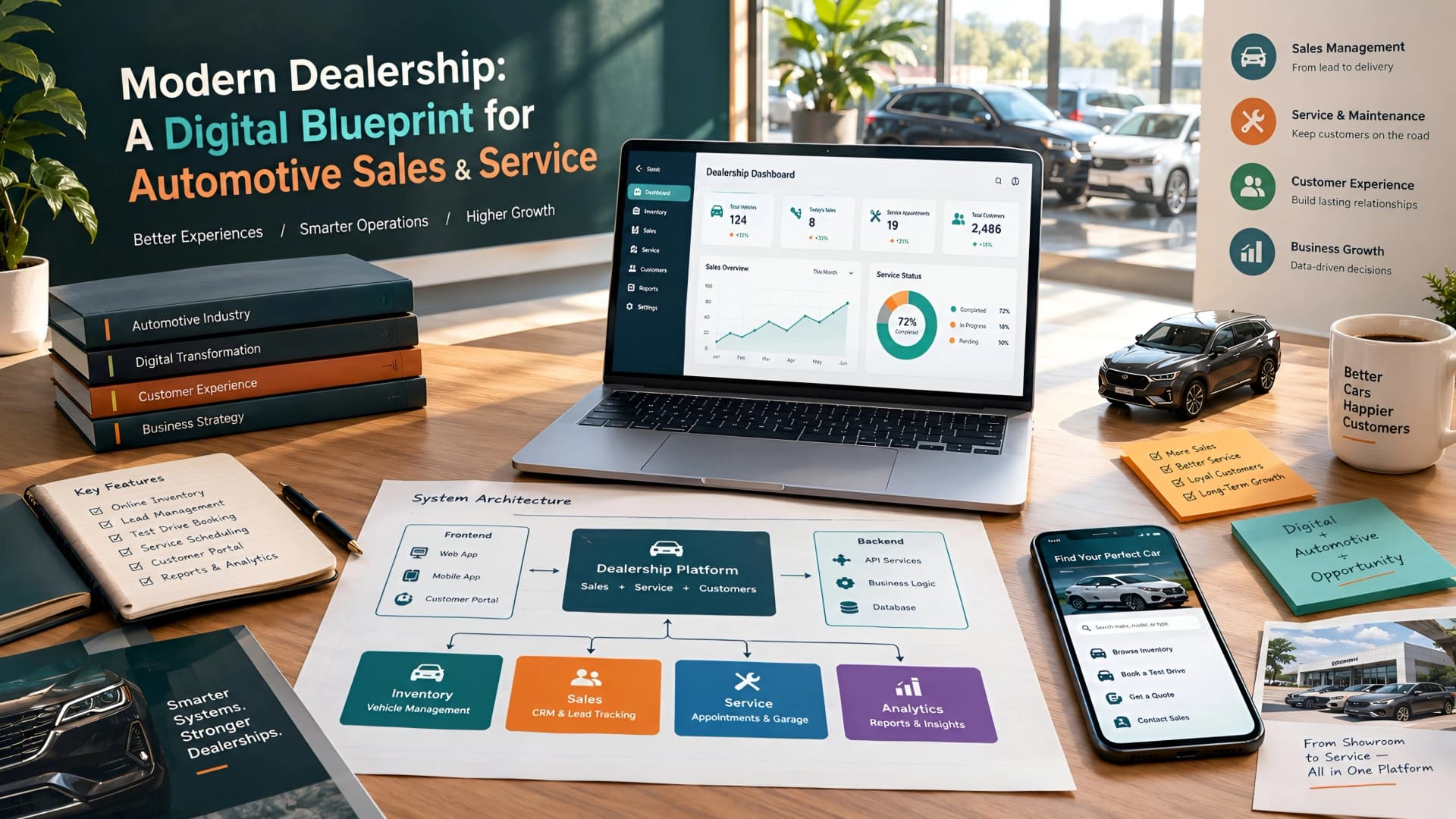
Key Architectural Components of a Modern Dealership Platform
Building a robust platform requires careful consideration of several interconnected components. Each piece must communicate seamlessly to deliver a truly unified experience.
We focus on a modular architecture, allowing for future expansion and adaptation without re-engineering the entire system.
- Real-Time Inventory Management: A dynamic database that updates instantly as vehicles are sold, acquired, or moved. This feeds directly into the public-facing website and internal sales tools.
- Customer Relationship Management (CRM): A centralized hub for all customer interactions, purchase history, service records, and communication preferences. This empowers personalized engagement.
- Lead Management System: Tools to capture, qualify, and track leads from various sources (web forms, calls, third-party sites). Automated routing and follow-up reminders are crucial here.
- Service Scheduling & Management: Integrates appointment booking, service history, parts ordering, and technician scheduling. It improves efficiency for the service department and convenience for customers.
- Marketing & Analytics Dashboard: Provides insights into website traffic, lead conversion rates, sales performance, and marketing campaign effectiveness. Data-driven decisions are key.
- Secure Payment Gateway Integration: For online deposits, parts purchases, and service payments. Security and compliance are paramount.
- Dealer Management System (DMS) Integration: The ability to connect with existing DMS platforms is often critical. This ensures data consistency across the entire business.
Implementing Automotive Dealership Software: Production-Ready Architecture
Moving from concept to a production-ready system involves meticulous planning and execution. We prioritize scalability, security, and maintainability from day one.
A well-architected system not only performs reliably but also simplifies future enhancements and reduces long-term operational costs.
Data Flow and Integration Strategy
The heart of an integrated platform lies in its data flow. We design APIs and integration layers that allow different modules to communicate efficiently and securely.
This often involves carefully mapping data fields between systems, ensuring consistency and preventing data silos.
Deployment and Scaling Considerations
When deploying automotive dealership software, we consider cloud-native solutions for their flexibility and scalability. Platforms like AWS, Google Cloud, or Azure offer robust infrastructure.
Our deployments are automated using CI/CD pipelines, ensuring consistent, reliable releases and minimizing downtime during updates.
"We learned that a resilient data synchronization strategy is non-negotiable for dealerships. Real-time updates prevent frustrating customer experiences and costly internal errors."
Security Best Practices for Dealership Platforms
Customer data, especially financial and personal information, demands the highest security standards. We implement end-to-end encryption, multi-factor authentication, and regular security audits.
Compliance with industry standards and data protection regulations is always a core consideration in our development process.
Common Pitfalls & How to Avoid Them
The journey to digital transformation is not without its challenges. Recognizing common pitfalls upfront helps steer clear of costly mistakes.
We often see issues arise from an over-reliance on off-the-shelf solutions that don't quite fit, or from underestimating the complexity of data migration.
Pitfall 1: Vendor Lock-in with Proprietary Systems
Many legacy dealership systems are proprietary, making it difficult to integrate with other tools or migrate data. This can stifle innovation and lead to high recurring costs.
Our approach favors open standards and flexible architectures that allow for future integrations and data portability, giving dealerships more control.
Pitfall 2: Neglecting User Experience (UX) for Staff & Customers
A powerful system is only useful if people can easily use it. Complex, unintuitive interfaces lead to low adoption rates among staff and frustration for customers.
We prioritize intuitive admin dashboards for staff and seamless, mobile-first customer interfaces, ensuring a positive experience for all users.
Pitfall 3: Underestimating Data Migration Complexity
Moving years of customer data, inventory history, and service records from old systems to a new platform is a significant undertaking. It requires meticulous planning and data cleansing.
We build robust migration strategies, often involving incremental data transfers and thorough validation, to ensure data integrity throughout the transition.
Tradeoffs: Build vs. Buy vs. Hybrid Solutions
Dealerships often face the fundamental decision: should they buy an off-the-shelf solution, build a custom one, or opt for a hybrid approach?
Each path has distinct advantages and disadvantages that must be weighed against business needs and long-term goals.
Comparison Matrix: Build vs. Buy vs. Hybrid
| Feature | Custom Build | Off-the-Shelf | Hybrid Approach |
|---|---|---|---|
| Initial Cost | Higher | Lower | Medium |
| Customization | Unlimited | Limited | Moderate to High |
| Integration Ease | Designed In | Varies (often difficult) | Specific Integrations |
| Scalability | Designed In | Vendor Dependent | Designed In (for custom parts) |
| Maintenance | Internal/Vendor | Vendor Managed | Mixed |
| Time to Market | Longer | Faster | Medium |
| Competitive Advantage | High | Low | Medium to High |
Muhyo Tech's Perspective on Custom Solutions
While off-the-shelf solutions offer speed, they rarely provide a perfect fit. They often force dealerships to adapt their unique workflows to the software's limitations.
At Muhyo Tech, we typically recommend a custom full-stack web app development approach or a strategic hybrid. This allows us to tailor the platform precisely to a dealership's specific processes, customer journey, and growth aspirations, building a true competitive advantage.
The Business Value: Driving Sales & Reducing Operational Costs
The investment in modern automotive dealership software translates directly into tangible business benefits. It’s not just about technology; it’s about improving the core business.
From increased sales efficiency to stronger customer loyalty and reduced manual overhead, the impact is comprehensive.
Enhanced Sales Efficiency & Customer Engagement
With real-time inventory and a unified CRM, sales teams can respond faster, offer more personalized experiences, and close deals more efficiently. Automated lead nurturing ensures no prospect falls through the cracks.
Customers benefit from accurate online information, easier scheduling, and a smoother buying process, leading to higher satisfaction and repeat business.
Operational Cost Reduction & Data-Driven Decisions
Automating manual tasks, reducing data entry errors, and streamlining workflows significantly cut operational costs. The time saved allows staff to focus on higher-value activities.
The integrated analytics dashboard provides actionable insights into performance, allowing dealerships to optimize marketing spend, inventory levels, and sales strategies.
Building a Digital Future for Your Dealership
Digital transformation for automotive dealerships isn't a one-time project; it's an ongoing evolution. The goal is to create a dynamic, responsive platform that adapts to changing market demands and customer expectations.
By prioritizing thoughtful architecture, robust integration, and a focus on user experience, dealerships can build a powerful digital blueprint for sustained success.
A Checklist for Your Digital Dealership Platform
- Unified Data: Is all customer, inventory, and sales data accessible from a single source of truth?
- Real-Time Updates: Does your online inventory reflect actual availability instantly?
- Mobile Responsiveness: Is the entire platform, for both staff and customers, optimized for mobile devices?
- Scalability: Can the system handle increased traffic and data as your business grows?
- Security: Are customer data and transactions protected with industry-leading security measures?
- Intuitive UX: Is the platform easy for sales, service, and administrative staff to use daily?
- Integration Capabilities: Can it connect with existing DMS, accounting, or marketing tools?
- Analytics & Reporting: Does it provide clear, actionable insights into performance?
- Future-Proofing: Is the architecture flexible enough for new features and technologies?
Frequently Asked Questions (FAQs)
How long does it take to implement a comprehensive automotive dealership software solution?
The timeline varies significantly based on complexity, existing systems, and required integrations. A full-scale custom solution can take anywhere from 6 to 18 months, including discovery, development, testing, and deployment.
What are the biggest risks when undergoing digital transformation in a dealership?
Key risks include poor planning, resistance to change from staff, underestimating data migration challenges, choosing an inflexible platform, and neglecting cybersecurity. Careful project management and stakeholder buy-in are crucial.
Can an integrated platform truly replace my existing DMS?
In many cases, a well-designed integrated platform can either significantly augment an existing DMS or, for some dealerships, entirely replace it with more modern, flexible capabilities. It often depends on the age and capabilities of the current DMS and the dealership's specific needs.
How does Muhyo Tech ensure the software is maintainable long-term?
We focus on clean code, comprehensive documentation, modular architecture, and automated testing. This approach ensures the software is easy to update, debug, and expand, reducing technical debt and long-term maintenance costs.